

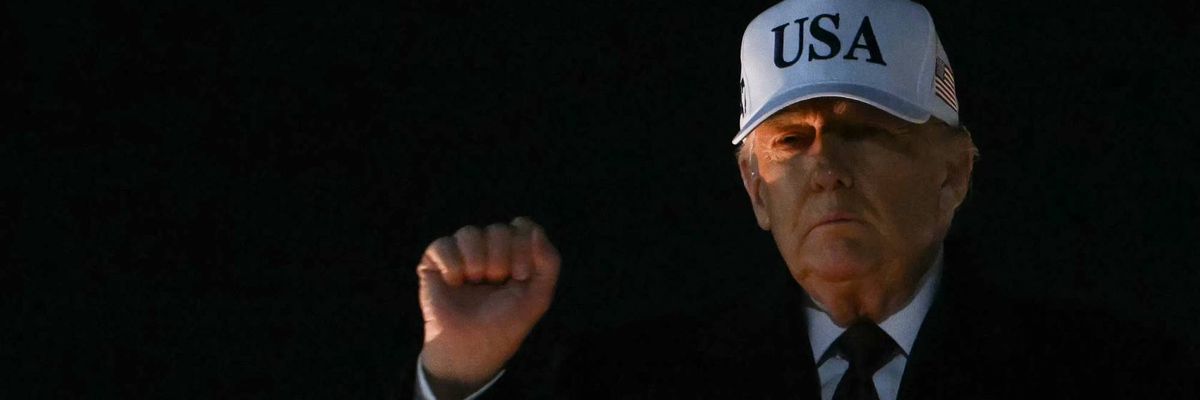
As armed federal agents roam the streets of American cities and amid threats to declare the Insurrection Act and use military force to quell protests in Minneapolis, President Donald Trump said once again that the next elections should be canceled because he expects his party to lose.
“It’s some deep psychological thing, but when you win the presidency, you don’t win the midterms,” Trump said in a closed-door interview published by Reuters on Thursday. He added that because he’s accomplished so much during his first term, “when you think of it, we shouldn’t even have an election.”
It’s at least the second time this month that Trump has floated the idea. He previously did so less directly during a speech commemorating the five-year anniversary of the January 6, 2021, Capitol insurrection, during which his supporters attempted to violently overturn his 2020 election loss to former President Joe Biden after he told them it was the result of fraud.
During that speech at the Kennedy Center, Trump described it as an outrage that Republicans even have to contest elections against Democrats later this year, suggesting canceling the election, but later backing off the idea.
“How do we even run against these people?” Trump said. “I won’t say cancel the election; they should cancel the election, because the fake news would say: ‘He wants the elections canceled. He’s a dictator.’ They always call me a dictator.”
In the same speech, he warned: “You gotta win the midterms. Because if we don’t win the midterms, they’ll find a reason to impeach me. I’ll get impeached.”
— (@)
Trump is correct that sitting presidents rarely see their parties do well in midterm elections two years after being elected. No sitting president has seen their party gain seats in both the House of Representatives and the Senate since 2002, when former President George W. Bush’s Republican Party was able to capitalize on fears of terrorism following the September 11 attacks just over a year before.
The president’s grip on a legislative trifecta is nearly as thin as it could possibly be, with Republicans holding just 218 seats to the Democrats’ 213.
Democrats were already favored to retake the House in November, and now appear even more likely to do so amid Trump’s consistent unpopularity. On Thursday, the nonpartisan Cook Political Report moved a total of 18 House races in the Democrats’ direction in its latest assessment of the odds to win the chamber.
— (@)
However, Trump is wrong that elections can be “canceled,” at least legally. Under the Elections Clause in Article I, Section 4 of the US Constitution, the administration of elections is vested in the states, with Congress holding the power to “make or alter such regulations.” The president has no authority to determine the timing of federal elections.
The United States has never once postponed a presidential election in its nearly 250-year history: They were carried out on schedule during periods of extraordinary crisis, including the Civil War in 1864, the influenza epidemic in 1918 and 1920, and World War II in 1942 and 1944.
Elections were also carried out on schedule in 2020, though Trump, who was then the president running for a second consecutive term, also suggested that they should be delayed then due to the Covid-19 pandemic.
At the time, he claimed that the widespread use of mail-in ballots, necessitated by the illness, would make it "the most INACCURATE & FRAUDULENT Election in history” and asked if he should "delay the Election until people can properly, securely and safely vote???” But Trump never pursued the idea seriously, as it was shot down by top Republicans.
After losing the election, he wrote in 2022 that what he called “a Massive Fraud” allowed for the “termination of all rules, regulations, and articles, even those found in the Constitution" in order to address the 2020 result.
Trump has more recently suggested that a war could give him the ticket to cancel elections. While speaking with Ukrainian President Volodymyr Zelenskyy in August of 2025, he spoke approvingly of the leader’s invocation of martial law and suspension of elections following Russia’s invasion three years prior.
— (@)
“So during war, you can’t have elections?” Trump said with a smile. "So let me just say, three and a half years from now— so you mean if we happen to be in a war with somebody, no more elections? Oh, that’s good.”
Since then, Trump has notably launched a war to take over Venezuela’s oil and threatened to launch several more, including with Greenland, Iran, and Mexico.
Asked on Thursday about why the president keeps talking about canceling elections, White House Press Secretary Karoline Leavitt told reporters: “The president was simply joking. He was saying, ‘We’re doing such a great job, we’re doing everything the American people thought, maybe we should just keep rolling.’ But he was speaking facetiously.”
Ryan Broderick, the writer of the political newsletter Garbage Day, said that with his latest comments—and “the threats of invoking the Insurrection Act in Minnesota this morning—he is very clearly exploring how to cancel the midterms.”
Trump has in recent days suggested using the National Guard to seize voting machines, stating that he regretted not doing so as he attempted to overturn his loss in 2020. His handpicked election officials have previously urged him to declare a “national emergency” that they said would give the federal government unprecedented powers to override the states and write their own election rules.
On the question of canceling the midterms outright, Ken White, a criminal defense attorney and First Amendment litigator, agreed that Trump “wants to, it’s plausible he’ll try, and his people would support it,” but said “it’s vastly harder and more complicated than people are suggesting and can’t be done by his fiat.”
New York Timescolumnist Jamelle Bouie argued that even if Trump wanted to cancel the midterms, he would face many logistical hurdles in doing so.
“How does Trump force 50 separate state boards of election to cancel their midterms?” he asked on social media. “How does he convince Republican House members to quit their jobs and give up their paychecks?”
“[US Immigration and Customs Enforcement] can’t even deal with irate middle-aged Midwesterners. How does he occupy hundreds, if not thousands, of polling sites and precincts?” he continued. “Trump v. Illinois clarified that he has no legal authority to unilaterally commandeer national guards. How does he move forward from there?”
Minnesota lawyer Andrew Rothstein encouraged people to “take Trump at his word here… but know his word isn’t law.”
Even if this year’s elections go forward as planned, Trump is working to influence the results by bullying Republican state legislators to rig their congressional maps for the GOP and attempting to seize sensitive voter data.
From Common Dreams via This RSS Feed.