

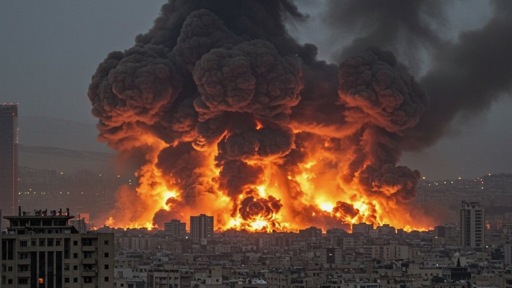
Washington and Tel Aviv are laying the ground for a new campaign, with European participation and regional backing. The plan targets Iran’s political system, seeks to eliminate resistance forces across Lebanon, Iraq, and Yemen, and presses ahead with the war of uprooting in Gaza and the West Bank.
Thus, this is not a phase for waiting, decoding signals, or negotiating through intermediaries. The dialogue Washington proposes is one of surrender, and surrender is not an option for those confronting US dominance. Everyone must be preparing for a confrontation that will be extremely harsh, yet decisive in shaping the balance of power in the region for years to come.
In the United States, Donald Trump faces growing domestic pressure and the prospect of electoral losses. History suggests that such moments often push toward external escalation, betting on the spectacle of force to restore political standing.
The buildup is unfolding amid deep political and civil fractures across the region and within the enemy camp itself. In the United States, Donald Trump faces growing domestic pressure and the prospect of electoral losses. History suggests that such moments often push toward external escalation, betting on the spectacle of force to restore political standing. There is little evidence that internal restraint will prevail over the logic of confrontation.
In Israel, there is a broad consensus across the political level that the moment is ripe for a wide offensive. They know there is no room for a decisive knockout in today’s world, yet they continue the policy of “mowing the grass”. This is not merely the project of Netanyahu and the right wing. It is the doctrine of the whole entity. The enemy has no intention of retreating unless it is made to pay a price. Israel is moving forward with a policy of open fronts and has no interest in any settlement that leads to the closure of any of these fronts. On the contrary, it sees open fronts as strategic leverage and a gateway to renewed large-scale wars against Gaza and Lebanon. The idea of de-escalation has no place in this doctrine.
In Israel, there is a broad consensus across the political level that the moment is ripe for a wide offensive.
Faced with this alignment of Trump’s recklessness, Israeli expansion, and Arab complicity, the question is no longer whether the new campaign is coming, but how it will be confronted. With what tools will we face it? Have the rules of engagement been revised? Have the self-imposed restraints that paralyzed previous rounds been lifted?
Read more: Six points to navigate the turmoil in Iran
Decision makers are facing an exceptionally difficult moment, as clarity of vision is not enough to make a decision. In moments like this, attention turns to the tools at hand — not to measure our own strength alone, but to locate the enemy’s pressure points.
It is a mistake to drown in comparisons of air power, naval fleets, and technological superiority, or to inflate fear of US, Israeli, European, and regional intelligence capabilities. Power is not tested only in weapons. It is tested in endurance.
Read more: Mass mobilizations continue across Iran against threats of US intervention
The real battlefield lies elsewhere: in the fractures within these societies and in the limits of their ruling financial elites’ ability to absorb prolonged losses. The record is clear. The wars in Iraq and Afghanistan drained the United States economically and financially on a scale few were willing to admit.
Some argue that a superpower can carry such burdens if it succeeds in controlling this region. But the past two decades tell a different story. Washington has not ruled alone. It has relied on internal destabilization, financial sieges, sanctions, and unconditional cover for Israel’s wars to preserve its gains.
First published in Al-Akhbar.
The post Resisting the upcoming US campaign in West Asia appeared first on Peoples Dispatch.
From Peoples Dispatch via This RSS Feed.