

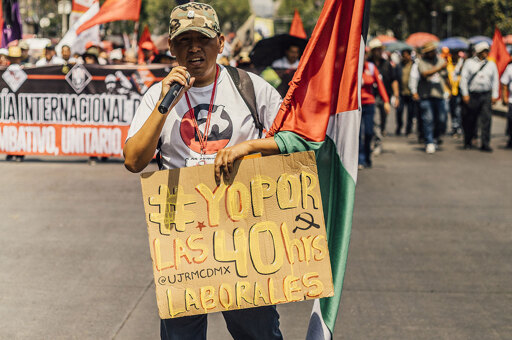
A January national day of action reveals that substantial forces within the Mexican labour movement are less than satisfied with both the possible outcomes of USMCA renegotiations and President Sheinbaum’s workweek reduction proposal, which leaves the door open for extreme overtime and does not codify a five day workweek (in country with atrophied monitoring mechanisms and a skeleton staff of labour inspectors) and proposes to only gradually implement the 40 hour work week by 2030.
The national day of action builds on a November mobilization, in which unions demanded the immediate implementation of the 40 hour workweek, where Francisco Hernández Juárez, General Secretary of the Mexican Telephone Workers Union, declared that “the working class cannot wait any longer. The reform must be approved now, without exceptions or shortcuts that affect labour rights.”
The National Union of Workers, Broad Unitary Social Front, and National Meeting of Leaders say in a press release that their “National Day of Struggle will seek to reclaim the most relevant issues for our country,” “to assert and promote its right to a democratic and inclusive development model that seeks equality and equity for all Mexicans,” and so unions “will mobilize throughout the country to defend our proposals, strengthen unionism and the rights of workers by promoting a sovereign and independent development model that allows us to grow and develop with greater justice and equity.”
The including:
- The implementation of the 40-hour workweek with 56 hours of pay and 2 mandatory days of rest
- The right to decent housing
- Restoration of the solidarity-based nature of pension funds
- De-indexation of the UMAs (Units of Measurement and Update)
- Energy and food sovereignty
- Strengthening of the rights of rural communities
- Allocation of a sufficient budget for education, science, technology, and health, as well as the integration and training of workers in information technologies, artificial intelligence, and the full right to connectivity
“In the upcoming review of the USMCA, the United States government will present pressure and positions on issues fundamental to our development. There are intentions to polarize issues in the bilateral relationship with our main trading partner in order to gain advantages that compromise the sovereignty and self-determination of our nation.”
The National Union of Workers also highlighted the wage and working condition asymmetries between Canada, the US and Mexico, where wages remain significantly lower despite recent gains since President AMLO’s election in 2018, a situation which primarily benefits US capital, which overwhelmingly dominates the manufacturing and exports sector in the country.
Beyond the labour movement, critics of President Sheinbaum’s include Morena’s parliamentary allies the Partido del Trabajo (the Workers Party, who warned in September of last year about attempts to dilute the reform), the neoliberal Movimiento Ciudadano party, newspaper columnists, left intellectuals and social organizations such as the National Front for 40 Hours. President Sheinbaum’s workweek reduction proposal put in place by outgoing and deeply unpopular Chilean President Gabriel Boric. It will be debated and voted on in the current session of Mexico’s Chamber of Deputies.

-

Mexican Unions To Rally for 40 Hour Workweek… With Two Days of Rest
January 15, 2026January 15, 2026
In the face of President Sheinbaum’s roundly criticized workweek reform proposal, considered excessively flexible & accommodating to capital & the danger to workers from USMCA renegotiations Mexican labour isn’t standing still.
-

30 Mexican Unions Unite in Face of USMCA & Labour Demands
January 15, 2026January 15, 2026
The bloc announced it will intensify regional meetings & coordination efforts, towards consolidating a unified trade union front.
-

Evangelical zionists Close to Forming Political Party
January 15, 2026January 15, 2026
Amongst other political malformities, two evangelical groups are set to become national political parties in Mexico, one with ties to the US ultra-right and the israeli government.
The post Mexican Unions To Rally for 40 Hour Workweek… With Two Days of Rest appeared first on Mexico Solidarity Media.
From Mexico Solidarity Media via This RSS Feed.