

This article originally appeared in the Democratic Constitution Blogon January 7, 2026. The views expressed in this article are the authors’* own and do not necessarily reflect those ofMexico Solidarity Mediaor theMexico Solidarity Project.*
Then
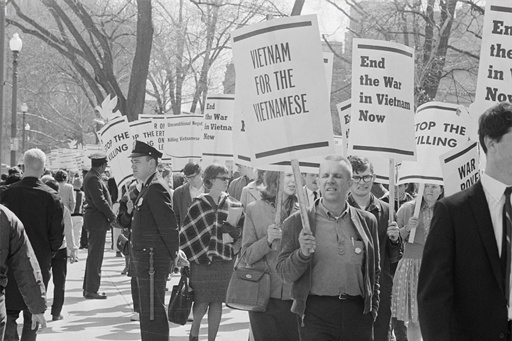
On April 17, 1965, thousands of people marched in Washington against the Vietnam War. The event was organized by Students for a Democratic Society (SDS), and a founding SDS member, Paul Potter, delivered the most memorable speech. Potter asked the crowd to “name” the system that waged war abroad, disenfranchised black Americans in the South, left millions of people “impoverished and excluded from the mainstream and promise of American society…puts material values above human values, and still persists in calling itself free.”
How could such a system be controlled, asked Potter. How could it be bent to the values of peace and justice instead of war and exploitation?
Martin Luther King developed a similar analysis, arguing that the U.S. was “the greatest purveyor of violence” in the world. If “America’s soul becomes totally poisoned, part of the autopsy must read ‘Vietnam,” King warned during his first public antiwar speech in 1967. Against naysayers within the Johnson administration and his own civil rights circle, King persisted, arguing that the movement for democracy at home was inextricably linked to the movement for democracy abroad.
Now
Early Saturday morning, the U.S. military carried out Operation Absolute Resolve, launching multiple airstrikes on Caracas, Venezuela, as well as on many locations linked to the country’s most important military facilities. It was the first time the U.S. had invaded another country in Latin America since Panama in 1989. Then, American soldiers killed hundreds of Panamanians and committed numerous war crimes along the way to extraditing Manuel Noriega on federal drug-trafficking charges, the same completely unfounded charges facing Nicolás Maduro.
Troops on the ground in Venezuela included a CIA mole in Maduro’s inner circle. Trump gave the go-ahead for more CIA involvement in the country as early as July 2025, which likely included the buildup to Saturday’s covert operation. As of Tuesday, the main organs of state remain intact, and leaders loyal to the Chavismo project, started by the late Hugo Chávez, remain in place, including former Vice President Delcy Rodríguez (now the acting President) and her brother, Jorge Rodríguez. Both are said to have been in talks with Washington over the last several months.
The root of our problems is a political system that protects an oligarchy of economic, political, and bureaucratic elites.
The 150 military aircraft involved in the operation included anti-aircraft support, intelligence-gathering platforms, and helicopters to drop off and pick up a Delta Force special operations team and domestic law enforcement agents, including members of the DEA and FBI. Two U.S. soldiers were injured, but the operation was considered a “clean-op,” or a success. Thirty-two Cuban nationals—soldiers in Maduro’s guard—were killed in the attack, along with some sixty-eight Venezuelan military officials and civilians.
Before the kidnapping, the U.S. had spent several months building up the largest military presence in the Caribbean since the Cuban Missile Crisis, and the wanton murder of alleged Venezuelan drug-runners has become routine. According to journalist Michael Fox—whose podcast, Under the Shadow, is an invaluable resource on Latin American history and U.S. intervention—Panama was a training ground: “Whether in El Chorillo [Panama City] or Iraq and Afghanistan or the Caribbean today, the US military slaps a drug trafficker or terrorist label on people and then issues their death sentences without trial or evidence. No due process. No jury. No judge. No conviction. No appeal. No regard for international law.”
There are various reasons for this latest attack. The importance of oil is obvious. The U.S. wants control over Venezuela’s billions of barrels. It also wants to keep resources out of the hands of China, Russia, and Iran—the only real threats to the American empire. Other plentiful natural resources include natural gas and gold. South America also holds over half the world’s identified lithium reserves within the “lithium triangle” located in parts of Argentina, Bolivia, and Chile.
On the domestic front, Trump has an eye on the 2026 midterms. He wants to distract from problems at home, and is attempting to drum up support through a simple narrative of “good guy catches bad guy.” Never mind that Maduro has no outstanding warrants in 192 of the 193 UN member states, and is wanted by zero international legal bodies. Abducting Maduro makes sense within the logic of Trump’s war against alleged drug-traffickers (no one look at Juan Orlando Hernandez, please) and leftists/communists. Using massive force abroad against political enemies may make it easier to justify the use of immense force at home.
And of course, the U.S. has long fought tooth-and-nail against every whiff of political dissent in its “own backyard.” The attack was brazen and illegal, but not out of character. As World War II drew to a close, Franklin Delano Roosevelt set out to create the United Nations and other international bodies and treaties. In so doing, he helped lay the foundation for U.S. imperial power—a force that grew in destructive might under Harry Truman and the ideological cover of the Cold War, or the “free world” versus the Soviet Union. Today, that collection of treaties and international bodies forms the backbone of “international law”—a power that, whatever FDR’s intentions, has been used above all to humiliate, weaken, and discipline countries that attempt to assert their sovereignty against Yankee might.
The System
Martin Luther King and SDS were grounded in the principles of universal democracy. They called for the self-determination of all sovereign countries and the liberation of the oppressed. The attack on Venezuela and the abduction of Maduro and his wife, Cilia Flores, violate all of these principles.
By the time he was gunned down in Memphis, King’s desire to name the system had taken him to the threshold of America’s political foundation: the Constitution. Unfortunately, he didn’t have time to fully develop and articulate his theory of escaping the American political labyrinth. And aside from a line in King’s final book, the civil rights movement came and went without naming the Constitution.
SDS also had the opportunity to build something around the Constitution. Tom Hayden included a subtle critique of the framers’ creation in his draft of the Port Huron Statement, but it was removed after other SDS members expressed concern about alienating their still-fledgling organization from the liberal majority. (Schaeffer discusses other aspects of Hayden and the New Left’s conception of democracy that mitigated against identifying the Constitution as the central issue, especially their attachment to C. Wright Mills’ concern with public engagement and the “Jeffersonian ideal of public debate”). Though able to vividly describe the horrific aspects of “the system,” the New Left also came and went without naming the Constitution.
The root of our problems is a political system that protects an oligarchy of economic, political, and bureaucratic elites. The Constitution denies universal and equal rights at home and protects the military behemoth that denies the same rights abroad. A democratic constitution would create a new political playing field and strengthen the movement to dismantle the imperial war machine and win the reforms demanded by the working class and all oppressed peoples. Only through democracy can we create a foreign policy that respects national sovereignty and the right to self-determination.
The attack on Venezuela is revolting, but must be understood as part of a long history of gringo imperialism, particularly in Latin America. Our task remains the same: in the words of Lenin, to educate the working class “in the spirit of the most consistent and resolutely revolutionary democracy.” In the U.S., that means agitating against the undemocratic Constitution and fighting for a democratic alternative.
Lucas De Hart is the founder of the Democratic Constitution Blog and co-host of the Democratic Constitution Podcast and Luke Pickrell is a member of Democratic Socialists of America (DSA). He co-runs the Democratic Constitution Blog and the Democratic Constitution Podcast.
-

Venezuela: Then & Now
January 15, 2026January 15, 2026
The US Constitution denies universal and equal rights at home and protects the military behemoth that denies the same rights abroad. A democratic constitution would create a new political playing field and strengthen the movement to dismantle the imperial war machine.
-

If Mexico distances itself further from China, it will be left alone against the US: Enrique Dussel
January 14, 2026January 14, 2026
In his view, Mexico’s national political and economic elite has failed to assume its responsibility to design a strategy toward China and Asia.
-

The US War on Latin America & The Caribbean
January 14, 2026January 14, 2026
When the world can watch a genocide unfold in real time, when the empire brazenly kidnaps a head of state, when multilateral institutions only muster mealy-mouthed statements in response, it becomes undeniable that only the people save the people.
The post Venezuela: Then & Now appeared first on Mexico Solidarity Media.
From Mexico Solidarity Media via This RSS Feed.