


Miles Morrisseau
ICT
A rise of Indian residential school denialism in Canada is bringing calls from Indigenous people and advocates for the federal government to update hate speech laws to criminalize the rhetoric.
The Assembly of First Nations passed a resolution at its special assembly in December demanding the Canadian government criminalize residential school denialism.
“Denialism is deliberate harm,” Chief David Monias, Pimicikamak Cree Nation, told the assembly after introducing the resolution. “Survivors and families and nations face intentional campaigns designed to erase the truth of residential schools and unmarked graves. Such action retraumatizes, survivors feel racism and undermines truth-telling and healing. Education alone is not enough to stop organized denialism.”
Laura Arndt, Mohawk, Six Nations of the Grand River, says survivors and families are being retraumatized by the denials.

Laura Arndt, Mohawk, Six Nations of the Grand River, says survivors and families are being retraumatized by the growth of Indian residential school denialism in Canada. Credit: Photo courtesy of Laura Arndt
“Denialism is really the last vestige of a colonial frame of empire building,” Arndt told ICT, “and I think we’re in this space where what happened to Indigenous people across North America has been made invisible in history, where the breaking of treaties and deaths associated with empire building and Indigenous people have been hidden.”
Arndt is the Secretariat Lead at the Survivors Secretariat, a nonprofit organization that researches and documents the history of the Mohawk Institute, one of Canada’s largest and longest-running Indian residential schools.
The Secretariat works closely with survivors and their families to document their stories. Arndt’s mother, aunts and grandmothers all attended the Mohawk Institute and she knows both the trauma of the past and how denialism impacts survivors today.
“In Canada, through the Indian Residential School Settlement and then the work of the Truth and Reconciliation Commission, it’s making it harder and harder to hide that history,” she said. “The TRC invites people into a safe space, to tell the truth of what happened, to explain really what that situation was like and survivors did, and they called it truth-telling. Then the denialists come in and they once again put survivors back into that re-traumatized space of being called liars, that they’re telling tales, they’re made to feel shameful because they now once again start to believe that nobody believes them.”
‘Rejection of well-documented facts’
Stephanie Scott, executive director of the National Centre for Truth and Reconciliation, is deeply concerned by the rise in residential school denialism in Canada.
“Denialism is not legitimate debate or academic inquiry,” she said. “It is the rejection of well-documented facts and lived experiences, supported by extensive colonial archival records and almost 7,000 survivor statements gathered through the Truth and Reconciliation Commission of Canada. Denying or minimizing the residential school experience retraumatizes survivors, undermines decades of truth-telling, and obstructs truth and reconciliation.”
The National Centre, based at the University of Manitoba, was established in 2007 as the archive for all the materials collected during the Truth and Reconciliation Commission.
Scott supports the calls to classify residential school denialism as hate speech under Canada’s criminal code.
“Residential school denialism perpetuates racism and misinformation and, when it targets survivors and their experiences, functions as a form of hate,” Scott said. “Freedom of expression does not mean freedom from accountability, particularly when speech causes harm. The NCTR supports informed, respectful dialogue grounded in truth and accountability, and we support ongoing discussions about how denialism may be addressed through legal and policy measures, including whether it should be recognized within the scope of hate-related offenses.”
Defunding reconciliation
Denialism has flourished as a successful cottage industry with books, research projects, newspaper editorials and a full-length documentary, “Making a Killing,” produced by a recently hatched political party, the OneBC party.
The party was established in British Columbia by Dallas Brodie in June 2025 after the elected member of the Legislative Assembly was kicked out of the provincial Conservative Party for her comments on residential schools.
The OneBC platform includes transforming reserves into townships, ending land acknowledgements, defunding the “reconciliation industry” and requiring all street and place names to be in English.

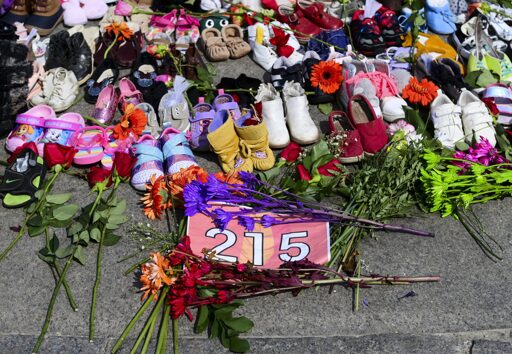
Ground-penetrating radar identified what are believed to be the remains of 215 children buried at the site of the former Kamloops Indian Residential School, shown here on May 27, 2021, according to Tk’emlups te Secwépemc First Nation in Kamloops, British Columbia, Canada. Credit: Photo by Andrew Snucins/The Canadian Press via AP
Among the targets is the Kamloops Indian Residential School, where Tk’emlups te Secwepemc First Nation of Kamloops announced in 2021 that ground-penetrating radar had found signs of 215 graves at the site of the former residential school in British Columbia.
No exhumations have been made and may never be done, as the community may not want to disturb the departed. Federal Information Commissioner Caroline Maynard has asked Canada’s Crown-Indigenous Relations Ministry to start releasing files on the site, the Toronto Sun reported on Jan. 14, 2026.
“The term ‘residential school denialism’ is so clearly being used as a political cudgel to stop Canadians from questioning false stories like the Kamloops grave hoax,” Masha Kleiner responded on behalf of OneBC. “Anyone employing the term is instantly discredited. We believe in truth and free speech at OneBC.”
Arndt does not believe that exhumation of remains is required, as each community that has made similar discoveries as Kamloops will make their own decision on whether to disturb the departed.
“I think the hardest part in all of this is that why should you have to show the remains of a dead child to prove that the child died? You don’t need that in any other sphere of the Canadian social strata,” Arndt said. “But when it comes to Indigenous people, they’re basically saying exhumation or no credibility as far as it goes with denialism. So we won’t go there. We honour the spirits of the children.”
Dr. Sean Carleton, an associate professor in the Department of Indigenous Studies at the University of Manitoba, conducted research into claims of a “mass grave hoax” and how denialists “cherry pick” information to support their rhetoric.
The research was published in October 2023 and he has continued to speak out against denialists and their tactics.
“What we are seeing is the evolution of this as a strategy, and I mean this is ripped right out of Holocaust denialism,” Carleton told ICT. “Most Holocaust denialism is quibbling with numbers. Is it 6 million Jews that were killed or was it 3 million? Were there actual gas chambers or did they die of malnutrition? … The goal is actually just to shake your confidence in the consensus and shake that confidence that you should want to do something about it.”
Carleton and his research partner Reid Gerbrandt looked at nearly 400 news articles in Canada that reported on the discovery of unmarked graves near the Kamloops Residential School and found that 6.3 percent of the reporting used the phrase “mass graves” in the early days of the news cycle and most would correct the reporting.
“It was far from this universal conspiracy theory,” Carleton said. “What we concluded is that this is just another form of residential school denialism where denialists will cherry pick a few things, they’ll find a New York Times article, they’ll find a CNBC article, they’ll find one of these things that talks about it as mass graves and say, ‘This is how people were misled.’”
Carleton said denialists “plant the seed” that the residential school history is incorrect.
“Denialists will present what they are doing as they’re just standing for the truth, they’re just curious, asking questions,” Carleton said, “but what they’re actually trying to do is shift the landscape of the conversation slowly but surely. If you can challenge people on mass graves and not care about residential schools … you can chip away at their support for reconciliation and you maybe could plant the seed in their mind that Indigenous people are just money-grabbing liars.”
Arndt believes the truth is known in the community and in families who will support each other.
“What I do hope is different this time is we, as their children, are standing with them and saying, ‘I believe you, Mom. I believe you, Grandma.’ And Canada’s archival bodies have shown records and documents that prove that they weren’t lying.”
The post ‘Deliberate harm’: Rise in residential school denialism brings call for action in Canada appeared first on ICT.
From ICT via This RSS Feed.