


Mark Trahant
Monda, Jan. 12, Newsrime:
Finally the House passed a health care bill
it’s now off to the Senate where it will chill
Unless legislation moves through that body
another reminder how our network is shoddy
Last week a brilliant reader pointed out that I buried the lede. Guilty. And I am about to do that again (my mind says, build the frame with facts first.) So here goes. This is a long narrative and I am wandering all over the place. Stick with me, if you can.
You should know that the United States spends roughly 18 percent of our Gross Domestic Product on health care just shy of $5 trillion. That works out to $14,570 per person. We spend more than any other industrial nation and the cost is expected to reach 20 percent of GDP within the next decade (one reason is that a lot of old people like me are expensive.)
And there is more bad news (at least from a fiscal point of view). From the Health System Tracker:
Over the past five decades, the difference between health spending as a share of the economy in the U.S. and comparable OECD countries has widened. In 1970, the U.S. spent about 6.2 percent of its GDP on health, similar to spending in several comparable countries (the average of comparably wealthy countries was about 4.9 percent of GDP in 1970). The U.S. was relatively on pace with other countries until the 1980s, when health spending in the U.S. grew at a significantly faster rate relative to its GDP. Since then, health spending as a share of the economy has grown faster in the U.S. than in peer nations.
Last week the House voted to extend Affordable Care Act premium tax credits to help families pay the growing cost of health insurance. And next the Senate will explore a “compromises” that would limit who benefits from that extension. (And if the Senate does act, will President Trump sign a bill? Long shot at best.)
Here’s the thing: The extension of ACA premium credits will not make health care more affordable. That won’t happen until we address the overall cost of the system and look for ways to make it more efficient. Our system is not that.
When the health care debate was in full swing, back in 2009, I wrote about walking around the Gallup flea market. What kind of system would cover the vendors? These are folks who might make a good living selling art, food, or even used household items. But can they afford health insurance (even with the tax subsidies from the ACA)?
The ACA’s original plan called for a public option. Here is what I wrote:
As more and more of us leave the corporate working world – and its health care benefits – we venture into our own version of the flea market. We will need a health care system that includes a viable self-insurance option, both in the larger community and for people in reservation-based economies. That’s why a public plan is essential to any reform.
But it must be a public option that recognizes the variety of work in this country. The definition of “affordable” needs to satisfy people who might earn a fabulous paycheck during fishing season and then coast for months after that. The public option will have to include people who might use the Indian Health Service for primary care, but who would be willing to pay extra for some services.
Republicans killed the public option. It was the price Democrats paid for the convoluted (but important first step ) that became the Affordable Care Act. The expansion of Medicaid was another step. Two steps forward, and now we go back.
The sad truth is the ACA did no go far enough. The U.S. spends almost twice as much as peer nations on health care because we are so afraid of public health insurance. (How many more people and services can be covered if you remove “profit” from the equation?)
A lot we can learn from Greenland
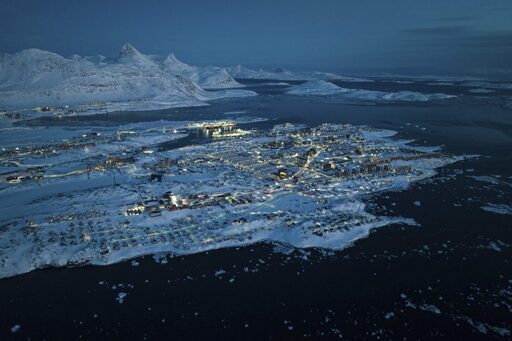
Last week President Trump demanded that Greenland be transferred to the United States either through the “the easy way,” or he warned, he will “do it the hard way.”
Of course this makes no sense. Political leaders in Greenland, including the opposition party, are clear: “We do not want to be Americans, we do not want to be Danes, we want to be Greenlanders. The future of Greenland must be decided by the Greenlandic people.”
That’s self-determination. Period. End of story.
A few years ago I was at the Arctic Circle conference in Reykjavík and heard the then-Prime Minister of Greenland Kim Kielsen. His talk was in the Kalaallit (or Greenlandic) language. This was just after Trump’s first big “I want Greenland rant.” Kielsen talked about the complexity of geography. “Our country is centrally located between two of the World’s superpowers,” he said. “And this is a fact which we can’t ignore.”
His message: Do business with Greenland, but the country is never for sale.
When I heard that talk, I was struck by how it could have just as easily been given at the Alaska Federation of Natives convention. He talked about hunting and fishing and how climate change was making it more difficult to feed families. Culture and community. Language. Basic infrastructure. The daily challenges of governing.
“The effects of climate change have a direct impact on our everyday lives, to our way of life and to our culture,” Kielsen said. “Our environment is visibly changing. Sea ice is no longer a guarantee during winter time, the migration patterns of wildlife and fish, to which we depend, are changing, and it is increasingly difficult to predict the weather. Whenever we open fish and game that we catch from the sea, it becomes more frequent that we find plastic in their stomachs. What is worse however, is the fact that the animals now also contain microplastics which are invisible to the naked eye.”
What’s so ironic about this moment in history is that the West, including the United States, could be learning important lessons from Greenland about the impact of climate change, wholistic health, or even the structure of government. This is a list of topics that neither Donald Trump or Marco Rubio would want to talk about.
Universal health care
A report a few years ago by the Inuit Circumpolar Conference or ICC looked at the health care issues of the 180,000 Inuit living in Alaska, Canada, Greenland, and Chukotka (Russia). “In Canada, national, government-funded universal health care is administered by territories and provinces with health care funding a mix of largely public and some private. In Alaska, health care is mostly private with personal health insurance an important feature of the funding arrangements. However, within both countries, there are specific government-funded arrangements to support indigenous health. In Greenland, where the population is predominantly Inuit, there is universal government-funded coverage.”
That is an important distinction. Greenland spends about 18 percent of its Gross Domestic Product on health care. And what do they get for that price tag? Universal government-funded coverage.
Compare that to the United States where roughly 8 million people (a number that’s growing larger) are uninsured. And American Indian and Alaska Natives have the highest uninsured population at nearly 20 percent. (The ACA helped a lot, but now the numbers are rising again.)
So the political question: If the United States takes Greenland the “hard way” will it still cover public health? Will this be the public option for export?
The future is Indigenous
Like so much of the rhetoric coming from the Trump administration, their view of Greenland would return us to another century. Instead of local people determining the future, it’s about the “great powers” deciding.
My thoughts go in the opposite direction. What if Greenland and its coming independence represents something else, an Indigenous future?
“The Arctic and Greenland are two entities which are inherently inseparable,” Kielisen said. “The Greenlandic people live on the island. The Arctic is our home.”
Now think about the logical extension of that idea. What if other future nation-states could emerge in the Arctic? For example: Nunavut could be one of the largest countries in the world and its population is only slightly smaller than Greenland.
What about beyond the Arctic? Consider the Navajo Nation as an independent global entity. Or a Miskitu homeland in Nicaragua and Honduras. Then there’s Māʻohi from French Polynesia and so many other potential nations around the world that could be freed from lingering colonialism.
What if the world of the future is about being Indigenous, smaller and sovereign?
The post ANALYSIS: Important lessons from Greenland appeared first on ICT.
From ICT via This RSS Feed.
You must log in or # to comment.