

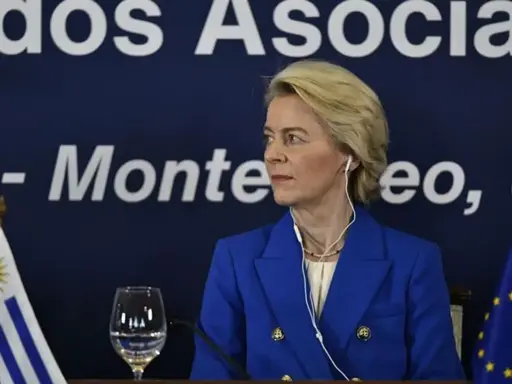

The EU’s new deal with prominent South American powers may not rely on bombs to assert power. But it’s still colonialism.
European Union nations are pushing forward with a much-delayed free-trade deal with South America’s biggest trading bloc, Mercosur. And some experts say the clear US return to open colonial tactics in the Western Hemisphere may have pushed it over the line. If you look a little closer, though, Europe’s own tactics aren’t much nicer.
‘Neocolonial and neoliberal’, just without the bombs
The main power in Mercosur is Brazil, which has Latin America’s biggest economy. And its president Luiz Inácio Lula da Silva hailed the “multilateralism” of the deal, in a clear nod to the recent unilateral actions of Donald Trump’s regime in the US. He also claimed there were “benefits for both blocs”. But there are many critics who disagree.
Neoliberal trade deals — which put corporate profits before the rights of ordinary people — have not been good news for the Global South. And the EU-Mercosur deal is likely to be no different.
Critics say it will deepen already unequal North–South trade relations, displacing indigenous people while trashing the environment, human rights, workers’ rights, and democratic accountability. It will primarily benefit big business on both sides of the Atlantic, while hindering meaningful development in Mercosur nations.
Massive and unscrupulous agribusinesses — which have been destroying the Amazon rainforest — will win big. Fewer regulations will mean they can export cheap products (“particularly beef, poultry, pork, sugar and ethanol“), undercutting smaller-scale farmers in Europe (who aren’t happy about the deal either).
Meanwhile, big manufacturers in Europe will gain even more potential clients. And they’ll gain reliable access to natural resources in the region, particularly Argentina’s lithium (which is key for development beyond fossil fuels).
In short, numerous critics call the deal “neocolonial“. The prominent Basque Workers’ Solidarity (ELA) trade union, for example, insists that the EU has proven itself an untrustworthy actor, saying it:
intends to continue its colonialist trade policies with the countries of the Global South while tolerating abuses against international law and human rights
Deepening agricultural decay
The further empowerment of agricultural business giants doesn’t just cement the might of a few unscrupulous profiteers. It also:
- Increases urbanisation, pushing people out of the countryside and changing their ways of life. This in turn puts more pressure on urban resources and it lets political elites control citizens more easily.
- Weakens ordinary people’s knowledge of food production, making us dangerously reliant on the whims of out-of-touch business elites who care about keeping costs low and profits high. More often than not, that means prioritising the sale of unhealthy food.
- Degrades soil, destroys more land, reduces biodiversity, and uses more fuel.
The EU-Mercosur deal’s pledge to address and limit environmental destruction has convinced few critics.
US is desperate. EU and China are playing a longer game
The new surge in brash US colonialism, as we’ve seen in Venezuela, Gaza and elsewhere, may indeed be pushing countries further into the arms of other power players like the EU and China. And numerous analysts say this may have pushed the EU-Mercosur deal over the line.
But the fact is that the US is desperate because it’s already been losing power in Latin America, after decades of violently enforcing its dominance there during the Cold War. In the 21st century, for example, China in particular has significantly boosted its cooperation efforts in the region.
The EU, meanwhile, is just a slightly less obvious colonial power in Latin America. It has postured previously about a green transition, but continues to dump that stance as it pushes to keep a role on the world stage. And that’s primarily for big business interests, of course, not ordinary Europeans.
It’s absolutely true that the EU needs to reconsider its partners, as the US behaves increasingly erratically. But in the interests of humanity, critics will rightly keep fighting to stop the European Parliament’s approval of the dangerous EU-Mercosur deal.
Featured image via the Parliament Magazine
By Ed Sykes
From Canary via This RSS Feed.
OH, yeah. South America must trade only with China, otherwise we are being exploited… All right.