

This article by Erick Augusto Vargas Noria originally appeared in the December 2025 edition ofMemoria: Revista de Crítica Militante. We thank Memoria for permission to reprint the article and encourage you to supportMemoriaand theCenter for Studies of the Labor and Socialist Movement. The views expressed in this article are the author’s own and do not necessarily reflect those ofMexico Solidarity Mediaor theMexico Solidarity Project*.*
The Mexican Revolution represented the clearest expression of popular protest against the deep social inequalities that prevailed under a system dominated by military, economic, religious, and local elites.
In this context, the Revolution placed at the center of national life a historically repressed, humiliated, and segregated group: the Indigenous population. It is no coincidence that the demand for “Tierra y Libertad” became a battle cry to end decades of injustice and abuses against the poorest communities in the country. In this sense, Emiliano Zapata, then as now, remains the symbol of the struggle against oppression and tyranny exercised from positions of power.
Throughout our history, the construction of the Mexican state has had luminous moments, such as the Cárdenas era, which successfully channeled the demands of the working class, peasantry, and the general population. That was a golden age in which significant progress was made in various areas, including land redistribution.
However, with regard to Indigenous justice, although significant steps have been taken, there is still a long and winding road ahead, not to mention the resistance that persists to this day.

Subcomandante Marcos of the EZLN with Hugo Aguilar Ortiz at 1996 peace talks in San Cristóbal de las Casas, Chiapas.
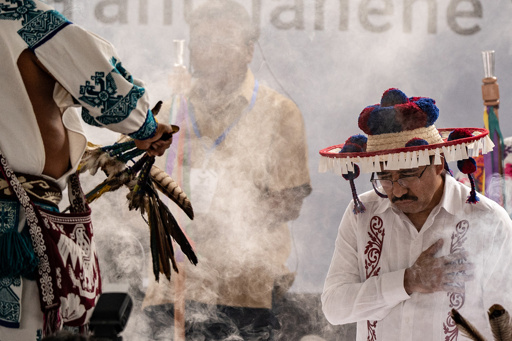
In this context, the arrival of Hugo Aguilar—a lawyer of Indigenous origin—to the presidency of the Supreme Court of Justice of the Nation (SCJN), along with justices elected by popular vote, constitutes a historic event. It represents the deepening of a process that began before 2018, was consolidated in 2024, and, in 2025, reaches its peak with a renewed judicial system.
The challenge is significant: one need only look at the degree of decay and backwardness inherited from the previous Court. Even so, expectations for the new justices are extremely high, although time to demonstrate results is limited. The task is to transform a system accustomed to privilege, favoritism, and corruption.
Regarding Indigenous issues, there are key points that must be discussed within a broad, pluralistic, inclusive, cross-cutting, historical, and profoundly human framework. Among these, the following stand out:
- Recognition of Multicultural Richness
Indigenous communities are living organisms that, from their very roots, preserve festivals, traditions, rituals, customs, languages, and their own ways of understanding the world. To legislate or administer justice without considering this multicultural richness would mean ignoring the essence of our peoples.
- Territory as a Legitimate Inheritance
For Indigenous communities, territory is a space to which they belong and which they claim as their legitimate inheritance, long before the arrival of the Spanish Crown. The dispossession and massacres suffered for centuries remain open wounds, now embodied in the voraciousness of corporations and businesses. In this regard, the State’s historical debt is enormous, and the judicial system must assume a central role in its redress.
As Carina García points out: “The cases litigated by indigenous communities in defense of collective rights are generally of two types: against companies and against the Mexican State, through its institutions; the latter, for non-compliance with services, for example, water, health and education” (2025).
- Respect for the Environment & Sustainability
From the Indigenous worldview, Mother Earth is part of a whole, encompassing vegetation, fauna, and all living beings. There was a profound respect for the natural environment. Respecting the environment and territory today means halting the extractive economic model and, in some cities, curbing the ambitions of real estate developers. At stake here is not only the sustainability of Indigenous communities but also the very preservation of civilization. It is essential that the Supreme Court of Justice of the Nation (SCJN) address the defiance of local governments.
- Preservation of Cultural Heritage
The preservation of archaeological sites, an essential part of our heritage, requires public policies that include the communities themselves in their protection. The legacy of our past—ceremonial centers, pyramids, sculptures, codices, ecosystems—must be promoted, yes, but above all, protected.
These points open the discussion to two issues of great relevance in recent decades: autonomy and the full exercise of the rights of Indigenous peoples.
President Claudia Sheinbaum has taken the first steps. Today, the Supreme Court of Justice of the Nation (SCJN) and the Congress of the Union have the historical and material conditions to achieve what Zapata, the Flores Magón brothers, Revueltas, Cárdenas, and many others championed: that our Indigenous communities never again be forgotten or marginalized from major national decisions. It is crucial to move from rhetoric to action and initiate a genuine transformative process that begins at the federal level and extends across the board to state and local governments, which are directly responsible for ensuring compliance with the law.
As Tomás López, president of the Indigenous Professional Center for Consulting, Defense, and Translation (CEPIADET), points out: of all the cases processed in the country, 80% fall under the jurisdiction of state judicial authorities, while only 20% reach the Federal Judiciary (PJF). This demonstrates the enormous responsibility of local governments in handling this volume of cases.
For her part, academic Ortiz Quintero highlights the importance of the 2024 constitutional reform, which recognizes Indigenous peoples as collective subjects of rights, with legal personality, their own patrimony, and legal pluralism. This progress is crucial not only for the recognition itself, but also because it grants communities the possibility of filing injunctions and other legal remedies, such as constitutional disputes.
Example of Cases Pending Resolution by the SCJN in Indigenous Matters
| Record | Type | Subject |
|---|---|---|
| 344/2025 | Amparo in review 536/2022 | Establish clear criteria for interpreting the rights to autonomy, self-determination, and self-government of peoples and communities in accordance with ILO Convention 169. Legal recognition of community governments. Obligation of the authorities to guarantee social, economic, cultural, and political institutions. (Chiapas) |
| 324/2025 | Amparo in review 277/2024 | The lack of consultation with an indigenous community regarding the issuance of construction permits for a housing development, and the failure to determine the scope of the legal rights of individuals belonging to Indigenous communities. (Oaxaca) |
| 1856/2025VIAJ | Several | It discusses the recognition of the rights and culture of indigenous and Afro-Mexican communities, as well as the participation of traditional community and independent government in development. |
| 1485/2025 | Several | In the State of Mexico, it concerns a motion from the local Congress to harmonize the local Constitution with the reform of Article 2 of the Magna Carta regarding Indigenous and Afro-Mexican peoples and communities. |
| 32/2025 | Direct appeal 460/2022 | Criminal proceedings for violent crimes. Application of the protocol for justice officials in cases involving the rights of persons with disabilities; assistance from an expert interpreter in the Nahuatl language and a lawyer specializing in their language and culture must be provided. |
This brief overview is just a glimpse of the enormous challenge facing the new Supreme Court justices. It is now up to society to take a more active role and demand compliance with what is already enshrined in the Constitution.
The arrival of Hugo Aguilar, who has Indigenous roots, does not mean that everything will change overnight. However, it is an unmistakable sign of the changing times we are living through. We trust that this new Court will bring the administration of justice closer to the people of Mexico.
-

A Renewed Opportunity for Indigenous Justice in Mexico
January 14, 2026
It is crucial to move from rhetoric to action and initiate a genuine transformative process that begins at the federal level and extends across the board to state and local governments, which are directly responsible for ensuring compliance.
-

Mexico Tells Trump ‘Not in our Hemisphere’ Soberanía 91
January 14, 2026
A large anti-imperialist march in Mexico City, US diplomatic pressure on Mexico, US funding CIA-linked contractors involved in Mexican labor, and Losers & Haters.
-

Mexican Government to Invest Billions in Safe Pathways Illumination Program
January 14, 2026January 14, 2026
The street lighting program matches illumination with sidewalk improvements and murals to bring security and a sense of community to previously dim and neglected urban areas.
The post A Renewed Opportunity for Indigenous Justice in Mexico appeared first on Mexico Solidarity Media.
From Mexico Solidarity Media via This RSS Feed.