

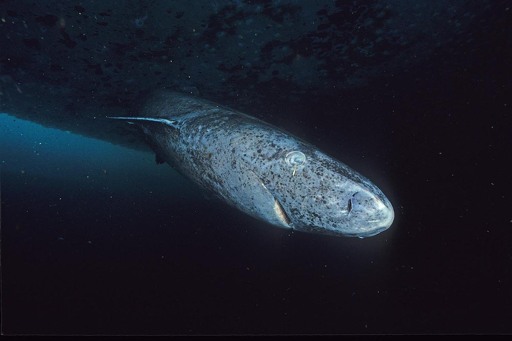
Greenland sharks are the longest-living vertebrate known to science, topping out at more than 400 years old, and scientists have largely believed they were nearly blind. But new research suggests they actually can see, and, remarkably, maintain their vision for more than a century. Greenland sharks (Somniosus microcephalus) mostly live in the cold waters of the Arctic and North Atlantic, in the ocean’s dimly lit twilight zone, at depths of 200-1,000 meters (660-3,300 feet). Their dark habitat led scientists to believe that the sharks could barely see. Many Greenland sharks have also been found with parasites in their eyes, raising the possibility they may even be blind. Lily Fogg, who researches fish vision at the University of Basel in Switzerland, told Mongabay in a video call that shark biologist John Fleng Steffensen approached her to study the Greenland shark’s vision. Fleng Steffensen originally discovered Greenland sharks’ incredible longevity, and had 10 shark specimens from an ongoing study. “He said, ‘I’ve got these eyes, would you like to do a study on them?’ And we said, ‘Why not? That’s a great opportunity.’ If they’re going in the bin, then that would just be a waste,” Fogg said. So, Fogg and her team synthesized the shark’s genome and found that the genes involved with vision were still intact and functioning. The team also looked at cross sections of the sharks’ eyes to see if the structure of the tissue was degraded. “We found that it’s actually beautifully intact,” Fogg said. Furthermore, the researchers found…This article was originally published on Mongabay
From Conservation news via This RSS Feed.