

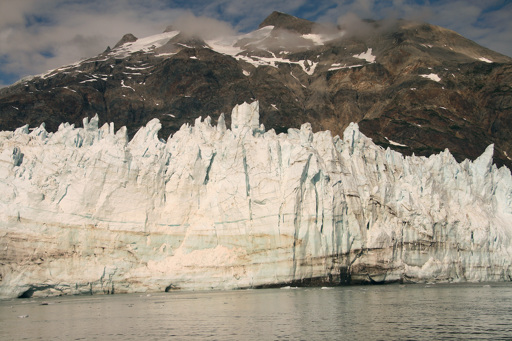
Glaciers are often treated as scenic features or scientific curiosities. In fact, they are critical infrastructure. Though they cover roughly a tenth of the Earth’s land surface, meltwater from glaciers and seasonal snowpacks supports drinking water, agriculture, industry, and energy production for close to half the global population. That support system is now shrinking, fast. Measurements collected over decades show that glacier loss is not a future risk but a present condition. According to the World Glacier Monitoring Service, glaciers worldwide have lost more than 30 meters of average thickness since 1970. The pace has accelerated since the early 2000s. Each of the last several years has set new records for ice loss. What was once gradual retreat has become sustained decline. Annual mass balance of reference glaciers with more than 30 years of ongoing glaciological measurements. Annual mass change values are given on the y-axis in the unit meter water equivalent (m w.e.) which corresponds to tonnes per square meter (1,000 kg m-2). Courtesy of the World Glacier Monitoring Service (WGMS) Cumulative mass change relative to 1992 for regional and global means based on data from reference glaciers. Cumulative values are given on the y-axis in the unit meter water equivalent (m w.e.). Courtesy of the World Glacier Monitoring Service (WGMS) The cause is not mysterious. Rising global temperatures have increased surface melt while shortening accumulation seasons. In many mountain regions, precipitation that once fell as snow now arrives as rain, depriving glaciers of replenishment. The Intergovernmental Panel on…This article was originally published on Mongabay
From Conservation news via This RSS Feed.