

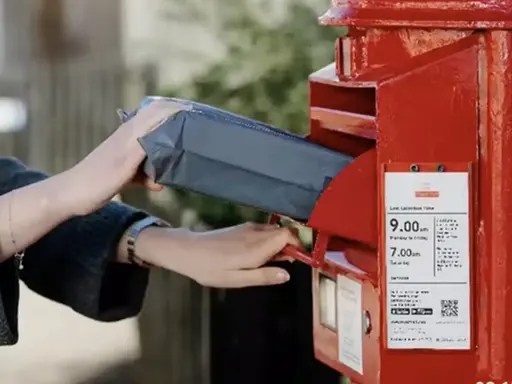

Royal Mail is rolling out a new design to 3,500 post boxes across the UK, which may potentially exclude millions of older people.
Solar panels on top of the postboxes will power a digitally-activated drawer. This automated design is expected to enable Royal Mail to compete with other parcel companies. Many of these companies already offer automated delivery boxes for small and medium-sized packages.
The company ran a successful pilot in both Hertfordshire and Cambridgeshire. Now, it will be rolling them out across Edinburgh, Nottingham, Sheffield and Manchester.
Post boxes cost-cutting
In July, Royal Mail announced that it would only deliver second-class letters on alternate weekdays, excluding Saturdays. This is an attempt to cut costs.
Then, in October, Ofcom fined the company £21m for failing to meet letter delivery targets. In total, it failed to deliver a quarter of all first-class mail on time. It also missed its target for second-class post from 2024/25.
In total, Ofcom has fined Royal Mail three times in three years. It issued fines of £5.6m and £10.5m in November 2023 and December 2024 – meaning it has been failing for years.
In December, a company owned by Daniel Kretinsky, a Czech billionaire, bought Royal Mail for £3.6bn.
Shutting out older people
Previous research shows that many older people lack basic technology skills, which are required to use apps or online services, such as those suggested here by Royal Mail.
This would automatically impede many older people from being able to use the new post boxes.
There are over 110,000 post boxes across the UK. These are conveniently located, which allows people to post letters easily. Whilst there are no official statistics on the number of people still using post boxes, we can reasonably assume that the majority of those doing so will be older individuals.
One in five older people – around 2.7 million people- do not use the internet. Moreover, one in four is completely unable to turn on a device and type in login information.
Many younger people now rely on electronic communication such as email and WhatsApp. Additionally, younger people tend to be more technologically minded. This means they are far more confident using apps and online services. All in all, Royal Mail’s changes will hit older people the hardest.
Discrimination
In a statement related to the digitalisation of local council services, Age UK said:
Although many older people fully embrace the digital world, digital exclusion increases with age and disability and these are protected characteristics under the Equality Act 2010.
In an increasing digital world, Age UK urges Councils to consider their equality considerations in the design of policies and the delivery of services. The Charity warns if councils are not providing suitable non-digital alternative ways to apply for services it can be argued that they are not fulfilling their duties under the 2010 Equality Act, potentially opening them up to legal challenge.
Therefore, we should hold the company responsible for operating the country’s national delivery service to the same standard.
Moving away from non-digital letter boxes to ones which require an app, login information, and using payment information on an electronic device will isolate millions of older people.
In an age where consecutive governments have forced community groups, libraries, and other places where older people socialise to close due to funding cuts, this will only further shut out a generation that is already struggling to adjust to a technology-filled world.
Feature image via Mark 1333/ YouTube screenshot
By HG
From Canary via This RSS Feed.