

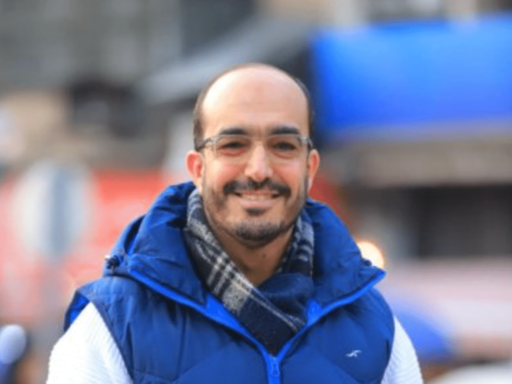

After spending nine months in Israeli occupation prisons, Palestinian journalist Samer Khwaira, 45, has been reunited with his wife and four children in Nablus, in the occupied West Bank. He tells the Canary his freedom is overwhelming, and he feels he has been reborn.
Palestinian journalist joyful about freedom but sad for those political prisoners he left behind
Samer told us:
The joy of returning to my family, my wife, my daughters, my son, my neighbours, and the great embrace of society has made me very happy, and I pray to God that this will also be the lot of all families. It really is a wonderful feeling, a feeling that made me cry.
Even now, whenever I remember my circumstances in prison and my current circumstances, I cry with overwhelming joy and also with sadness for those I left behind in the occupation’s prisons. They are living in extremely difficult and abnormal conditions.


In April 2025, at around 3am, Israeli occupation forces (IOF) raided his home. 30-40 heavily armed soldiers stormed the house, thoroughly searching it.
Khwaira explains****:****
My daughters were in a state of panic and, to be honest, I was also afraid. With so many soldiers, they could have opened fire, assaulted me, or broken things. Thank God, nothing like that happened, but my family was undoubtedly very affected. My daughters cried continuously for two or three days because of this event. They did not expect their father to be arrested.
For the first 45 days of his detention, he was in an Israeli occupation military camp, in Huwara, South Nablus. Then he was transferred to Megiddo prison – known for its abuse and torture – in the northernmost point of the territory. The last place he was detained was Nafha prison in the Naqab where he spent over six months, before being released on 7 January.
Collective punishment
Khwaira says:
I had never been imprisoned before. This was my first experience, and God willing, it will be my last, because returning to prison means death for me due to the very difficult conditions there. I was aware of the conditions in prison because I am a journalist and I have met many prisoners whom I have written about. But I never imagined the conditions would be this difficult. There are beatings, humiliation, shackling of the feet and hands, spraying with toxic gas, and many repressive measures. If punishment is given out, it is given out to everyone. Israel always implemented a policy of collective punishment. If one person makes a mistake, everyone is punished.
Khwaira, like so many Palestinian political prisoners languishing in ‘Israel’s’ jails contracted scabies, a highly infectious skin disease, in September last year. This then led to boils appearing over his body. He was made to wait for three months before receiving any treatment, but this was insufficient to control the disease. He is still suffering from these problems, but is now undergoing proper treatment. Khwaira also lost around 22 kg because of lack of food, and the extremely poor quality of that which was available to him in jail.
Israeli occupation prison guards do not only subject prisoners to physical torture. Khwaira says he had no contact whatsoever with his family, and his lawyer was only permitted to visit him once during his nine months in detention. He tells us of the psychological trauma inflicted on him, and says he had intense worries about his family, who were left to cope with the absence of a father, and breadwinner.
Severe psychological trauma
He told us:
The psychological effects were a million times harder for me than the physical ones. There is no doubt that I was under severe psychological pressure during my detention due to the terror, fear and anxiety caused by the Israeli occupation’s prison administration.
But I also had no contact with my family. There is no way to communicate from prison to the outside world. There are no phones, no way at all. We were completely isolated, 100 percent isolated. The psychological pressure my family were under, not knowing anything about me, having no means of communication- all this caused severe psychological pressure.
Khwaira was held under administrative detention. This means he was given no charge or trial, and the evidence against him was kept secret. Under this policy, detention orders can be renewed indefinitely, so prisoners have no idea how long they will be incarcerated. Each of Khwaira’s orders lasted three months, and these were renewed three times by the court.
He has been a journalist for more than 20 years. His most recent job, before his arrest, was working as a presenter for his local radio station in Nablus. He hosted an early morning show, covered general news, politics, and local conditions on the ground. Khwaira says he continues to question why he was taken away from his work, separated from his family, and arrested. The occupation gave him no reasons. But Khwaira is convinced he was arrested because of his journalistic work, as no charges were brought against him.
He says:
You are arrested without charge, on suspicion or as a precaution. Or you are arrested, so you are removed as an influential figure in your community. I consider myself a professional journalist, and although I may criticise, that is my right.
Khwaira says the situation has become more difficult and dangerous for journalists since October 2023. Dozens have their journalistic equipment and cameras confiscated, and are arrested and beaten, especially those working in the field.
But somehow, through all his hardship and suffering, Khwaira has managed to stay positive. He says:
Praise be to God I am breathing freely, and have returned to my home and my city. I feel so relieved. Because of this positive state of mind, my recovery from illness will be faster. I don’t know, as yet, if the job I had with the radio station is still there, or if other people have been brought in to fill the void I left. But, of course, I will not work in anything other than journalism and media. I will return to work, God willing, in the very near future.
Palestinian Journalists Syndicate: Arrest of journalists “a tool to empty the field of witnesses and prevent the transmission of truth”
42 journalists were arrested in 2025. According to the Palestinian Journalists Syndicate (PJS):
Arrest has become an immediate tool to empty the field of witnesses and prevent the transmission of truth. ” The Syndicate found the Israeli occupation has been focusing on the most influential journalists, and have arrested the same journalists multiple times. Not only did it find that, in 2025, administrative detention had expanded in use. It also documented a “noticeable escalation” in home raids, and arrests of journalists in front of their families. The purpose of this, is to “attempt to break them psychologically and socially, and to transform arrest from an act of repression into a form of collective punishment affecting families and the surrounding community.
In an attempt to cover up their crimes, and spread their own propaganda, both in the West Bank and Gaza, ‘Israel’ does whatever it can to stop journalists doing their work, whether this means targeting and killing them or, like Samer Khwaira, imprisoning and torturing them.
Featured image via author
By Charlie Jaay
From Canary via This RSS Feed.