

By July 2025, President Donald Trump was already overhauling U.S. immigration. A month earlier, he had sent the National Guard to support Immigration and Customs Enforcement (ICE) operations in Los Angeles, and he’d issued travel bans for 19 countries, including Haiti and Venezuela.
As these and other anti-immigration operations ramped up, Maryland’s executive secretary for agriculture emailed a group of farmers and industry representatives, asking how new restrictions on immigrants’ ability to access federal benefits might impact agricultural operations in the state. He was asking on behalf of Governor Wes Moore, a Democrat.
Maryland has a massive poultry industry, shared with Delaware and Virginia on the Delmarva Peninsula, home to the highest concentration of industrial chicken production in the country.
Zach Evans, an executive manager at Mountaire Farms, the fourth-largest chicken company in the U.S., was among the recipients of that email, which Civil Eats obtained through a public records request. Within the hour, he wrote back to say that those particular policy changes would notaffect Mountaire’s employees.
However, he wrote, he wanted to call attention to another federal policy change that would threaten food processors, including Mountaire.
“My company alone will lose approximately 15 percent of our total workforce within the next 45 days—nearly 1,300 employees, including over 900 on Delmarva—on top of prior losses resulting from changes.”
Trump’s decision to revoke a designation called Temporary Protected Status (TPS) for immigrants from certain countries, he continued, combined with the end of other humanitarian programs for immigrants and refugees, would likely result in the loss of more than 20 percent of jobs at chicken processing plants on the Delmarva Peninsula.
“My company alone will lose approximately 15 percent of our total workforce within the next 45 days—nearly 1,300 employees, including over 900 on Delmarva—on top of prior losses resulting from changes,” Evans wrote, including supervisors, shift leads, managers, and superintendents.
“Individuals under TPS or Parole have been fully contributing to Social Security and federal programs but will now be cut off from those same programs,” he wrote. “Additionally, many are being compelled to liquidate their 401(k) and profit-sharing accounts as we are compelled to terminate their employment.”
Evans referred Civil Eats to Mountaire’s director of communications, Catherine Bassett, who declined requests for an interview. Bassett did not respond to later emails that detailed Civil Eats’ findings in the documents and again requested an interview or comment.

Poultry plants like this one in Edinburg, Virgina, rely heavily on immigrant labor. (Photo credit: Aaron Ansarov/USDA)
While he works for Mountaire, Evans represents the larger, influential poultry industry on the Maryland Agriculture Commission. In 2024, the industry on the Delmarva Peninsula produced 613 million chickens worth $4.8 billion dollars in an area under 6,000 square miles and employed nearly 18,000 people.
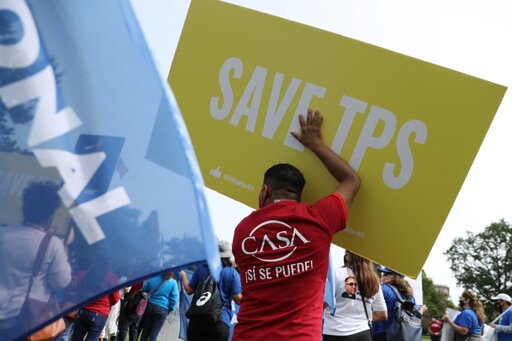
Some of its workers enjoy temporary protections under federal law. TPS allows non-citizens to live and work in the United States legally for up to 18 months, if they are coming from countries deemed unsafe due to political unrest or natural disasters. The protections, expanded under the Biden administration, apply to a large number of people from Haiti and Venezuela, and can be repeatedly renewed.
Under the Trump administration, hundreds of thousands of people were to lose those protections in August 2025, though the move was delayed after a court intervened. Officials now say protections will expire on Feb. 3, pending another legal challenge, where a judge is expected to rule by Feb. 2.
The end of TPS would upend the lives of thousands of Haitian immigrants who live and work in Delmarva chicken plants. It could also, as Evans indicated, create a major workforce challenge, and contribute to higher food prices.
Documents obtained by Civil Eats through a public records request show that the companies of Delmarva are bracing for the impact of Trump policies while quietly putting the issue in front of state agencies and elected officials, who are Democrats. The documents underscore the complicated nature of business and politics under the Trump administration’s sweeping changes to immigration. And while this is true for many companies, the public records provide a closer view of the TPS issue.
Mountaire, for example, has longstanding ties to Trump. According to a Vox analysis, Mountaire CEO Ronald Cameron has spent more than $75 million over the past decade helping Republicans get elected. That includes $4.7 million exclusively on Trump’s 2020 and 2024 campaigns.
Publicly, the companies have said very little. The industry group involved in the effort, the Delmarva Chicken Association (DCA), declined a request for an interview or to comment. A spokesperson for Mountaire declined an initial interview request and did not respond to further requests for comment. A spokesperson for Perdue referred Civil Eats to the National Chicken Council; a spokesperson there declined an interview and sent an emailed statement that said some poultry companies have utilized TPS but that the Council does not keep track of the number and that adapting to labor challenges is par for the course for the industry.
“I think they should definitely speak up,” said Rose Simon, who runs Love and Hope Rescue Mission in Delaware, providing food, mental health resources, and other services to community members, including poultry workers. “Those workers have really committed their time and their energy to their place of work for a very long time.”

Secretary of Homeland Security Kristi Noem has said that allowing Haitian nationals to remain temporarily in the United States is “contrary to the U.S. national interest.”(Photo credit: Michael M. Santiago/Getty Images)
The Human Cost of Immigration Policies
In December, the Department of Homeland Security (DHS) announced that 2.5 million immigrants have left the U.S. since Trump’s inauguration, either voluntarily or through deportation. While televised raids and city takeovers have received the most attention, the situation on the Delmarva is one example of the less visible impacts of the termination of programs that authorize immigrants to work in the U.S.
In addition to the end of TPS for up to 500,000 Haitians, protected status will also end for around 10,000 immigrants from South Sudan, Burma, and Ethiopia. Already, about 80 Haitians were laid off from a meatpacking plant in Minnesota when their legal status ended. At a plant in Iowa in July, JBS fired 200 immigrant employees last year after their legal status was revoked. In Illinois, hundreds of workers at a JBS meatpacking plant and a food distribution warehouse are losing their status.
This week, the Trump administration announced that TPS would end for about 2,400 Somalis on March 17.
TPS for about 600,000 Venezuelans ended in October. Since the Trump administration’s capture of Venezuelan president Nicolás Maduro, political leaders in Florida—and this week, members of Congress—have pushed the DHS to reverse the decision. Secretary of Homeland Security Kristi Noem has said there is no plan to do that. While she initially said Venezuelans in the U.S. who lost TPS could apply for refugee status, the DHS later said that is not the case. Many Venezuelans who had TPS worked in food service and agriculture.
“TPS has also allowed hundreds of thousands of people to work legally, often in industries that are already experiencing severe labor shortages,” Representative Pramila Jayapal (D-Washington) said during a December House Judiciary Committee subcommittee hearing devoted to TPS. “These are folks working in construction, hospitality, food processing, manufacturing—the kinds of jobs that keep our economy running and that many businesses are struggling to fill.”

Representative Pramila Jayapal (D-Washington) joins fellow Democratic members of the House of Representatives in June 2024 to voice opposition to President Joe Biden’s decision to temporarily close most of the U.S.-Mexico border to migrants seeking asylum. (Photo credit: Chip Somodevilla/Getty Images)
The Impact on the Poultry Industry
Industry leaders, meanwhile, have been worried about the outcome on their businesses since Trump’s inauguration.
Emails obtained through Civil Eats’ record request show Evans, at Mountaire, began voicing concerns about losing significant workers at the company after the Trump administration made changes to U.S. humanitarian programs in early 2025. In March, he attended an agriculture roundtable in Maryland hosted by Senator Angela Alsobrooks (D-Maryland), along with other Maryland Agriculture Commission members.
After the gathering, Maryland’s executive secretary for agriculture, Harrison Palmer, sent out an email to the group asking them to provide input to flesh out a thank-you letter and recap some of the priorities they’d discussed.
Evans responded by suggesting the group add more detail to a bullet point in the letter called “Ag workforce visa & temporary citizenship programs be protected.”
He suggested adding that the end of protected status and humanitarian parolee status “will disproportionately impact agricultural industries and rural communities. While these programs were never meant to be permanent, they also offer no pathway to citizenship or long-term status for those relying on them.”
A month later, the documents show, Evans was at a Delmarva Chicken Association board meeting. In an update to board members included with the meeting agenda, the association’s executive director, Holly Porter, described the potential impact of revoked statuses.
“The numbers show this will have an impact on 23 percent of Delmarva’s workforce within just the chicken companies between now and August 2025, with other programs possibly expiring in future years,” she said. “While chicken companies have individually been sharing information, DCA has also been strategically sharing this with key elected officials and agencies where possible.”
Meeting minutes show that the president of the board also brought up concerns about TPS during the meeting. During that discussion, Evans “emphasized that it would be a negative outcome if that led to fewer birds being raised to compensate for fewer processing employees,” according to the documents.
Barring another court decision halting the change in February, more industry disruptions are likely, with consumers bearing the cost. One analysis found that the loss of workers with TPS could cause food prices to increase 14.5 percent by 2028.
In the emailed statement sent in response to Civil Eats’ request, Tom Super, senior vice president of public affairs at the National Chicken Council, said the industry will adapt.
“Labor is a constant challenge for the poultry processing industry, and has been for decades,” he wrote. “Adapting and remaining strong in the face of challenging circumstances is what the poultry industry does, and it will remain a strong driver of the regional economies where we operate.”
The Future for Haitian Immigrants
Haitian immigrants will also need to adapt, though they have fewer resources and options. Haitians established communities in Maryland and Delaware decades ago, but populations grew significantly over the last few years as Biden-era policies allowed more immigrants to apply for TPS and other humanitarian programs. Many of the migrants found work in Delmarva poultry plants owned by Mountaire, Perdue, and other companies.
Simon, at Love and Hope, is Haitian, and she provides support for Haitians in her area. She estimates that about 75 percent of individuals who access her services work in the state’s poultry plants.
In December, she said both Mountaire and Perdue’s Delaware plants had already let go employees who were working under expiring legal statuses. Civil Eats could not confirm that assertion, as neither Mountaire nor Perdue responded to questions.
Nevertheless, Hope said that demand for her support services has been increasing.
“People are devastated,” she said. “They don’t have food, they don’t have the ability to provide for themselves, for their daily needs.” Many who have lost their jobs are now trying to figure out where to go, while some are hoping the end date for TPS would be changed once again, she said, because “they don’t have nowhere to go back to.”

A pregnant woman from Haiti rests near the U.S.-Mexico border wall after crossing with her family in 2021. Immigration from Haiti spiked in the U.S following a massive earthquake in 2010 and again during the Biden administration, which expanded humanitarian protections. (Photo by John Moore/Getty Images)
The U.S. State Department currently has a “do not travel” advisory in place for Haiti due to “kidnapping, crime, terrorist activity, civil unrest, and limited health care.” However, in the order ending TPS for Haitians, Noem said while the situation in Haiti was concerning, “permitting Haitian nationals to remain temporarily in the United States is contrary to the U.S. national interest.”
During the House hearing in December, Republican lawmakers and their witnesses argued that protected status should not have been granted to people who came into the country without legal status. “These aliens compete with Americans for housing, medical care, education, emergency services, law enforcement services, and other social services,” Representative Tom McClintock (R-California) said.
Advocates for workers disagreed. In fact, at the hearing, they said the end of protected status for people who fled dangerous conditions won’t necessarily persuade them to return—but it may drive many into the underground economy.
Jimmy Williams, general president of the International Union of Painters and Allied Trades, told lawmakers on the committee that many of the union’s members working under TPS have received years of training and are highly skilled workers in an industry facing major workforce shortages. Revoking their legal status to work, he said, could push immigrants into under-the-table work, where low wages undercut union labor.
“We run the risk of running one more million workers into that shadow economy, which has destroyed working conditions for our members and for working people here in the United States,” he said. “When you think about what this country is doing to TPS recipients by pulling the rug out while they are contributing to this society, it only will drive people further into the shadows.”
The post Poultry Companies Quietly Connect With Democrats on Immigrant Policy Concerns appeared first on Civil Eats.
From Civil Eats via This RSS Feed.