

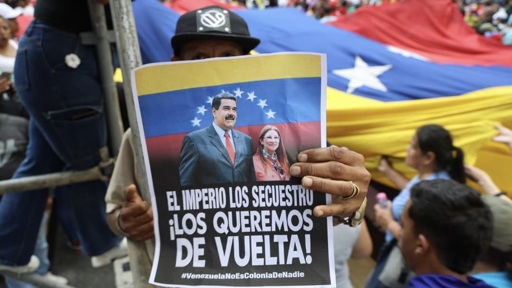
On January 3, 2026, beneath the cover of darkness, more than 150 US aircraft and elite Delta Force units struck Caracas, abducting President Nicolás Maduro and his wife, Cilia Flores. Having neutralized several key military and communications installations, US bombers then engaged in an act of psychological warfare as they targeted the Cuartel de la Montaña – the mausoleum of the former President, Hugo Chávez.
This brazen act of war follows months of illegal US strikes on Venezuelan and Colombian fishing boats, the imposition of a naval blockade, and the seizure of several oil tankers. Significantly, it is the most violent chapter in a 25-year imperialist campaign of collective punishment designed to crush Venezuela for daring to steer its own course against a tide of US influence.
Read more: “Venezuela will never again be a colony”: Maduro government denounces Trump’s oil blockade
Venezuela’s only crime: its independent path
In 1998 the Venezuelan people – in a rejection of the Washington consensus and the local caudillo oligarchy – elected Hugo Chávez as president and enthusiastically backed his Latin Americanist project of national, and regional rejuvenation.
This Bolivarian revolution was rooted in the peoples of the Global South and inspired by the proud history of the continent’s struggles for independence. It was also deeply entrenched in Venezuelan identity, and an unwavering commitment to social justice and a sovereign economic model that demonstrated that another world was possible.
Chávez understood that to break free from the shackles of a colonial economic model, Venezuela would need to control its natural resources – chiefly the largest oil reserves in the world. So, in 2001 the National Assembly enabled Chávez to enact the Organic Hydrocarbons Law, allowing Venezuela to (re)nationalize the state oil company and renegotiate commercial agreements in the public interest. Subsequently the Venezuelan Exchequer was able to increase social spending by USD 770 billion.
The era of ExxonMobil, Chevron and IMF plundering was over, for now.
The Bolivarian government’s decision to utilize oil revenues for healthcare, education, housing, and food was seen in Washington as a direct threat to US geopolitical and corporate interests. The crime was not corruption, mismanagement, or authoritarianism – but the exercise of Venezuelan self-determination.
Chávez’s social revolution was one thing, but what really vexed Washington was the regional impact of the Bolivarian example. Through initiatives like the Bolivarian Alternative for Latin America (ALBA) and Petrocaribe – the preferential oil agreement with Caribbean states – Chávez spearheaded a political and economic alternative to US hegemony.
These projects delivered affordable energy, social investment, and regional cooperation without IMF conditionality. They deepened ties between Caribbean and Latin American nations based on solidarity rather than subordination. They demonstrated that another way was possible – one that prioritized social need over corporate greed and exploitation.
For the US establishment, this was intolerable. A successful alternative in a single country is a threat, but a regional alternative? That is an existential challenge!
So as it was for Iran (1953), Guatemala (1954), Cuba (1961), Congo (1961), Brazil (1964), Indonesia (1965), Ghana (1966), Chile (1973), Grenada (1983), Panama (1989) and Iraq (2003) – when a Global South nation asserts control over its own resources, the US responds with the same colonial playbook: destabilization, economic strangulation, and the manufacture of a “crisis” to justify intervention.
Consequently, for more than two decades the US has played an insidious role in undermining Venezuelan popular democracy and has undoubtedly shaped the country’s internal politics.
US intelligence services have cultivated, funded, and actively promoted opposition figures willing to align with Washington’s imperialist agenda. Among the most prominent is María Corina Machado – a politician whose rise has been anything but organic, her ascent is not a story of grassroots mobilization, but of foreign engineering.
Machado’s organizations have benefitted from US funding since the early 2000s. Nurtured as a reliable instrument of regime change, Machado is now a polished figure designed to give a democratic veneer to a project of foreign intervention. Her recent elevation to international acclaim – including the awarding of the Nobel Peace Prize – only serves to underscore the colonial choreography at work.
However, Machado is unlikely to have allowed for Trump’s volatility. During his press conference announcing the kidnapping of Maduro, the US president insisted: “I think it would be very tough for her (Machado) to be leader. She doesn’t have the support or the respect within the country.” Instead, he insisted: “We’re (the US) in charge.”
“OUR hemisphere”
Undoubtedly then the attack on Venezuela is central to the US strategic ambition to reassert hemispheric control – an objective openly revived in Donald Trump’s 2025 National Security Strategy. “This is OUR hemisphere” the official US State Department’s X account proclaimed days after the kidnapping.
This so-called “Donroe Doctrine” is explicitly neo-colonial in its desire to restore US dominance by seizing Latin America’s strategic natural resources and establishing a US-centered supply chain that insulates the US military industrial complex from China’s growing technological superiority and control of rare earth minerals.
It has also unleashed US intelligence services throughout Latin America, with various human rights organizations and political analysts identifying increasing instances of US involvement in regional political crises, including the chaotic elections in Honduras, which saw Trump blatantly back an electoral coup d’etat.
The US President has since threatened to launch airstrikes in Mexico and military operations in Colombia, as he continues to openly threaten Nicaragua and Cuba at every opportunity.
Trump’s objective is obvious: restore Uncle Sam’s children in the strategic seats of power throughout the region, ensure they are obedient to the interests of Washington, and sell-off their public assets to Wall Street and “big oil” in Texas.
Seen through this wider strategic lens, Trump’s attack on Venezuela is part of a broader neo-colonial effort to reassert control over natural resources – particularly the global energy system – at a moment of intensifying geopolitical competition.
The same logic underpins the escalating pressure on Greenland, where Trump has appointed a Special Envoy tasked explicitly with “leading the charge” to secure the Arctic island’s vast mineral and energy reserves in the name of US national security.
Significantly, this framework also illuminates the growing threats directed at Iran. With access to Venezuelan heavy crude now secured, the US has reduced its exposure to disruptions in the Persian Gulf and reinforced its buffer against global supply shocks. That shift has now very visibly emboldened Washington, lowering the perceived risks of confrontation with Tehran and widening the scope for unilateral coercive pressure.
These developments have also increased Washington’s ability to influence global oil flows and pricing. Not only will this reinforce the central role of the US dollar in energy markets and help preserve the petrodollar system that underpins much of the US’s global financial dominance; it also enables Trump to tighten the squeeze on Cuba – given the Caribbean island’s heavy reliance on Venezuelan oil.
Countering hyper-imperialist hegemony
It’s clear to see then that for Trump, and the wider US imperialist apparatus, Venezuela is not simply a hemispheric issue; it is a strategic asset with the potential to shape the future of global energy markets, and the trajectory of geopolitical conflict far beyond Caracas.
So, this is not only a crisis for Venezuela, and Latin American sovereignty – but a direct challenge to the international system itself. The very primacy of international law – the core principle that sovereign states cannot be attacked or have their leaders removed by force – is now under open assault by Washington.
For anti-imperialist people everywhere, this moment of turmoil has nonetheless created a crucial opportunity to recalibrate; to reflect on the truth of that expression by Leon Trotsky, when he said every revolution from time to time needs to feel the whip of the counterrevolution.
For those of us adjacent to the imperial core, our role is clear: we must rally the people’s hearts and minds in this great era of chaos.
To do so we must continue to lead domestic opposition to this new phase of hyper-imperialist hegemony, counter the mass disinformation campaign of corporate media, and work with global partners in charting a new direction for human society rooted in international law, sovereign equality, and the collective voice of the Global South.
This means building a world where the Global South has real representation and real influence in global governance structures, not the marginal role assigned to them by Washington and its acolytes.
It means defending the principles of the UN Charter – sovereignty, non-intervention, peaceful coexistence – against the corrosive erosion caused by unilateral sanctions and extraterritorial coercion.
As the world faces fragmentation on many fronts, it also means championing civilizational equality. Trump’s desire to frame entire nations and people as enemies, failed states, and even an existential threat is fundamental to the deeper imperialist urge to legitimize domination.
So, we must reject the logic of the “clash of civilizations” and instead advocate mutual learning, cultural exchange, and respect amongst peoples. No nation has the right to impose its model on another; every society must be free to choose its own path, shaped by its own history and conditions.
Under the shadow of US colonialism in Caracas, these principles are not abstract. They are the basis of a global movement capable of resisting hegemony and building a genuinely multipolar world.
The struggle for democracy, sovereignty, and peace in Latin America – and throughout the Global South – depends on these principles.
Chris Hazzard is the MP for South Down in the North of Ireland with the Sinn Féin Party.
The post The empire strikes Caracas: a new age of US colonial violence appeared first on Peoples Dispatch.
From Peoples Dispatch via This RSS Feed.