

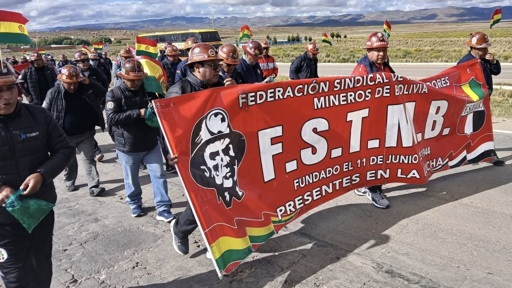
After several weeks of mass marches and road blockades, Bolivian workers succeeded in forcing the recently inaugurated neoliberal government of Rodrigo Paz to repeal the controversial Decree 5503, popularly known as the “gasolinazo,” which eliminated hydrocarbon subsidies in Bolivia. The measure promptly raised the prices of several products by as much as 162%.
Initially, after several attempts at dialogue, the Paz administration refused to back down on its decision, despite the clear social discontent it had caused. Subsequently, workers called for a “national revolution”, which aimed to radicalize the struggle on all fronts.
“We remain steadfast in our commitment to putting our house in order, to fixing the economy that was destroyed by those who governed in recent years… The future is at risk from those who want chaos. No one invests in a country that is blocked,” Paz had declared.
But, after observing how the protests grew with each passing day and seeking to avoid an uncontrollable scenario for his political project, Paz had to give in to popular demand and eliminate the so-called “Gasolinazo.”
The struggle wins new rights
But the victory of the Bolivian people goes beyond the reversal of the neoliberal measure, which had been demanded by the International Monetary Fund for decades. After instituting the gasolinazo, Paz had raised the minimum wage to 3,300 bolivianos (about USD 478), hoping that the popular response would not be so strong.
After several talks with the government, Bolivian workers from the Bolivian Workers’ Union (COB) managed to get the fuel subsidy cut reversed, and maintain the wage increase, which shows not only the strength of the workers’ organization, but also their skill in negotiations.
In addition, Paz promised that, from now on, the executive branch will no longer legislate unilaterally on labor issues, but will include social movements in its decisions.
The gains achieved through the workers’ struggle have transcended purely union issues. According to the COB, the government also agreed that, contrary to the intent of Decree 5503, it would not cede greater control of state natural resources to foreign companies.
Regarding the important victory of the Bolivian proletariat, Mario Argollo, Executive Secretary of the COB, said: “We have fulfilled our duty to all the people who are mobilizing. [The people] should feel happy, because their struggle has not been in vain. Their struggle has yielded wonderful results! The country will thank them in the future.”
In this regard, the COB announced that it was lifting its call for blockades and mobilizations in Bolivia, which had persisted despite a massive media campaign waged against the unions by the executive branch and economic elites.
This was announced by Argollo alongside other social leaders who participated in the struggle, such as teachers, students, Indigenous people, and others: “Following the signing with the government, the pressure measures that had been put in place throughout the country [are suspended]. We are grateful for the participation of all our comrades who have been on the picket lines in the streets, on strike, in the rain, in the hail, who have mobilized during vacations, on New Year’s Day, at Christmas. There has been practically no rest, but these are the results! Let us remember that in unity we can achieve anything. When we are united, no one can subdue us!”
Despite lifting of the measures, the COB has announced that it will remain in a state of emergency to ensure that the agreements are fulfilled and that the government does not attempt to reapply these types of measures.
The post “When we are united, no one can defeat us!”: Bolivian workers defeat gasolinazo and win new rights appeared first on Peoples Dispatch.
From Peoples Dispatch via This RSS Feed.