

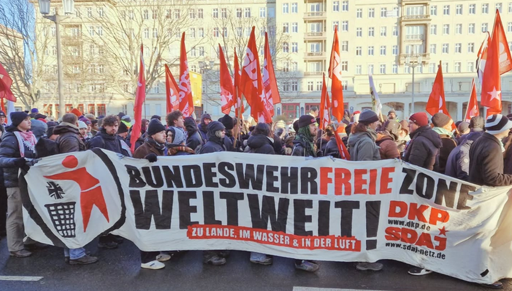
The 31st Rosa Luxemburg Conference took place in Berlin on January 10 amid extensive preparations for war and armament pursued by the conservative government of Chancellor Friedrich Merz. Thousands of participants gathered to challenge this militarization agenda, with trade unionists, youth associations, media organizations, and left-wing parties offering a sharp critique of the current moment.
Among the speakers were UN Special Rapporteur Francesca Albanese, trade unionist Cinzia Della Porta of the Unione Sindacale di Base (USB), Robert Saleem Holbrook of the US-based Abolitionist Law Center, and media workers from Canal Red. But while the conference maintained a strong internationalist character – with participants from around the world stressing solidarity with Palestine, Venezuela, and Cuba – a significant portion of the program focused on developments within Germany itself.
Read more: Germany and the EU embrace military Keynesianism
As economist Jörg Goldberg noted, the German government, like others across the Global North, is responding to threats to Western dominance by pursuing an increasingly aggressive and militarized strategy, one that comes at the expense of social security and labor rights. The consequences of this policy line are already being felt by the working class, with growing awareness of the dangers involved in certain parts of the population. Notably, students and young people have recently emerged at the forefront of resistance to the war agenda, driven at least in part by the government’s plans to reintroduce military conscription.
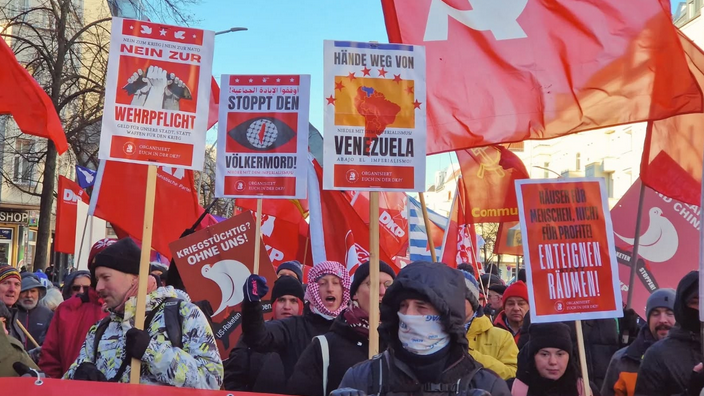
A youth panel at the conference examined how Germany’s political establishment is pressuring young people into the armed forces not only through direct reforms, but also through policies that attack livelihoods. The situation imposed onto young workers and students today amounts to “economic blackmail” for those without wealthy families to support them, argued Max Radtke of the trade union ver.di. For this reason, Selina Pfister, another panelist, emphasized that opposing conscription must go hand in hand with improving overall living conditions – an issue she suggested should be among the priorities of progressive parliamentary forces.
Source: DKP Berlin/Facebook
The reintroduction of conscription should be understood as a question of class interests, added David Christner of Junge Linke (Young Left). He emphasized the need for a sharper analysis of “who is being sent to kill and die, and for whose interests,” saying that the political imperative at this point is to develop a “practical alternative to repression and militarization.”
The discussion included representatives from a wide range of organizations, including the Socialist German Workers Youth (SDAJ), Linksjugend, and student groups that organized a successful strike against conscription in December 2025. The same student coalition also announced further actions in the coming months, including mass demonstrations and new strikes planned for March.
Read more: Students on strike against military service: “You’re not a coward if you don’t want to die for Germany!”
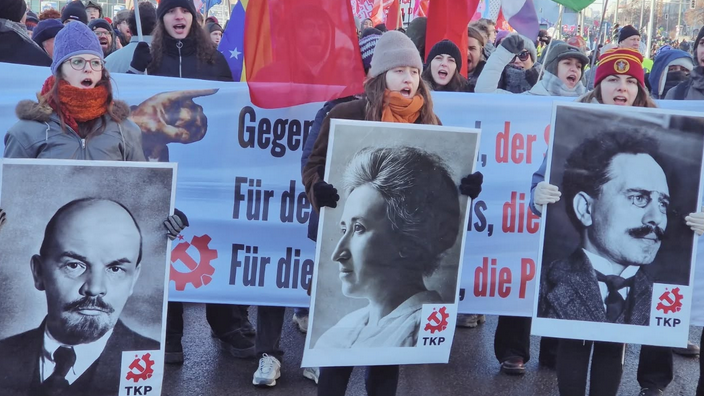
Although youth anti-militarism featured prominently throughout the conference, the program also addressed other issues. In a panel with representatives from the Social Democratic Party (SPD), Die Linke, the Communist Party of Germany (DKP), and the associations DIDF and VdÄÄ, Daniel Bratanovic of the newspaper junge Welt discussed the importance of a consistent and uncompromising pro-peace position within progressive political parties. Such a stance, however, has been largely amiss in recent times, many of the activists present at the conference thought.
“The SPD remains in coalition with the conservative CDU, which is driving Germany’s transition to a wartime economy based on weapons production,” activists from the Zetkin Forum for Social Research told Peoples Dispatch. “The few anti-militarist voices remaining in the party are isolated and unable to influence the leadership.” They noted that representatives of Die Linke had also failed to use their recent electoral gains to resist the war drive in parliament. In contrast, Tatjana Sambale, a nurse, trade unionist, and member of the DKP, “advocated for sharp condemnation of NATO as the true aggressors and more assertive strategies within the unions to uncover the link between military spending, social cuts, and wage losses.”
Source: DKP Berlin/Facebook
The themes raised at the conference were carried into the streets the following day, when approximately 10,000 people marked the approaching anniversary of the murders of Rosa Luxemburg and Karl Liebknecht with a march to their graves. According to Junge Welt, young people again made up a significant share of participants, signaling a determination to sustain opposition to militarization and strengthening of far-right forces in Germany.
The post Rosa Luxemburg Conference 2026 proposes alternatives to Germany’s war path appeared first on Peoples Dispatch.
From Peoples Dispatch via This RSS Feed.