

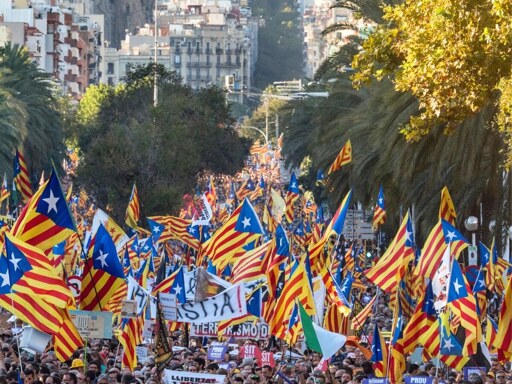

The state of Spain is not formed by one nation, but by several nations. These are Castile (the former Crown of Castile), Euskadi, Galicia and the Catalan Countries (the former Catalan-Aragonese Crown, where Catalan is spoken).
But Castile (with its capital in Madrid) has never wanted it to be a state that benefits everyone; instead, it has regarded the other nations as conquered colonies to be plundered, just as it did in the Americas, Equatorial Guinea, Western Sahara and the Philippines.
For Spain, the distinct identity of these other nations is not a richness for the country but is seen as a danger; that is why it always denies them and tries to diminish them. But, since the old Catalan-Aragonese Crown was one of the great nations of the Mediterranean, Catalonia’s will to free itself from Spain and recover its sovereignty has always been present throughout history and will continue until it succeeds.
Spain suppresses Catalan independence
That is why in 2017 Catalonia organised an independence referendum and Spain did not hesitate to suppress it with 10,000 police officers, with images that went around the world.
Afterwards the ‘deep state’, through the judiciary, took care of the revenge against the Catalan politicians. The Supreme Court twisted the law to sentence them to a hundred years in prison, despite the fact that there was no violence at the referendum and every option was considered, both leaving Spain and staying.
But at the time, the entire political spectrum (including the PSOE) was fine with it because it was an attempt to destroy the Catalan independence movement.
When the right-wing PP government fell, it was replaced by Sánchez’s PSOE, which continued the policy of denying all rights to Catalan separatists. But then a severe condemnation by the Council of Europe forced Sánchez to grant pardons to the Catalan political prisoners so they could be released from prison.
And, in the next parliamentary term, Sánchez’s eagerness to govern, given the arithmetic of the chamber, forced him to strike a deal with the Catalan separatists, who demanded an amnesty law that would place the political issue at the heart of the debate, remove the disqualifications of the pardoned Catalan politicians and prevent Catalan activists from going to prison.
The independence supporters themselves distrusted such a law because, although it was necessary on a judicial level, it could allow Spain to appear conciliatory and hide its true repressive nature, and the PSOE had always opposed an amnesty law, only pushing it as a tactical measure, knowing that the judges would later have to interpret the law and that, given their ultra-Spanish nationalist profile, it would not go very far.
The amnesty prevented more activists from going to prison, but it neither removed the politicians’ disqualifications, nor did it allow for a debate on self-determination.
‘Deep state’ revenge
But simply for having thwarted the Supreme Court’s revenge, the ‘deep state’ could not stomach this move by the PSOE and expelled it from the ‘constitutional consensus’ designed to prevent nations from seceding. For this reason, the police, the judiciary and the press began a judicial harassment of Sánchez as an ‘enemy of Spain’, just as they had done with the Catalan separatists.
The Spanish judiciary has organised a campaign of prospective (illegal) police investigations aimed at incriminating president Sánchez’s circle in any possible offence.
Thus, they have finally indicted Sánchez’s wife and brother, are trying three of Sánchez’s trusted men (Ábalos, Cerdán and Koldo) on corruption charges, and have uncovered several cases of sexual harassment by PSOE politicians and, above all, an unprecedented event: the Supreme Court has convicted the Attorney General appointed by the PSOE, Álvaro García Ortiz, to two years’ disqualification and fines for allegedly leaking to the press the defence strategy of an accused close to the PP, which proved he had committed the crime.
Although leaking information of this nature to the press is not legal, there are constant leaks to the press from the judiciary in Spain and they have never been investigated. Moreover, it has not been proven that it was the Attorney General who did it.
It is also relevant that, despite the usual slowness of the Spanish justice system, this case was tried at breakneck speed and, on 20 November (precisely the anniversary of the death of the dictator Franco), the judges themselves communicated the contents of the sentence to the press before it had even been drafted!
Political decomposition
Spain is suffering a political decomposition that places it on an unstoppable downward slope, with a runaway judiciary which, rather than being dependent on political parties, acts with its own political agenda and goes far beyond them.
And this monster that was spawned by attacking Basques and Catalans now threatens to devour Sánchez, with no qualms about twisting the facts to use the law as a political weapon (‘lawfare’).
This Spain, a prison of nations, needs a judicial, police, political, economic and media apparatus that uses violence to prevent any rethinking of the State, and this inevitably ends up corroding any possibility of democracy.
Spain could only become truly democratic if it accepted the right to self-determination of the nations that make it up, but that is an impossibility because it would contradict the very nature with which Spain was conceived.
Possibly in 2026 the PSOE government will fall and the far-right PP will return, hand in hand with the hard-right VOX. This prospect only further strengthens the Catalan desire to regain sovereignty and, the next time Spain is challenged, we must not wait for the EU to bless Catalonia’s independence, but rather sustain the non-violent struggle to the end, until we achieve becoming an independent state once more.
Featured image via Wikimedia CC by SA 2.0
.jpg)
From Canary via This RSS Feed.