

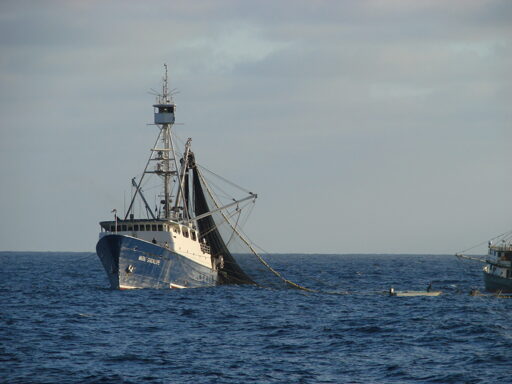
Marine heat waves have become longer and more frequent along the U.S. West Coast, as elsewhere in the world. But heating doesn’t always lead fish to change their location. A new study suggests a better way to tell if such ecological shifts are happening: Use fishing vessel tracking data. The study, published Dec. 22, 2025, in the journal Proceedings of the National Academy of Sciences, found that tracking data could provide early detection of extreme northward and inshore shifts in albacore tuna (Thunnus alalunga) and Pacific bluefin tuna (T. orientalis) distribution in response to heat waves. The data also showed when such shifts weren’t happening, despite high sea surface temperatures. Related data also showed when there was low albacore availability for fishing. The study indicates that tracking data can in some cases be used as an early-warning signal for ecological change in the ocean, the authors suggest. “We have so much data on fishing vessel activity,” study lead author Heather Welch, a marine spatial ecologist at the University of California, Santa Cruz, said in a statement. “These data are traditionally used for surveillance, and it is exciting that they may also be useful for understanding ecosystem health.” Map shows total fishing effort, in hours, for albacore at different locations off the U.S. West Coast from 2010-2024. Annual average locations are overlaid as white points, with two years labeled (2015 and 2017). The 2015 average location indicates a distribution shift by albacore in response to a devastating marine heat wave known…This article was originally published on Mongabay
From Conservation news via This RSS Feed.