

This article and photos by Axel Hernández originally appeared in the January 5, 2026 edition of Desinformémonos.
In rejection of the 2026 FIFA World Cup and US military intervention in Venezuela, neighborhood organizations defending their territory called for a graphic protest near Azteca Stadium, which will be the opening venue for this sporting event that is intensifying the struggles that the towns and neighborhoods of the Pedregales area south of Mexico City have waged for years.
Drinking water shortages and real estate speculation and development in the area are the main concerns of the residents of Santa Úrsula Coapa, who have taken the lead in the organizational effort promoted in response to the need to strengthen their struggle against the arrival of the FIFA World Cup, a sporting event that will be celebrated by Mexico, the United States and Canada, and which has come to exacerbate processes of dispossession in this, one of the six original towns of the Coyoacán borough.
“We are carrying out acts of resistance by holding assemblies in public spaces, trying to occupy this space as if it were part of our identity, and trying to reclaim it from FIFA in this way, by holding assemblies, activities, and meeting every week to demonstrate that there is a dispossession by FIFA and by the Mexico City government,” said Natalia Lara, a member of the Tlalpan and Coyoacán Neighborhood Assembly, in an interview with Desinformémonos from the underpass near the Azteca Stadium, which in recent weeks has been the meeting point for graphic interventions, a posada (a traditional Mexican Christmas celebration) against gentrification, and now for two assemblies.
“The World Cup is going to magnify gentrification in Mexico City and in general at the national level,” Natalia emphasizes, and continues sharing her assessment of these meetings they have held with neighborhood organizations and collectives, “there are many activities around how to make visible and denounce the planning of the territory, around how life is being commodified, how the identity of native peoples is being lost and how certain spaces are being commodified and touristified.”
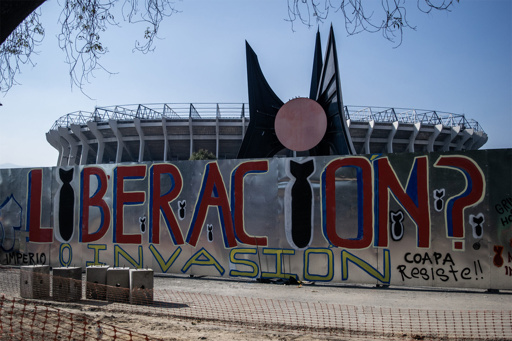
In response to the attack perpetrated by the United States against Venezuela, this second assembly was accompanied by a call for an artistic protest on the walls surrounding the venue that for decades has been popularly known as the Colossus of Santa Úrsula.
Regarding this and other artistic interventions in public spaces that have been taking place in the area, Desinformémonos spoke with Vlocke Negro, one of the artists who has participated in these actions over the past few weeks: “It has been a process in which our interventions have been censored, and we have been returning to do the graffiti again. This time we have this emergency here in Latin America where we see the United States invading another country.”

In response to the United States’ attack on Venezuela, residents of southern Mexico City left an anti-imperialist message near Azteca Stadium, the opening venue for the 2026 World Cup.
The word Liberation, between question marks and with the two i’s replaced by drawings of missiles, was part of the message that was displayed on metal sheets placed in a parking lot of the Azteca Stadium, on the Calzada de Tlalpan.
Vlocke Negro emphasized the visibility of the space and the intention of this action: “We are doing this graffiti to draw attention to this issue. This is a place where many people pass by and where many people have already read the message and you can hear that people know about the issue because it is something that is happening in the news, so the intention is always to reach people with a reflection, with a questioning and that they themselves come to a conclusion.”
The 2026 World Cup: Fuel to Reignite Old Conflicts South of Mexico City
The effects of the World Cup are already beginning to impact the daily lives of its residents. This is the case for Mr. Enrique Zarazúa, a shoeshiner who has worked on Calzada de Tlalpan, near the stadium, for the last 25 of his nearly 80 years of life. The construction around the sports complex has reached the area where he and about a dozen other vendors set up their stalls daily, in the busy bus stop near the Estadio Azteca Light Rail station.
Mr. Enrique recounts that last Thursday, the concrete on the sidewalk where he works was lifted and some stones were placed on his shoe-cleaning cart. Some time ago, officials from the Coyoacán mayor’s office came to inform him that they would be temporarily relocated but that they would be notified in advance; however, that did not happen.

Enrique Zarazúa, a shoeshiner displaced from his work area due to remodeling work around the Azteca Stadium
The construction, which began a month and a half ago according to Mr. Zarazúa, has left people who sold products and food in that pedestrian corridor without income. He explained: “Many aren’t working. How will their children eat if they have nowhere to work? That’s the hardest part for those of us who live next to Azteca Stadium; it’s affecting people.”
The eviction of vendors is just one of the many problems that have arisen with the upcoming World Cup. For this reason, the Residents’ Assembly of Tlalpan and Coyoacán, the two boroughs near the stadium where the opening match will be held, has called for the formation of a broad organization to address these conflicts.

Repaving works and a controversial bike lane have affected the bus stop at Azteca Stadium, on Calzada de Tlalpan.
Following the first assembly against the imposition of the World Cup, held on December 21st under the overpass, the participating organizations and groups agreed to focus on several key areas. The first of these addresses actions aimed at protecting the environment, with particular emphasis on issues related to water supply—one of the main conflicts in Santa Úrsula Coapa and surrounding neighborhoods—as well as ensuring good air quality and waste management.
A second focus is on territorial planning, on which they have firmly rejected government policies in this area, denouncing that the infrastructure works being carried out in the area, such as the construction of the bike path on Calzada de Tlalpan and the drainage, repaving and lighting works, in addition to not being consulted with the inhabitants of these neighborhoods, are focused on promoting the touristification of communities that do not have the necessary conditions to receive mass tourism.

A third focus of this assembly’s work will address the fight against the constant evictions in the capital, with the right to the city being one of the banners of this collective work.
The expropriation of a water well, located across from the stadium and leased to the Televisa company, and the call to boycott the 2026 World Cup, are among the other objectives stemming from this assembly. This boycott is echoed in various media reports and by calls on social media users for FIFA, the organization that runs the tournament, to suspend the United States as host of the competition as punishment for the attack that led to the kidnapping of Venezuelan President Nicolás Maduro.

Bombs in Venezuela, solidarity in Santa Úrsula Coapa
-

CDMX Neighbourhood Organizations Call for World Cup Boycott After US Attack on Venezuela
January 13, 2026
Hyper-charged gentrification, dispossession and social cleansing are intensifying neighbourhood resistance near Azteca Stadium, the opening venue for the FIFA sporting event.
-

Four People Arrested In Guadalajara Fare Hike Protest Released
January 13, 2026January 13, 2026
More than a thousand people protested to demand that the Governor of Jalisco reverse his decision to increase public transport fares.
-

People’s Mañanera January 13
January 13, 2026January 13, 2026
President Sheinbaum’s daily press conference, with comments on Mexican sovereignty, recovering public healthcare, re-socializing fertilizer production, cell-phone registration, audience rights, and Artificial Intelligence legislation.
The post CDMX Neighbourhood Organizations Call for World Cup Boycott After US Attack on Venezuela appeared first on Mexico Solidarity Media.
From Mexico Solidarity Media via This RSS Feed.