

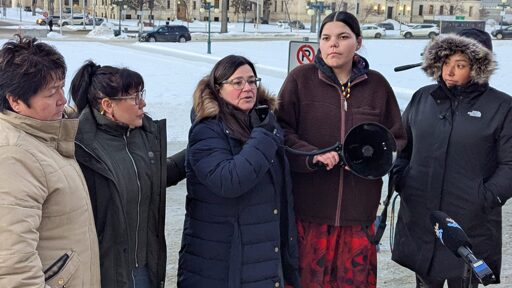

(Left to right) Councillor Shirley Robinson, Winnipeg Centre MP Leah Gazan, Judy Saunders-McKay, Paige Paupanekis and Manitoba Grand Chief Kyra Wilson at a round dance at the Manitoba Legislature on Thursday, Jan. 8. Photo by Crystal Greene
Paige Paupanekis, a Pimicikamak Cree Nation member and community volunteer, has been working non-stop since a power outage happened in her community over the holidays.
One of the 21-year-old’s first tasks was rounding up pizza donations to send to her Cree community — located about 530 kilometres north of “Winnipeg” — to feed people.
It was during frigid -20 C temperatures on Dec. 28 that a Manitoba Hydro powerline broke, along a 300-metre crossing between two islands on the Nelson River.
It caused a power outage that lasted four days, until electricity was restored.
But the outage caused lasting infrastructure damage, such as frozen pipes, backed up sewers, and other problems.
On Thursday, about 70 people gathered to drum and round-dance outside the Manitoba Legislature to raise awareness and demonstrate solidarity with Pimicikamak.
“A young leader from Brokenhead Ojibway Nation has stood with us and organized this round dance to call up for prayers and support,” Paupanekis said.
“We’re gonna pray for our people and to stand together in a good way and show that they’re not alone.”

Paige Paupanekis speaks at the Manitoba Legislature on Jan. 8. Photo by Crystal Greene
Kyra Wilson, grand chief of the Assembly of Manitoba Chiefs, told rally participants that First Nations people are “always having to wait for government to make a decision on how much our lives matter.”
She said that part of the problem is that funding and resources for First Nations emergency management fall under the control of federal and provincial governments.
“None of that comes to our First Nations leadership,” Wilson said.
On Friday, federal Minister of Emergency Management and Community Resilience Eleanor Olszewski announced a specialized military team would be deployed to the First Nation to provide “targeted assessment and advisory support.”
The military team began arriving in “Manitoba” on Sunday, according to the nation’s chief.
In a statement, Wilson thanked the government for intervening — but added that the infrastructure failure was preventable.
“When a First Nation needs military assistance just to restore basic living conditions, it points to a system that failed to invest early and responsibly,” she said.
“We appreciate the work being done on the ground right now … but emergency deployments cannot become the standing response to chronic infrastructure gaps in northern First Nations.”
Now, the power outage has led to a public health crisis, according to community leaders. Licensed nurse and band councillor Brenda Frogg has been raising the alarm over water-borne illnesses.
“We’re seeing a lot of gastroenteritis, nausea, vomiting, diarrhea in the clinic,” Frogg said in a video posted to Facebook.
“It’s becoming a major concern, especially now when the sewers are backing up into the houses.”
‘We’ve been pleading for years’
After the power line broke, Pimicikamak Elders and families with children were evacuated; but some residents stayed in their homes without heat and power. Generators kept the lights and wifi on for those who were able to stay in Pimicikamak.
One of those was Carleen Muswagon, a mother of eight, whose home was spared from damage after the power outage.
She said growing up with her late grandparents — at times without electricity — prepared her for this moment.
When last month’s power outage started, she recalled, she’d been walking her sister’s dog, and getting her children ready for bed.
She believes “neglect” is to blame for the failure of the hydro mainline, which she added was in desperate need of replacement.
“We’ve been pleading for years,” she said, adding the powerlines running through town are more than 40 years old.
“They’re really old. We need a whole upgrade for everything.”
The power outage had a ripple effect on the community’s already crumbling infrastructure. Almost all of the more-than 1,300 homes on the reserve are now in need of repair, according to Pimicikamak Chief David Monias.
The outage was the third time in recent months that members of the community have been forced to flee.
There were two earlier evacuations last spring and summer as wildfires ripped through northern Manitoba — impacting many First Nations including Pimicikamak.
This time, more than 4,000 Pimicikamak residents were displaced. There are about 7,000 residents total, nearly 95 per cent of whom are registered band members.
Chief Monias urged community members to stay where they are, in cities they evacuated to, such as “Winnipeg” and “Thompson.” Monias said community infrastructure needs to be repaired before people can return home.
“We’re trying to move as fast as we can,” Monias said, adding technicians have been putting in up to 16 hour days. A water plant technician had to work overtime to keep the water treatment facility operating throughout the power outage, he said — including by using tape and plumber’s glue.
In the case of one houses on the reserve, on Jan. 5 a crew started thawing out its water tank. But it took three days for the ice to melt enough to allow them to actually start repairs.
Todd McConnell, a plumber who has traveled three hours each day to and from Pimicikamak, joined Monias on a Facebook live video.
“Once the holding tanks are unthawed and we can get water in, we’ve got to test the lines inside the house,” McConnell said. “A lot of them have been frozen, compromised.
“We find splits everywhere, in almost everyone’s home, that have been compromised — their toilets are frozen, unflushable (and) sink taps are burst.”
On Sunday, Monias announced that the community will set up a temporary water treatment plant.
‘What’s five bucks gonna do this year?’

Shirley Robinson, Paige Paupanekis, Leah Gazan and Kyra Wilson at the Manitoba Legislature on Jan. 8. Photo by Crystal Greene
Band member Muswagon shared with IndigiNews the impacts that hydro development and residential “schools” had on her community, and her own wellbeing — including people grappling with poverty and a housing shortage.
“Canada” and “Manitoba” signed the Northern Flood Agreement in 1977.
The deal promised to take care of Indigenous communities who sacrificed their pristine waters and lands to flooding for hydroelectric dams — so southern “Manitobans” could live comfortably with electricity to light and heat their homes.
“These people that came here when they ‘discovered’ our land, they promised us something — they still never fulfilled that promise,” she said.
Each year, First Nations members included under Treaty 5 receive a $5 annuity payment, a stipulation made when the treaty was signed in 1895-96.
“What’s five bucks gonna do this year?” asked Muswagon, who started laughing during her phone interview. “Five bucks isn’t gonna work … It should be $5,000 now a year.”
If the $5 annuity wasn’t small enough, now the nations who lost their ancestral waters to hydro dams have to buy bottled water to drink.
“A case of water is $30 in Cross Lake,” Muswagon said. “How are we now buying back our own water?”
Pimicikamak councillor Shirley Robinson, who has been co-ordinating and supporting evacuees based in Winnipeg, said people need assistance as soon as possible.
Those who stayed in Pimicikamak have been relying entirely on bottled water, she explained.
“Our people are still struggling without water,” said Robinson. “Our people are displaced, they’re lonely, our Elders are crying, they miss home … We want to be back as a community; we want to be back as one.”
Judy Saunders-McKay, a school teacher from Pimicikamak who taught in the community for ten years, became emotional as she spoke at Thursday’s round dance.
“They’re real people, they need help,” she said. “It’s not OK when you’re watching the news and you see somebody that you know — and their children are cold, and they’re hungry, and they’re going without.”
Saunders-McKay said she’s had to avoid social media after reading comments there blaming the community members for their misfortune — remarks that residents “should have been ready for this” or “should get wood stoves for next time,” she recounted. She said she had to get off social media because of people’s comments.
“Do they actually know what’s going on up there, and what the limited resources and conditions that they live in?,” asked Hunter Martens, 19, the grandchild of Monias.

Hunter Martens holds up a sign at the Manitoba Legislature during a round dance on Jan. 8. Photo by Crystal Greene
The post Pimicikamak faces long road to repair after havoc-wreaking power outage appeared first on Indiginews.
From Indiginews via This RSS Feed.