

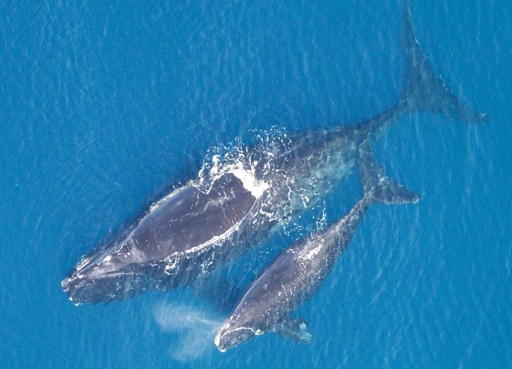
Founder’s Briefs: An occasional series where Mongabay founder Rhett Ayers Butler shares analysis, perspectives and story summaries. Scientists monitoring North Atlantic right whales have recorded an increase in births this winter. Fifteen calves have been identified so far, an encouraging figure for a population that has struggled to sustain itself. There were an estimated 384 North Atlantic right whales (Eubalaena glacialis) by the end of 2024, according to the North Atlantic Right Whale Consortium. That figure is up from its low point earlier in the decade. Since 2020, the whale’s population has grown by just over 7% from 358 individuals. Scientists identified some first-time mothers entering the breeding pool during the 2025-2026 calving season. They also noted that some females are calving at shorter intervals. These are the kinds of details biologists track when assessing whether recovery is possible. In a small population, every birth matters. But the arithmetic is unforgiving. The U.S. National Oceanic and Atmospheric Administration (NOAA) Fisheries estimates that something like 50 calves a year, sustained over many years, would be needed to put the species on a clear path to recovery. That is well beyond what is plausible, given how few reproductive females remain. Right whales can live for more than a century. In the modern North Atlantic, many do not. Their median lifespan is measured in decades, not because of biology, but because of ropes and steel. The threats to the whale are familiar and well-documented: entanglement in fishing gear, collisions with large vessels, and…This article was originally published on Mongabay
From Conservation news via This RSS Feed.