


Addison LenhartICT
When he first attended the University of Illinois Chicago in the early 2000s, George Ironstrack, a citizen of the Miami tribe of Oklahoma (Myaamia), was vaguely aware of the sport of lacrosse.
Ironstrack was pursuing a degree to become a history teacher and had just recently met Daryl Baldwin, the current executive director of the Myaamia Center, the research hub of the Tribe.
“He was teaching language classes and I got really interested in learning my language,” Ironstrack said. “He really saw it as important to use the language in the context of various things that are innately Myaamia in their culture.”
After learning more from Baldwin, Ironstrack began researching other games played by the Myaamia people.
“I came across old accounts of Myaamia people playing peekitahaminki or what folks call lacrosse in English,” Ironstrack said. “So I sought out people to teach me the basics of the game where I went to university, and learned to play kind of the more standard game.”
Ironstrack brought what he learned back to the Myaamia community, and began to educate other tribal citizens.
“Lacrosse kind of gave me a place to kind of push my Myaamia identity,” Ironstrack said. “It was a place to figure out how to use language in that game to reshape what folks called lacrosse in English, into peekitahaminki, a community game that could be played in educational settings.”
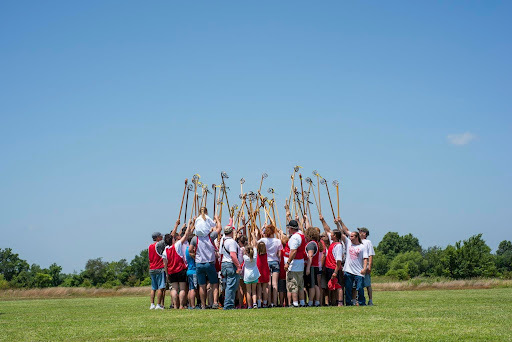
The sports’ impact on Ironstrack was clear and he recognized its potential to enhance language learning within the community. Today, it’s played at nearly every community gathering, but it’s the subtle differences from the common game that make this possible.
“We tend not to play with a lacrosse goal made out of metal pipes with a net,” Ironstrack said. “We typically play with a wooden or plastic pole, and the goal is to hit that pole with a lacrosse ball and that’s how you score.”
These differences also allow for larger scale participation, making it more conducive to a community atmosphere.
“There’s a structure but it’s less evident and less positional, so we don’t have any assigned goalies or defenseman,” Ironstrack said. “You just have as many people as you want to play on the field, of all different ages and genders. Some people might play more defensively or offensively, but the game is much more free flowing.”
Peekitahaminki has served as an exciting athletic activity within the Myaamia community, but it’s also become a key tool for youth development in the tribe as well.
“I’ve seen especially for youth who haven’t grown up in the tribe, they’re looking for some kind of beginning point to connect to,” Ironstrack said. “They grew up in a place where ‘more standard’ lacrosse is played, and that gives them a connection that they can kind of obsess about a little bit.”
Not only have newer tribal members benefitted from the revitalization of peekitahaminki, Ironstrack also noted the positives he’s seen in members who grew up in the Myaamia tribe.
“It gives them a very strong community connection point, they know they can go to Myaamia lacrosse games, there’s going to be maybe a dance afterwards,” Ironstrack said. “They really see peekitahaminki as a place to connect with other Myaamia people.”
The social benefits of peekitahaminki are substantial, including that it is also an activity played intently using the traditional Myaamia language.
“Before we start every round of play, we’re asking everyone a series of questions in the language,” Ironstrack said. “In gameplay there’s a series of commands we use regularly. The most common one is ‘miililo’, which just means give me the ball. There’s a lot of communication that occurs in the game.”
The use of the Myaamia language in peekitahaminki has been a major component in tribal members’ ability to communicate with the language. Jarrid Baldwin, son of Daryl and a citizen of the tribe, is one of the people who grew up surrounded and immersed in the Myaamia culture.
Baldwin, who’s worked in the tribe as a language instructor, has seen the impact peekitahaminki has had on young people in the tribe and their connection to language.
“We’ve got a bunch of young college students who want to get out there and hit each other,” Baldwin said. “You’re gonna have younger people out on the field like me, who are already using a lot of language and the language just kind of fits naturally with the game because it came from us. When you have an activity that people are interested in and start playing it more, they’re naturally going to grow in those other fields as well.”
This growth is apparent when watching gatherings unfold. Each participant is enthusiastically engaged in the play on the field, but also seemingly feels a level of comfort using the language, something that isn’t always present elsewhere according to Ironstrack.
“If you’re a young adult or even an older adult, people have a lot of language, and they’re scared to use language,” Ironstrack said. “Peekitahaminki is like having a safe place to use language, a lot of the fear disappears and folks are just more willing to use language in that context.”
Because of the impact of peekitahaminki, it’s become crucial to the bigger picture revitalization efforts of the tribe.
“It’s visually evocative,” Ironstrack said. “For those in our community who are disconnected, when they get the newspaper or the social media posts, they can see the vibrancy and the intense love and joy and community that comes from these games. Symbolically it represents revitalization in a lot of ways.”
While the revitalization of peekitahaminki within the tribe has been rapid, the movement received a huge boost in 2015.
Prior to this time, peekitahaminki had been played mostly with modern sticks and equipment. Ironstrack traveled to the Menominee reservation to meet with Joey Awonohopay, a tribal chairman in the Menominee tribe.
It was there where Ironstrack learned the process of constructing “Great Lakes” style wooden lacrosse sticks. Ironstrack, like he had done roughly 15 years prior, brought back what he learned to the community and jumpstarted another huge cultural push in the tribe.

Myaamia lacrosse stick made by Myaamia youth at the Eemamwiciki Summer Programs, 2022. (Photo by Jonathan Fox, Myaamia Center)
“Once we made the switch it happened quickly,” Baldwin said. “We typically exclusively play with traditional sticks and include the rule switches and things like that. Switching at the community level happened fast.”
Enter Doug Peconge. Peconge, a citizen of the tribe, became curious of the stick-making process upon Ironstrack’s return.
“I just started working for the community, and was at the youth camps that first year when they started to figure out how to do it,” Peconge said. “I really became fascinated with it.”
Constructing a great lakes stick is a detailed and tedious process. While initially constructing sticks, Peconge and other tribal citizens realized the traditional method of cutting a tree down and producing sticks that way, wouldn’t be sustainable in Indiana or Oklahoma.
“We had to figure out a different way of doing it,” Peconge said. “We had a community member whose husband figured out how to do it by going to the lumber yard. That’s really what has made it possible for us to play the game in a more historical and traditional way.”
Though Peconge was a novice when he began his stick-making journey, his production has improved over time.
“I could take a board that’s six inches wide, which would give me six lacrosse sticks,” Peconge said. “I can have them steamed and bent in about two hours, and then the next day, I can finish it in about an hour. With cutting a tree down, just making one stick could take a couple days.”
Not only has playing peekitahaminki served as a connection point for Myaamia youth, the stick-making process has also been beneficial in capturing the attention of young tribal members.
“Our young folks come and have that interest in making lacrosse sticks,” Peconge said. “Providing that opportunity for them, I definitely see them as being more engaged culturally once they’ve gone through that process.”
Peconge’s dedication to lacrosse stick making opened numerous doors for the tribe and allowed him to embark on more important, larger scale projects.

Akima ‘Chief’ Doug Lankford and Doug Peconge work on a Myaamia lacrosse stick together at a workshop led by Doug, 2019. (Photo by Jonathan Fox, Myaamia Center.)
In the fall of 2015, during a conversation with the tribe’s chief Douglas Lankford, Lankford alluded to the idea of the community playing a game exclusively with wooden sticks.
Joshua Sutterfield, the director of culture education in the Myaamia tribe, noted the challenges of an event like this. “We had to have enough sticks because there were almost 60 people on the field,” Sutterfield said. “We just didn’t have those sticks.”
While it seemed unrealistic and challenging at the time, Peconge was determined to make it happen.
“In my mind I was like ‘well we can totally do that’,” Peconge said. “I literally spent from that fall into the late spring doing nothing but making sticks.”
Peconge worked tirelessly for several months, producing 75 hand-made wooden lacrosse sticks to be used by the community in an all-wooden stick game.
In the summer of 2019, Peconge and several other’s lofty visions came to fruition. Around 60 members of the Myaamia tribe gathered together in front of about 80 other community members in Miami, Oklahoma to play peekitahaminki exclusively with wooden sticks.
It was the first game of peekitahaminki played by the Myaamia tribe with only wooden sticks in over 200 years, according to Sutterfield.
“I remember everybody talking about how amazing it is that we’re gonna play with sticks we consider traditional,” Sutterfield said. “There was this common understanding that this was gonna be a memorial game, as well as a re-introduction game.”

George Ironstrack, Jarrid Baldwin, and Doug Peconge play lacrosse during the first Miami Tribe lacrosse game played entirely with Great-Lakes style Myaamia lacrosse sticks in over 200 years, 2019. (Photo by Karen Baldwin, Miami Tribe of Oklahoma.)
Prior to the game, Chief Lankford welcomed Peconge, Ironstrack and Jarrid Baldwin to the center of the field. He recognized the three of them for their significant contributions to the revitalization of the sport and to the events of the day. Peconge recalled the emotions he felt at the game, and has since experienced as a result.
“You know it was just the four of us and I didn’t really think about the significance of it,” Peconge said. “For me at the time, I think I was like ‘oh this is pretty cool.’ It wasn’t till later when I sat down and reflected on it and thought ‘wow, that was something.’”
The trio then engaged in an honorary face-off to begin the momentous game.
“It was fun to have this moment where all these key folks were recognized and got to do a bit of bumping and checking with each other,” Ironstrack said. “That definitely stuck with me too.”
Ironstrack observed the growth in numbers of peekitahaminki from when he first brought it back to the community.
“One of the biggest games I remember, we played in Peru, Indiana in a park, and I thought ‘This is one of the best games we’ve ever played’ and maybe 20 people played,” Ironstrack said. “It’s just incomprehensible the number of people that are on the field now.”
Baldwin believes the event set in motion a stricter adherence to the traditions of peekitahaminki within the tribe.
“That really really set the tone for the future in terms of playing more so with traditional sticks than modern sticks,” Baldwin said. “The community wanted that and wanted to be a part of it.”
The progress over the last 25 years has been significant, but Ironstrack believes there’s more to be made, and young people are at the center of it.
“It’s OK for young people to take and organize their own games,” Ironstrack said. “It’s just really important to have those spaces where young people can take initiative and practice their own leadership.”
In just two decades peekitahaminki has revitalized into a mainstay within the Myaamia community.
The post Miami Tribe of Oklahoma fosters youth development through sport appeared first on ICT.
From ICT via This RSS Feed.