

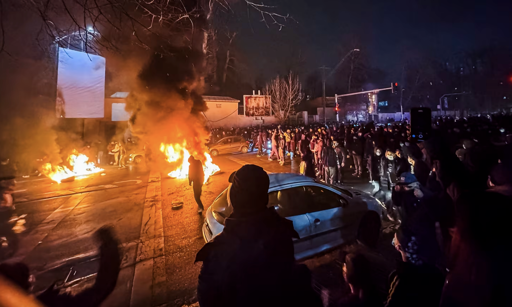
“It was spectacular! The crowd was huge, their courage exemplary. From 8 p.m. to midnight, I marched from downtown Tehran to the north. The security forces were firing tear gas and pellet guns. The dominant slogans were in favor of Reza Pahlavi, as well as ‘Death to the dictator,’” a Tehran resident told Le Monde.
This testimony captures both the magnitude of the moment and its contradictions: the enormous opportunities opened by a historic mass mobilization, and the grave dangers it faces. U.S. President Trump and Israeli Prime Minister Netanyahu are seeking to co-opt part of the movement through an aggressive campaign in support of Reza Pahlavi, while simultaneously threatening direct military intervention against Iran in order to impose a regime fully subordinated to imperialism.
This mortal danger makes one question decisive: Can the revolt against Khamenei develop in complete independence from imperialist forces?
Khamenei Is No Longer Frightening Away Protestors
During the night from Thursday to Friday, protests against the reactionary regime of the Islamic Republic entered a new phase. Tens — perhaps hundreds — of thousands took to the streets, confronting regime militias head-on in Tehran and Mashhad, the country’s two largest cities. Images circulating on social media show a qualitative shift: demonstrators were no longer dispersing under police charges, but responding directly to repression. In several videos, protesters are seen driving cars into security forces and police barricades blocking their advance.
This escalation followed a day of strikes called by Kurdish organizations, including Komala in Iranian Kurdistan, marking the entry of Kurdish regions into the mobilization and echoing the uprisings after the murder of Mahsa Amini. Ilam province has been particularly active. Across Tehran and other cities, most shops have closed; merchants, especially bazaar owners, are playing a central role in demonstrations. Since December 28, HRANA has recorded nearly 350 demonstrations across 31 provinces and 111 cities.
Students have also assumed a more prominent role, organizing protests inside universities and linking youth mobilization with urban uprisings of the working class. On Wednesday, January 7 — the eleventh day of protests — ten universities mobilized. In total, at least 35 universities have participated since late December.
In a speech on Friday, January 9, Khamenei denounced protesters as “mercenaries in the service of foreign powers,” a familiar tactic aimed at delegitimizing revolt. But this rhetoric may signal a tactical shift. Whereas the Basij usually confront demonstrations, such framing could justify the deployment of the Islamic Revolutionary Guard Corps’s (IRGC) assault forces — an army within the army, directly subordinated to the Supreme Leader. After limited use during the 2022 uprising, the IRGC has already been deployed in Iranian Kurdistan. The nationwide internet shutdown suggests preparations for mass repression.
Among the most brutal acts was a raid on a hospital in Ilam, where wounded protesters were receiving treatment. Reports also indicate the involvement of Iraqi Shiite militias allied with Tehran. More than 200 people have been killed, with security forces reportedly using live ammunition.
A Fragile Regime
This new surge of protests followed the 2019 movement, which was marked by oil-worker strikes, and the 2022 uprising. But above all, it reflects the growing fragility of Khamenei’s regime. Iran has emerged weakened from confrontation with Israel and the United States: its regional network is battered, sanctions have devastated an already fragile economy, and internal divisions are sharpening. The looming question of succession has turned into a broader indictment of Khamenei’s four decades in power.
Defeats suffered by the IRGC have strengthened the regular army, while “reformist” factions advocating accommodation with Washington are gaining ground. Analysts point to figures such as Hassan Rouhani and Hassan Khomeini as potential contenders. As Kamran Bokhari notes, the regime has sought controlled reforms — like easing social restrictions and reopening diplomacy with the United States — to stabilize the system after war, while advancing a partial opening to imperialist capital.
These tendencies were reflected in a Foreign Affairs op-ed by Mohammad Javad Zarif just days before the uprising, proposing a new nuclear deal, security agreements, and economic cooperation aimed at developing Iran’s private sector. Whether through continuity or reform, the balance of forces at the top raises the prospect of a Bonapartist outcome: rule by force to contain mass unrest.
The Threat of Imperialist Intervention
Pressure is rapidly intensifying. Just days after the aggression against Venezuela and the kidnapping of President Nicolás Maduro, U.S. imperialism is openly threatening intervention against Iran. Trump has declared that if Iran represses protesters, the United States is prepared to intervene.
This scenario — decapitation of the regime followed by negotiations with “reformist” factions — is being openly discussed. Israeli leaders have issued similar threats, explicitly invoking Venezuela as a warning. Israel has approved plans for an attack and placed its forces on high alert.
At the same time, imperialism has resurrected Reza Pahlavi. A long-standing ally of Netanyahu and Trump, promoted through Western and Israeli media, the Shah’s heir is being presented as an alternative, despite exaggerated claims of support inside Iran. His return represents an immense danger.
Backed by imperialist powers, Pahlavi symbolizes the dictatorship overthrown in 1979 by workers’ councils before the clergy hijacked the revolution. His restoration would mean total subordination to U.S. imperialism, plunder of Iran’s resources, and intensified exploitation of workers. Whatever his rhetoric, Pahlavi offers only a recycled dictatorship.
The Central Role of the Working Class, Independent from Imperialism
The revolt has drawn in new layers, like merchants and bazaar owners radicalized by the collapse of the rial, and youth shaped by the Mahsa Amini uprising. The most decisive force, however, remains the working class. Today, labor’s participation is uneven but significant: strikes at South Pars gas facilities, maintenance workers in Zagros and Lorestan, and solidarity statements from teachers, truck drivers, and oil workers.
If the Iranian working class intervenes as an independent force — against Khamenei and against imperialism — it can block the hijacking of the uprising by Pahlavi and avert a Libyan-style catastrophe. A political general strike led by workers could bring down the regime, which is now sustained only by repression, opening the possibility of a progressive outcome rooted in class power.
Such a victory would reverberate across the region, reviving class struggle in the Middle East and strengthening the Palestinian struggle. At this crossroads, the dangers are immense — but so are the possibilities, provided the fight against Khamenei is waged in total independence from imperialism and from those who dream of restoring a puppet monarchy to erase the defeat of 1979.
Originally published in French on January 11 in Révolution Permanente.
The post Revolt in Iran: Only Workers Can Turn the Tide Against Khamenei and Pahlavi appeared first on Left Voice.
From Left Voice via This RSS Feed.