

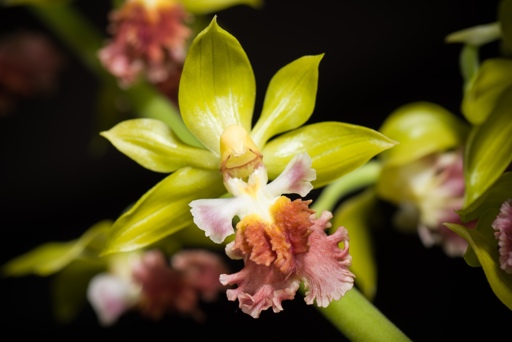
Myanmar is a country of extremes. From tropical forests, mangroves and wetlands to frost-bitten alpine mountain slopes and jagged limestone karst outcrops, it’s home to tremendous botanical diversity. Orchids alone account for more than 1,200 species, and researchers have described scores of new-to-science plant species in recent years, including a color-shifting Begonia and a rare type of ginger that flourishes in lofty cloud forests. Yet there remain glaring gaps in what’s known about Myanmar’s floristic diversity. “Myanmar hosts exceptionally high plant diversity and endemism,” Ke-Ping Ma, a biologist at the University of Chinese Academy of Sciences, told Mongabay. “However, there has been a long-standing lack [of] plant distribution data, due in part to limited field surveys and incomplete digitization of herbarium records.” Political instability inflamed by the 2021 military coup also severely hampers biological research. Some of the most unstable parts of Myanmar are also the most biologically rich. Once protected by their remoteness, these areas are increasingly threatened by rampant natural resource extraction as vying political groups seek to fund their operations. “Biodiversity is often one of the neglected victims of war because you can’t go and collect data, and you also can’t protect areas,” said Alice Hughes, a biologist at the University of Melbourne in Australia. “We have very little data even on basic things like [patterns of] habitat destruction. Whilst we can get some of that information from satellites, obviously, anything requiring on-the-ground information is very, very challenging.” There are 14,020 vascular plant species recorded in Myanmar,…This article was originally published on Mongabay
From Conservation news via This RSS Feed.