

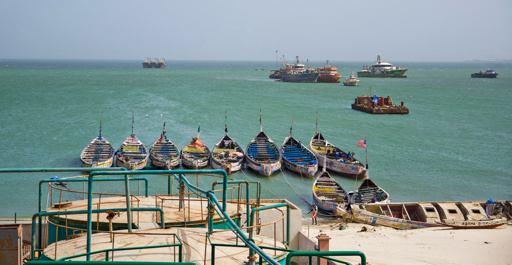
NOUADHIBOU, Mauritania — On a busy weekday, the coastal strip of Bountiya in Nouadhibou, Mauritania’s second-biggest city, is eerily quiet. This was once the beating heart of the West African nation’s fishmeal industry. “In 2018, it was so busy with trucks and people that you couldn’t even park your car,” said the director of one of 28 processing plants located in the strip, who spoke to Mongabay on condition of anonymity. Managers and owners of the plants were reluctant to speak on record criticizing government policies. Most of the plants in Bountiya are now closed. Those still operating are struggling to survive. A government crackdown in recent years has made it difficult to access raw fish. Fishmeal, sold for animal feed, is made by pressing, drying and grinding fish into powdered form. (A byproduct of this process is fish oil.) It takes 5 kilograms of raw fish to produce 1 kilo of fish powder. “Until 2017, if you were selling your factory, they would call you a fool,” said a manager at another plant, who also asked not to be named. “But now you cannot sell. It’s a fool who buys.” In 2017, Mauritania produced 111,866 metric tons of fish meal, followed by 124,961 metric tons in 2018 and 128,789 metric tons in 2020. A significant chunk of fish landed in Mauritania were consumed by the sector; in 2021 alone, for instance, more than 50% of the total pelagic fish catch went to fishmeal plants. According to official data for…This article was originally published on Mongabay
From Conservation news via This RSS Feed.