

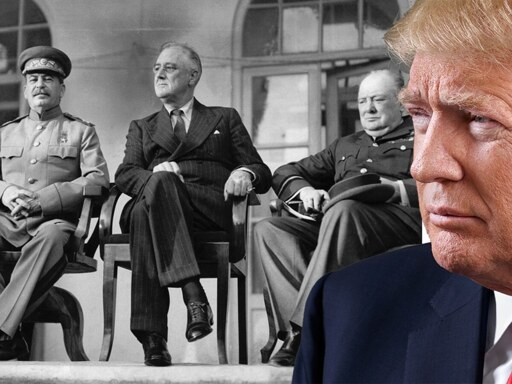
As fascism swept across pre world war two Italy nearly a century ago, Antonio Gramsci wrote these words:
The old world is dying, and the new world struggles to be born: this is the time of monsters.
In prison under Mussolini’s regime, Gramsci was reflecting on the collapse of the world he once knew.
Today, at the dawn of 2026, we are witnessing the death of the world that emerged from the ashes of world war two. The institutions built to safeguard peace, the organisations sculpted from the ruins and bound by the blood of tens of millions, have become relics. That “new world” is now the old world, and it is not merely dying; it is dead. We are, once again, in a time of monsters.
Trump’s threats
Donald Trump’s second term as president of the US began with threats against sovereign nations and territories: Venezuela, Iran, Greenland, South Africa, Nigeria, to name a few. When the New Year’s Eve ball dropped in New York on 1 January, it marked more than the start of a new year, it signalled the end of US global hegemony. Not because the US collapsed, but because its far-right administration appears intent on abandoning global supremacy in favour of carving out a hemisphere where it can exercise total, unrestrained dominance.
The kidnapping of Venezuelan president Nicolás Maduro and his wife Cilia Flores, abducted in the dead of night and shipped off to New York to be put on trial, set a chilling precedent. Without a protracted war, the US seized control of a sovereign nation, a stark departure from the wars and interventions of previous decades.
Maduro’s successor was handpicked by the Trump administration as his very own vice president, Delcy Rodríguez, enraging certain American politicians who expected full-scale regime change. They, too, are grappling with the death of the old order, though for darker reasons. For Trump, the goal is control of resources and capital. Regime change is not required if obedience and guarantees of serving the interests of US capital can be instilled (through fear, if necessary).
World war or global business?
Trump is not a statesman; he is a businessman. He is underestimated by his opponents and
overestimated by his sycophants. His loyalty lies not with US interests, but with US capital. Oil barons knew his plans for Venezuela before governors and senators did. The administration’s playbook echoes the infamous quote attributed to Mayer Rothschild:
Give me control of a nation’s money supply, and I care not who makes its laws.
The petrodollar was swiftly secured, and deputy president JD Vance made the terms clear: Venezuela may sell oil, but only if it serves US interests. Not Venezuelan interests. Not the interests of its own people. US interests above all. A new era of colonialism has begun, driven by a
reimagined imperial power shifting from global supremacy to unrestrained regional dominance.
The death of Venezuelan sovereignty was a warning shot to the Americas: serve US interests or face the consequences. Trump’s crude remark about Colombian president Gustavo Petro (“He should watch his ass”) underscored the threat. Cuba is in the crosshairs. Greenland, too, raising tensions with Denmark and Europe. Should the US seize Greenland, NATO’s demise will follow. Why? Because a multipolar world order has no need for a North Atlantic alliance designed for a world that no longer exists.
Why would Trump gamble on downgrading the US from global superpower status to regional hegemon? Two reasons: First, the US has been overstretched for decades. Overextended empires are vulnerable (just ask the Romans). Second, Trump thinks like a businessman. A niche strategy of regional dominance avoids the catastrophic risks of global overstretch.
Go west
A “blue ocean” within a hemisphere, a market space where the US can exercise absolute control, is far more appealing than propping up Europe or policing the Pacific. Why spend billions defending distant allies when you can subjugate smaller nations in your own backyard for a fraction of the cost and seize their oil, rare earth metals, and resources fuelling next-generation technologies. It is clear now to the US that China’s rise cannot be stopped, nor significantly slowed.
The idea of a multipolar world dominated by major regional powers is not new, but it aligns closely with Trump’s isolationist stance. After all, ‘owning’ an entire hemisphere of the globe is a preferable alternative to risking becoming the next collapsed super power. For an authoritarian regime, avoiding a USSR-style disintegration whilst continuing to exert global influence as an imperialist power, albeit within a smaller sphere of influence, is an acceptable trade-off that must be secured at all costs.
The exception, driven by the powerful Israeli lobby, is unwavering US support for Israel. Genocide in Gaza, the bombing of neighbouring states and threats of wider regional conflict, these atrocities are not merely tolerated; they are endorsed.
BRICS
This multipolar reality is not only confined to economics, it now carries a growing military dimension. The EU is ramping up its defence spending and accelerating is militarisation. The BRICS bloc (Brazil. Russia, India, China, and South Africa) once seen primarily as a financial bloc, is now projecting hard power.
Just this week, China, South Africa, Russia, and Iran conducted joint naval exercises off Simon’s Town, a historic British naval base in South Africa. Chinese and Russian vessels mooring in Simon’s Town, a base that once symbolised British naval dominance on the southern tip of Africa, stands as a striking illustration of this profound realignment in global power.
The drills, framed around securing maritime trade routes and interoperability, underscore how BRICS-Plus nations are asserting themselves beyond commerce, shaping security architectures in the Indian and Atlantic Oceans. These manoeuvres signal that the emerging order will not be dictated by Western alliances alone; it will be contested on the high seas as well as in boardrooms. While a direct “hot” war between nuclear powers would be catastrophic, a more likely scenario is conflict through proxy wars (such as Ukraine / NATO versus Russia) and economic confrontation.
For example, Europe is unlikely to engage in armed conflict with the US over Greenland should Washington attempt an invasion. However, the US currently lacks the infrastructure to refine any rare earth metals it might seize; that capability exists almost exclusively in China and would take the US a decade or more to develop domestically. During that time Europe would respond economically, absorbing any financial loss Denmark suffers from losing Greenland, and realign with other major powers accordingly.
Where Europe must exercise extreme caution is in preventing foreign interference in its internal affairs. Sponsorship of a Trump-aligned Reform UK movement or a far-right AfD surge in Germany could severely undermine Europe’s ability to safeguard its own interests.
War is not peace
For Americans, violence is no longer a US export: it has come home through the actions of the Immigration and Customs Enforcement (ICE) unit, which operates with paramilitary characteristics. Reform UK have signalled interested in the idea of such a paramilitary-style unit operating within the UK. Days after Maduro’s abduction and the renewed demands for Greenland, Trump’s internal military force, ICE, killed another unarmed civilian in cold blood.
This time, the murder of Renee Good was caught on video and went viral around the world within minutes. Trump and Vance blamed the victim, they tried to rewrite the events and circumstances that led to her murder, but the truth was undeniable. The president has his own brutal military force that he can, and will, call on even against unarmed American civilians.
No one is safe in the US anymore. African Americans and Latinos never really were. Immigrants have long been targets (and especially now with ICE acting with brutal force and ripping families apart). But now, even white Americans face the terrifying realisation that federal agents can kill with impunity. Governors are mobilising National Guards to protect citizens from federal forces. Protests are erupting. If they turn violent, Trump will have the pretext he needs for a full-scale assault on civil liberties under the guise of “law and order.”
What next?
Where this will end is uncertain. What is certain is that the old order born from the ruins of world war two is dead. International law is no longer sacrosanct. Major powers will carve out spheres of influence. The US has staked its claim on the Americas and surrounding regions, China will be the Major Power in the East. Russia is vying for dominance in its region, with a Europe having to forge a new path for itself without US backing.
And in the shadows, the most disruptive technologies humanity has ever known are developing at an accelerating pace and are being utilised by these powerful militaries. One such technology is artificial intelligence, which may easily evolve beyond our, or any major power’s, control. A new world will be born. But until then, we must navigate a time of monsters once again.
Featured image via the Canary
From Canary via This RSS Feed.