

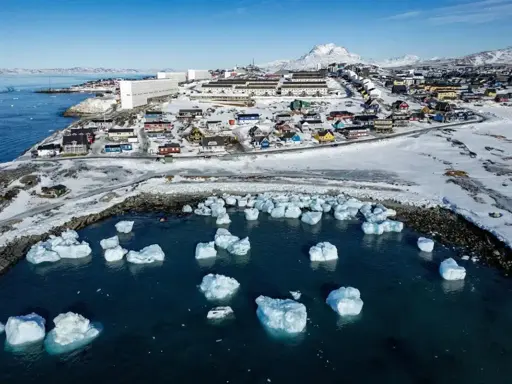
Starmer’s Labour Government is aligning with US imperial ambitions to secure critical minerals, despite evidence that Greenland’s resource promise is more geopolitical theatre than near-term reality. As the Trump administration openly discusses purchasing or seizing Greenland, UK officials have carefully avoided confrontation.
Still, Starmer’s silence and failure to challenge the threat of Greenland’s capture “whether they like it or not” — to use Trump’s own words — is a tacit endorsement of neocolonial extractivism.
In a Lords debate on 8 January, Labour’s Jenny Chapman dodged questions about potential US military action from UK soil.
Crossbench peer Andrew Tyrie questioned whether protocols governing US military bases in the United Kingdom would:
preclude the use of those forces in the event of an invasion of, or military action in, Greenland.
In response, Chapman refused to address the hypothetical, instead praising the “world’s closest” security relationship.
Cagey
Chapman further obscured the issue, saying:
There is no world in which I am answering that question. There is always negotiation and discussion about the appropriate use of bases in this country. I just remind noble Lords—I do not think they need to be reminded—that the very close military, security and intelligence co-operation between the United Kingdom and the United States is decades old.
At the same time, deputy prime minister David Lammy visited Washington, reinforcing the “special relationship” without challenging US aggression toward Greenland. This diplomatic posture coincides with the UK’s own commercial interests in the region.
In October 2025, the UK resumed trade talks with Greenland. The UK-Greenland trade talks aim at eliminating seafood tariffs and to “strengthen cooperation on critical minerals”. They note that UK firms hold a third of the mining licences there. Negotiations for a UK-Greenland Free Trade Agreement opened in 2022, to reinstate tariff-free trade that ended when the UK left the EU. This agreement was paused prior to the UK’s 2024 general election.
However, there is analysis that sharply contradicts the narrative of Greenland as a mineral powerhouse. During the Lords debate, Conservative Anne McIntosh also pointed out that since 1951 Greenland:
has been perfectly open to the United States to establish more military bases and a bigger military presence in Greenland. If the issue is not military but to extract minerals, it is perfectly possible for the United States to negotiate agreements to mine the minerals.
Even a US think tank funded by weapons manufacturers and mining firms, CSIS, anticipates difficulties. According to CSIS:
The Tanbreez mine presents a potential pathway to enhance U.S. REE access, but realizing this potential requires more than just financing—it demands long-term commitment to infrastructure, genuine community engagement, and diplomatic coordination.
There have only been nine active mine sites in Greenland since World War II. Today, there are only two mining projects operating on the island: the White Mountain anorthosite mine and the small but high-grade Nalunaq gold mine.
Greenland fixation
Tracy Hughes, founder & executive director of the Critical Minerals Institute, said:
The fixation on Greenland has always been more about geopolitical posturing – a military-strategic interest and stock-promotion narrative – than a realistic supply solution for the tech sector.
Hughes continued:
Put simply: rare earths in Greenland won’t materially move markets in the next decade, and the hype far outstrips the hard science and economics behind these critical minerals.
The US drive mirrors this disconnect between rhetoric and resource reality. While Trump’s kidnapping of Venezuela’s President Maduro was framed as an oil grab, analysts quoted in the Financial Times article The new era of resource imperialism, argue oil was a “pretext,” with the real motive being “American power and very little else”. The Financial Times quoted Daniel Drezner, professor of international politics at the Fletcher School at Tufts University, saying:
I don’t doubt that Donald Trump thinks it’s all about oil, but he’s wrong.
Instead, Drezner pointed to Venezuela’s run-down infrastructure and high extraction costs.
Starmer’s inability to take a clear stance on Greenland isn’t just fence-sitting — it rubber stamps Trump’s ‘America first’ policy and extractivst and colonial ambitions in Greenland.
Featured image via the Canary
By Nandita Lal
From Canary via This RSS Feed.