

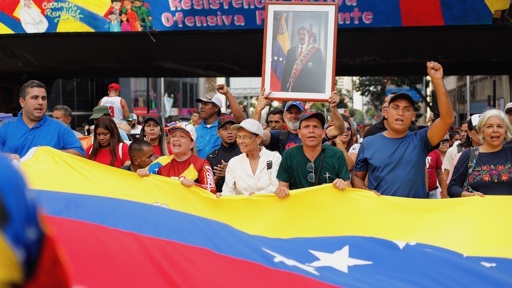
On January 3, the US launched Operation Absolute Resolve, a massive military operation on Venezuelan soil that involved airstrikes on Caracas and left at least 100 people dead, including civilians. The stated objective of the operation was to arrest Venezuelan President Nicolás Maduro Moros and First Lady Cilia Flores on “narco-terrorism” charges. On January 5, Maduro and Flores were dragged into Manhattan federal court in shackles, where they pleaded not guilty.
The attack represents a qualitative escalation in Washington’s long-standing war against Venezuela. Even as the Trump administration drops the drug-war pretense and speaks openly about reclaiming Venezuela’s oil, the true objective of this war has always been to strangle the Bolivarian Revolution. The prize is not simply oil as a commodity, but the sovereignty it finances: the power to convert oil revenue into social and national development, and to wield that wealth as an instrument of regional integration beyond Washington’s control.
Put plainly, a Bolivarian Revolution armed with the biggest oil reserves on the planet and a strong leadership poses a threat to Washington’s imperialist ambitions in the region.
Even during decades of hybrid war, the Bolivarian Revolution has used its immense oil wealth to not only deliver measurable improvements to the lives of millions of Venezuelans but to advance regional cooperation. Those gains were the result of a process to transform Venezuelan society that began in 1998, when Hugo Chávez won his first presidency behind a wave of popular support.
Oil as a means
Upon winning the presidency, Chávez immediately began to implement a series of social and economic reforms aimed at addressing the most urgent needs of the population. To accelerate those reforms, in 2001 Chávez’s government passed the Organic Law of Hydrocarbons. Under the new law, primary activities in petroleum production were to be carried out directly by the state, either by a 100% state-owned company such as Petróleos de Venezuela, S.A. (PDVSA) or by a joint-venture company in which the state held more than 50% of the shares. The law also increased the royalty rate on oil production from 16.67% to 30%. This shift was meant to redirect a larger share of oil revenue towards social programs and long-term national development.This was an attack on a long-standing arrangement in which Venezuela’s oil wealth circulated upward and outward – through domestic elites, foreign firms, and the architecture of dependency that has disciplined Latin America for more than a century.
The backlash was immediate and violent. Only a year later, in 2002, a US-backed coup would attempt to strangle the Bolivarian Revolution in its cradle. But mass uprisings demanding Chávez’s return would see him reinstated in just 48 hours. The following years would be marked by economic pressure, oil lockouts, coup attempts, and military attacks – episodes that illustrated a long-standing rule of US imperialism: whenever a country tries to convert resource wealth into popular sovereignty, it is treated as a threat to be neutralized.
In the years that followed, the Bolivarian Revolution would use the country’s oil wealth to address the most pressing needs of the people. Below we look at how this massive program of wealth redistribution addressed four key areas of social need: hunger alleviation, illiteracy, housing, and health.
The Bolivarian Revolution goes to war against poverty
One of the first steps the Bolivarian governments took to meet these needs was to transform the relationship between the people and state institutions. To do so, they implemented a system of “missions”: state programs designed to work directly with communities to tackle entrenched deprivations directly – education, health, food access, housing, work – especially in urban and rural areas long written off by the pre-Chávez state.
Misión Mercal (Mercal Mission) was created in 2003 to combat food insecurity by guaranteeing access to food and basic goods at subsidized prices, through a network of supermarkets, mini-markets (“Mercalitos”), and mobile markets. The mission operates through the state-owned company Mercados de Alimentos, C.A. (MERCAL) and distributes subsidized products – often at significant discounts – integrating local producers into its supply chain.
In 2013, just ten years after implementation, the UN’s Food and Agriculture Organization (FAO) recognized Venezuela as among the countries that had met the Millennium Development Goal hunger target – halving the proportion of hungry people between 1990–1992 and 2010–2012.
Misión Robinson ends illiteracy
Misión Robinson (Robinson Mission) was launched in 2003 to confront one of the most enduring marks of class rule in Venezuela: the abandonment of millions of working-class and rural people by the education system. The mission targeted adults who had been locked out of schooling in rural and urban communities. It operated through community-based study circles, bringing instruction into neighborhood spaces. The program used the Cuban Yo Sí Puedo (Yes, I Can) method – an accelerated literacy model designed for mass campaigns – mobilizing facilitators, materials, and infrastructure at a scale the pre-Chávez state never attempted.
In October 2005, after two years of Misión Robinson, the United Nations Educational, Scientific and Cultural Organization declared the country an “Illiteracy Free Territory”, with more than 95% of the population being literate. In just two years Misión Robinson managed to reach 1.5 million people.
Misión Hábitat and Gran Misión Vivienda Venezuela launch to eradicate homelessness
For decades, Venezuela’s oil rent fed an urban order in which the poor built the city with their hands – then were told they had no right to it. By the early 2000s, a majority of housing was concentrated in barrios, often with precarious services and in high-risk zones, a housing crisis that predated Chávez and was produced by class rule.
The Bolivarian Revolution broke with that model by codifying housing as a social right. Venezuela’s 1999 Constitution affirms the right to “adequate, safe, comfortable, and hygienic housing, with essential basic services, including a habitat that humanizes family, neighborhood, and community relations”, and obligates the state to prioritize families with scarce resources and guarantee access to social policies and credit.
Misión Hábitat (Habitat Mission) emerged out of that constitutional turn: a program to treat housing not as a commodity, but as planned “habitat” – linking construction to services, land regularization, and popular participation. Alongside it, the state expanded tenure security through the Urban Land Tenure Regularization program; by the time of Fundavivienda’s report, more than 1,087,989 urban land titles had been issued.
After the 2010 floods displaced roughly 130,000 people, the Bolivarian state launched Gran Misión Vivienda Venezuela (GMVV) in 2011 as an emergency-scale housing initiative. A PDVSA filing with the US Securities and Exchange Commission notes that the 2011 Special Debt Law allocated Bs.10.0 billion (about USD 2.3 billion) to GMVV; by the end of 2011, Bs.7.9 billion had been spent building about 49,420 new homes in the regions hardest hit by the rains.
But GMVV was never just a construction quota. Fundavivienda describes the program as organized around four interlocked pillars – land, materials and inputs, executing entities, and financing – plus “the integration of organized civil society”, including systems of participation and self-construction. In 2018, a UN Human Rights Council independent expert assessed conditions in the country reported that GMVV “has contributed to saving millions of persons from homelessness”, and that “over two million housing units have been delivered to those who would otherwise live in shanty towns”.
This matters for the same reason Mercal and Robinson matter. Housing is class power made visible. A state that uses oil income to build homes, formalize land rights, and extend the right to live with dignity is not “buying loyalty”. It is redistributing power. And in a resource-rich country that dared to make sovereignty and social planning the starting point, that redistribution is exactly what Washington moved to strangle.
Misión Barrio adentro reverses medical exclusion
Misión Barrio Adentro (Barrio Adentro Mission) was launched in 2003 to confront a health system that for decades functioned as a kind of medical apartheid: clinics and doctors concentrated where money and privilege lived, while the urban and rural communities were left to improvise survival. Barrio Adentro flipped the map. It brought a preventive, community-based model of medicine directly into working-class neighbourhoods, staffed in large part by international brigades of doctors (many from Cuba) and rooted in local health committees and community organization.
The scale was deliberate. The Pan American Health Organization’s (PAHO) Health in the Americas country profile reports that the Ministry of Health’s ambulatory network was supplemented by Misión Barrio Adentro’s roughly 8,600 “consultation points” by the end of 2005. PAHO notes that the mission received USD 169.4 million from PDVSA in 2003 to build up the primary health care network. In the first 18 months, PAHO reports 163 million free medical consultations, alongside millions of dental checkups and eye exams.
Barrio Adentro also expanded the health workforce and the infrastructure of care. PAHO reports that in 2000 Venezuela had 20 physicians per 10,000 people; by 2005, with about 1,100 Venezuelan doctors working in Barrio Adentro alongside 15,000 Cuban doctors, the country reached 25 doctors per 10,000 people. The same profile describes how the service system was built as an integrated network – primary care clinics, comprehensive diagnostic centers, rehabilitation facilities, high-technology centers, and hospitals – and reports that by the end of 2005 about 640 primary care clinics were operating, with 1,670 being equipped, alongside thousands of interim consultation points operating out of rooms in homes in low-income areas.
This matters for the same reason Mercal and Robinson matter. You cannot speak of democracy while health is rationed by class and geography. Barrio Adentro treated healthcare as a front in a broader war against social exclusion – and it did so by using the state’s recovered capacity and recovered revenue to build clinics where the old order built abandonment.
Oil beyond borders: how the Bolivarian Revolution funded regional integration – and why Washington moved to break It
The Bolivarian Revolution’s oil policy was never confined to the national ledger. From the beginning, Chávez framed recovered oil revenue not only as a means to fund social rights at home, but as the material basis for a different regional order – one less subordinated to Washington and organized around solidarity, cooperation, and sovereignty.
PetroCaribe was one of the clearest expressions of that project. Signed in 2005, the PetroCaribeEnergy Cooperation Agreement defined PetroCaribe as an instrument of energy policy aimed at the integration of Caribbean peoples through the “sovereign use” of energy resources for the direct benefit of their populations. The mechanism mattered: Venezuela supplied crude and refined products under financing schemes that allowed deferred payment in goods and services through compensation mechanisms. And the terms were explicitly concessional – long maturities of 17–25 years, including a two-year grace period, with 1% or 2% annual interest depending on oil prices. In practice, that meant breathing room: Brookings notes that PetroCaribe allowed participating countries to finance 40% to 60% of their imports through long-term, low-interest loans.
If PetroCaribe used oil to loosen the Caribbean’s financial chokehold, ALBA (later ALBA-TCP) sought to name the political horizon openly. Chávez proposed it as an alternative to the US-backed Free Trade Area of the Americas (FTAA), and it was formally created in 2004 through a joint agreement spearheaded by Chávez and Fidel Castro. ALBA defined itself around principles of solidarity and complementarity – an attempt to replace “free trade” discipline with planned cooperation across smaller economies and larger ones, across energy, social welfare, and development.
Then came the Community of Latin American and Caribbean States (Comunidad de Estados Latinoamericanos y Caribeños, CELAC), the region’s most direct institutional refusal of Washington’s claim to hemispheric domination. CELAC’s founding summit in Caracas brought together 33 Latin American and Caribbean countries to form a new community (explicitly every country in the Americas except the United States and Canada). Whatever its contradictions, the form itself was a message: Latin America and the Caribbean did not need the empire’s permission to meet, coordinate, or imagine a common future.
This state-led integration was envisioned (and fought for) from below. ALBA Movimientos grew out of years of organizing across the region (with major moments in 2008 and 2009) and held its founding assembly in 2013, bringing together popular movements from 23 countries and formalizing an operational secretariat rooted in Brazil’s Landless Workers’ Movement (Movimento dos Trabalhadores Rurais Sem Terra, MST), alongside organizations in Venezuela, Cuba, Colombia, and Argentina. The point was to build a continental popular articulation with a post-capitalist horizon (autonomous from governments, but explicitly aligned against imperialism and neoliberal restoration).
And this is precisely why Washington’s war on Venezuela cannot be reduced to “oil” as a commodity. The problem for the US is what oil made possible: the capacity to finance sovereignty at home and to underwrite regional projects that shifted the balance of power. So the US moved on the integration architecture directly – politically, diplomatically, and financially. In 2014, for example, the Obama White House launched the Caribbean Energy Security Initiative (CESI), presenting it as a suite of options to help Caribbean nations transform their electricity sectors, mobilize financing, and diversify energy sources. Read alongside PetroCaribe, the strategic logic is clear: peel the region away from Venezuelan energy cooperation by substituting US-backed finance and policy frameworks.
Then came the escalations that targeted the source itself. In January 2019, the US Treasury sanctioned Venezuela’s state oil company PDVSA, blocking its property under US jurisdiction and broadly prohibiting US persons from transacting with it. Whatever rhetoric Washington wrapped around these measures, their material effect was straightforward: to constrict the revenue streams and operational capacity through which Venezuela could sustain both domestic redistribution and international cooperation.
Sovereignty is the target
Operation Absolute Resolve did not erupt out of nowhere. It is simply the latest (and most naked) expression of a pattern that has defined Washington’s relationship to the Global South for more than a hundred years: whenever a country’s resource wealth is pulled out of the circuits of elite accumulation and foreign control and redirected toward popular rights and independent state capacity, the response is coercion. Coups, lockouts, diplomatic siege, financial strangulation, and now open military assault and abduction are not separate episodes; they are the changing tactics of the same strategic objective.
What the Bolivarian Revolution demonstrated, in concrete and measurable terms, is that sovereignty is not an abstraction. It is a material capacity: the ability to take a resource that once flowed upward and outward and turn it into food security, literacy, housing, and healthcare – into institutions that make dignity ordinary rather than exceptional. That capacity is what sanctions have always targeted. Not because Washington suddenly discovered a concern for democracy or narcotics, but because a state that can plan, redistribute, and organize society at scale is harder to discipline (and because that example travels).
And it did travel. PetroCaribe, ALBA, CELAC, and the continental articulations from below were all, in different ways, attempts to build a regional order in which Latin America and the Caribbean could meet their needs without first seeking permission from the empire. In that context, the US obsession with Venezuela’s oil cannot be understood as a simple scramble for a commodity. It is an effort to break the political uses of that commodity: to sever the link between natural wealth and social rights at home, and to prevent that wealth from underwriting projects of regional autonomy beyond Washington’s control.
When governments and movements in the region are told that there is no alternative (no fiscal space, no development path, no room for planning) the Venezuelan case clarifies what that claim is really saying: that the only acceptable use of resources is the one that preserves unequal exchange. The war on Venezuela is therefore a war on the very idea that the people of the Global South can convert their wealth into sovereignty, and sovereignty into a different future.
This is why the question posed by January 3 is larger than Venezuela. If the kidnapping of a head of state and the bombing of a sovereign country can be normalized under the language of “law enforcement”, then sovereignty everywhere becomes conditional, granted or revoked according to imperial convenience. The answer cannot be cynicism or resignation. It must be clarity about what is at stake, and solidarity equal to the aggression: a defense of Venezuela’s right to decide its own destiny, and, with it, the right of our region to build an order based on cooperation, not subordination.
Eduardo Rodríguez is a Puerto Rican writer, editor, and translator. He is an editor at [Tricontinental: Institute for Social Research.](http://tricon/ link: https://thetricontinental.org/)
The post Washington’s war on sovereignty and development in Venezuela appeared first on Peoples Dispatch.
From Peoples Dispatch via This RSS Feed.