

Bullets:
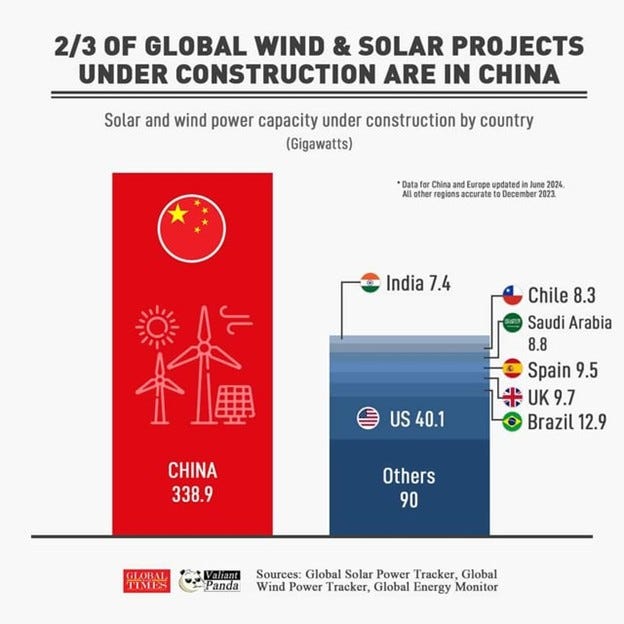
Solar and wind power are crucial to China’s power mix, and China builds more renewables power generation than the rest of the world combined.
But their dependency on renewable sources poses a serious problem for grid operators, who struggle to balance the intermittent supply sources hitting the system. That challenge is compounded in China, who have massive wind and solar facilities thousands of kilometers away from the population centers who depend on them to keep the lights on.
Local weather conditions in China’s far west regions can have wide-ranging impacts on the national system, and “backflow” issues can cause blackouts anywhere in local markets.
A new high-capacity DC transformer may be the answer in China, and elsewhere in Asia where heavy reliance on renewable power strains electric grids.
Inside China / Business is a reader-supported publication. To receive new posts and support my work, consider becoming a free or paid subscriber.
Report:
Good morning.
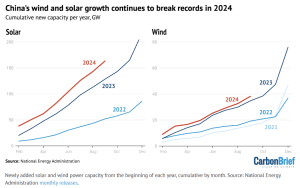
China builds more wind and solar than the rest of the world, combined. And the growth of renewable capacity is accelerating—new solar and wind installations break new records, year after year:
So renewable energy is increasingly important in China’s power mix. But ironically it also poses a lot of problems. New clean energy sources put a lot of stress on the power grid, and regulators in some places are even killing new projects. In the Dongbei region a power station was told not to add new solar capacity, because of the backflow problems there. That is a condition whereby more electricity is being generated, than can be consumed. Solar panels, in this instance, are generating power that there is no demand for. That leads to severe voltage fluctuations, and possibly to blackouts.
Across China, huge, double-digit percentage increases in renewable power are being added, every year. But the problem is on the consumption side: how much power is used, and how much is stored to be used later. Both the supply and demand are dependent on weather—that’s true everywhere in the world, but here they face a China-specific problem, in that the sources of wind and solar, and hydro, are the largest in the world, and they are thousands of miles away from China’s population centers, which are also some of the largest in the world.
So this represents a major infrastructure problem. More power storage facilities and bigger and smarter power grids are needed. That’s also true across other countries that are adopting renewable energy at scale. The ASEAN countries are wrestling with the same issues: the renewables boom has a ceiling, until the power grids are modernized to accommodate the problems of these mismatches, between supply and demand. Solar and wind power are unpredictable, and in the case of solar, doesn’t produce at all during the nighttime, which is the peak for household demand.
China is already hitting that ceiling. Xinjiang is where massive wind and solar installations are, and last August grid operators in Xinjiang saw major oscillations in production of power that nearly led to the national power grid shutting down. Again, generation of solar and wind changes with the weather, and those local weather problems in Northwest China resulted in stability problems nationwide. China’s National Energy Administration announced reforms on the regulatory and management side.
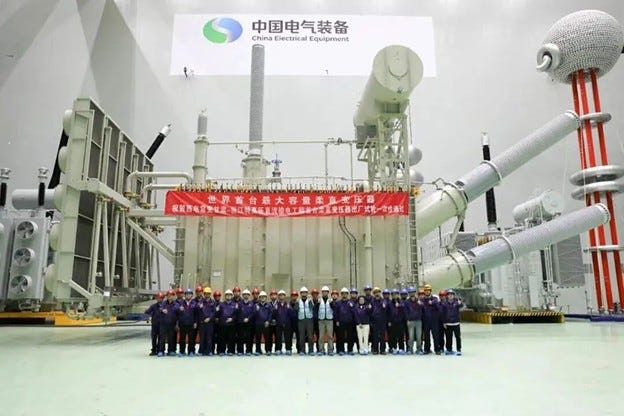
But more than anything, new technologies and applications are needed, on the hardware side. Here, engineers have built the world’s largest smart transformer, which experts say will plug some of the big holes in the renewables energy industry. This giant thing manages the renewables energy shocks to the system, coming from the supply side. It’s the highest capacity transformer in the field of direct current transmission, and will be installed along the new West-to-East transmission project, running from Gansu to Zhejiang.
This is from Interesting Engineering, and explains that the new transformer will prevent a repeat of what happened last summer in Xinjiang, and will revolutionize electric grids worldwide who are facing the same problems they’ve got here in China, and across Southeast Asia.
Small imbalances in supply and demand can cause outages, and heavy reliance on renewable energy compounds the problem, because of the variability in power supply. The problem gets worse still for long-distance power transmission, which China uses to keep Eastern cities powered on with electricity produced thousands of kilometers away. One of the solutions is large-capacity, flexible DC transformers, which are part of a high-voltage direct current system. Power plants and solar and wind farms generate AC power, which is converted to Direct Current to go over the long-distance wires. On the receiving end, DC is converted back to AC and distributed to power consumers.
The new transformer handles the big, fast changes in AC power coming in from renewable energy sources and hauls it to where the demand is. It routes electricity across multiple regions, and renewable energy becomes more reliable and predictable at scale.
These transformers will be deployed across China, along these huge “bullet train high-voltage lines” for electricity. So going back to the problem they had up in Northeast China, where the local power markets were already stuffed with supply and couldn’t handle any more—as long as there is power demand anywhere on the Chinese grid, these new transformers onboard it to the grid, which gets it to wherever it’s needed, matching supply and demand.
Be Good.
Resources and links:
China’s Renewable Energy Boom: A Record-Breaking Shift or Still Chained to Coal?
https://carboncredits.com/chinas-renewable-energy-boom-a-record-breaking-shift-or-still-chained-to-coal/
China is building more wind and solar capacity than the rest of the world combined
https://www.reddit.com/r/China/comments/1e3s6a1/china/_is/_building/_more/_wind/_solar/_capacity/_than/
World’s largest smart transformer to deliver 36 billion kWh of energy a year
https://interestingengineering.com/energy/china-record-breaking-transformer
Why Southeast Asia’s green energy boom hinges on smart grid investment
https://www.scmp.com/week-asia/health-environment/article/3328985/why-southeast-asias-green-energy-boom-hinges-smart-grid-investment
China’s green energy boom is stressing the grid – and sparking new currents in power reform
https://www.scmp.com/economy/china-economy/article/3268893/chinas-green-energy-boom-stressing-grid-and-sparking-new-currents-power-reform
China’s green energy boom is stressing the grid – and sparking new currents in power reform
https://www.scmp.com/economy/china-economy/article/3268893/chinas-green-energy-boom-stressing-grid-and-sparking-new-currents-power-reform
Xinjiang power swing threatened China’s nationwide electricity supply in August
Why is Chinese electricity so cheap?
‘A bullet train for power’: China’s ultra-high-voltage electricity grid
https://www.bbc.com/future/article/20241113-will-chinas-ultra-high-voltage-grid-pay-off-for-renewable-power
Economist, Electricity now flows across continents, courtesy of direct current
https://www.economist.com/science-and-technology/2017/01/14/electricity-now-flows-across-continents-courtesy-of-direct-current
Inside China / Business is a reader-supported publication. To receive new posts and support my work, consider becoming a free or paid subscriber.
From Inside China / Business via This RSS Feed.