

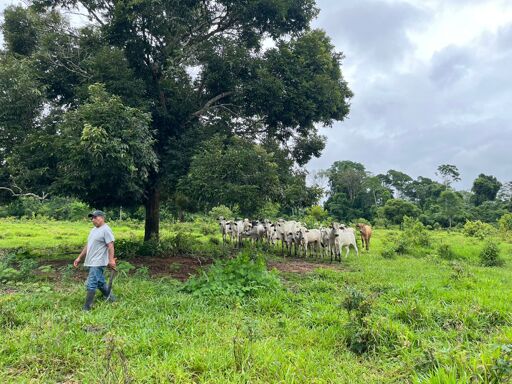
In the rolling hills of Iñapari, a remote town in the Peruvian Amazon on the tri-border with Bolivia and Brazil, cattle ranchers are ditching grass monocultures, which have been shown to harm biodiversity, in favor of forested pastures. For Antonio Cardozo, a local rancher who has planted hundreds of native trees, the switch has improved his cattle’s diet and health, while also providing him with additional sources of food and income. “Learning has a cost, but in a few years you start to see a difference,” says Cardozo, who has been combining trees with rotational grazing, a practice that keeps the soil intact and allows grass to regrow. In less than a year, this practice allowed him to more than double the number of cows he grazes per hectare Livestock farming is responsible for roughly 80% of the deforestation in the Amazon Basin and 14.5% of greenhouse gas emissions globally. Yet agricultural solutions receive just 7% of global climate funding and were absent from the recent COP30 climate summit agreement. According to some researchers, planting trees in pastures, an agroforestry technique known as silvopasture, represents one of the most effective yet neglected opportunities to reduce global greenhouse gas emissions. Under ideal conditions, silvopasture sequesters carbon in trees and soils while providing better forage and shade to heat-stressed cows, leading to healthier animals that emit less methane and occupy less land. It can also help small farmers adapt to climate-related disasters — responsible for $2.9 trillion in losses over the last…This article was originally published on Mongabay
From Conservation news via This RSS Feed.