

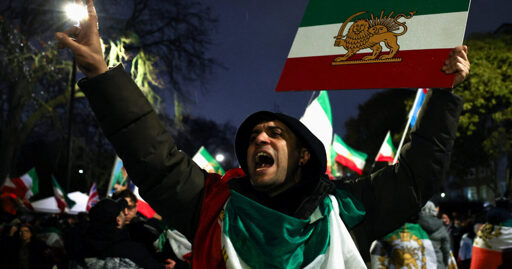
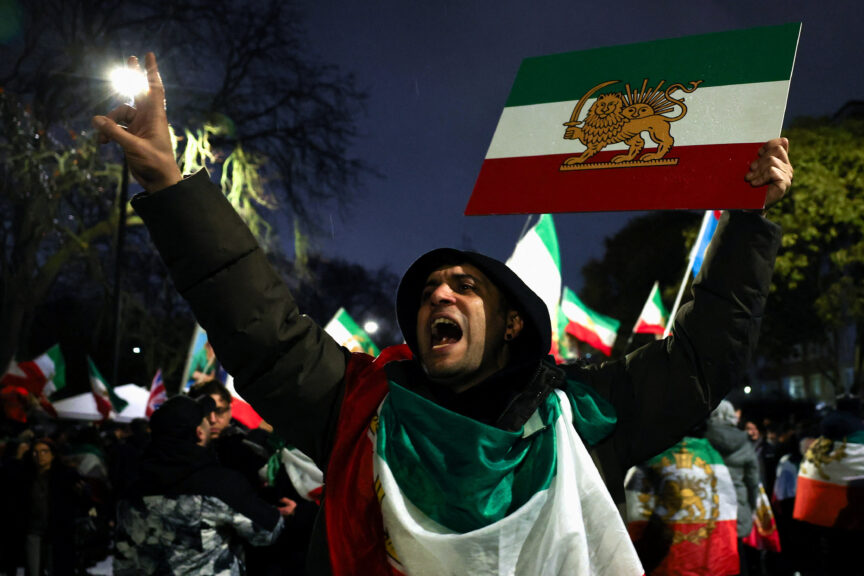
Regime change is the phrase du jour for the second week on the trot. Last weekend, it was Venezuela, with a foray into Greenland midweek. Now it’s Iran, where a popular uprising against the government has entered its fifteenth day.
Iran is no stranger to large-scale protests, with mass uprisings having taken place in 2017, 2019 and 2022, to give a few examples from recent years. In each of those cases, the Islamic government survived through a mix of violent clampdowns and quiet concessions. But this time, according to experts, it feels different.
Now, I’m not qualified to judge whether that’s correct. But I can absolutely judge the response of the western political classes to a potential revolution in Iran, which has very much the same quality as ever: being as gloopy, as slippery – and, above all, as thick – as mince.
It’s impossible to know how many Iranians are currently calling for the fall of the country’s conservative Ayatollah, Ali Khamenei. A blanket internet shutdown in place, and with protests largely taking place at night, keeping track is not easy. The latter both hinders and serves those protesters courageously endangering their lives, helping to keep them from amongst the more than 500 estimated to have been killed (the figure may well be far higher) and the over 10,000 thought to have been arrested by the regime so far.
The uprising has now gone on for more than two weeks. Since its beginning as a merchants’ strike in late December in response to a collapsed currency and growing economic woe under increased US oil sanctions, it’s only grown, emerging in dozens of towns and cities across all 31 of the country’s provinces.
Something massive is happening in Iran. What it is, what it ultimately wants, and what its end result will be are currently opaque. But that hasn’t stopped western elites, with no skin in the Iranian game, lecturing from the safety of what they take to be the moral high-ground, but which is in fact the intellectual basement.
“Stand with the protesters,” they demand, happily also standing with Tommy Robinson and assorted warmongers. And those who exercise caution have come in for the strongest criticism. You must, it seems, immediately jettison your knowledge of both the history that’s brought us here and the bill – charged in human lives – such events often demand. But those shouting the loudest have yet to consider that, amongst the protesters, the singular call to end the regime may disguise many potential futures.
There is, as far as anyone outside Iran knows, no organised resistance to either the Ayatollah or the Islamic Revolutionary Guard Corps (IRGC). That’s the 125,000 strong state militia with influence over almost every part of Iranian politics and society, itself backed up by socially embedded networks of commercial patronage and privilege. Were the clerical regime to fall entirely, rather than be replaced by more reformist figures, the IRGC would be primed to coup the country – as some allege it already did in 2009.
Outside Iran, contenders for a new leadership abound. Chief amongst them is Reza Pahlavi, son of the last Shah of Iran, deposed by the 1979 Islamic revolution (itself, it’s worth remembering, the Iranian people’s last successful popular uprising). The decadence and authoritarianism of that last king – not to mention his collaboration with British and US power in bringing down the country’s democratically elected and oil-nationalising prime minister Mohammad Mosaddegh in exchange for greater unchecked power – led Iranians to choose the only other path that lay available to them then.
What alternative paths lie available to them now? It’s unlikely that Pahlavi, who vocally encouraged Israel’s bombing of his countrymen last summer, nor any of the other external reformist candidates in exile will have the political support to unite a majority of Iran’s 90 million citizens across a country five times the size of Germany. That means they’d need forceful propping up – with the US standing ready to lend a hand.
President Donald Trump has reportedly been briefed on options for military strikes in the country while claiming he’ll make good on his pledge that “the USA stands ready to help!!!”. Iran’s parliament has, in return, threatened preemptive strikes on US bases in the region. Meanwhile, Israel’s spy agency Mossad, which conducted grim operations in Iran last summer, has also encouraged the protests.
Pahlavi and other Iranian anti-regime figures abroad are always keen to appeal to the liberal values held by much of their western audiences, highlighting the treatment of women, of minorities, and of dissenters in Iran. But they tend to elide the deep, sanctions-based economic hardship that has successfully aligned a broad cross-section of Iranian society in these protests: the merchants who kicked all this off are not a well-known liberal force in the country’s history, but traditionally a bulwark of conservatism.
Liberal students aligned with a conservative merchant class taking sides with a growing women’s movement and a hopeless younger generation of workers makes for a powerful force united against a common enemy. It’s pretty clear the current regime has been significantly – even heroically – weakened; it may yet fall. If it does, that same coalition could fall with it, paving the way for outside interests to carve up the country in the name of ‘peace’ by players for whom control, not liberalism, is the ultimate goal.
It’s fair to say that neither the US nor Israel has the will of the Iranian people – nor the lives of young Iranians being shot in the face by the country’s police – at heart. But they’ll be enjoying the swell of blind and highly vocal support emerging from western players, counting up the votes of permission they’re now receiving to pursue their own interests.
Given the history of violent western interference in the region, you can hardly blame those who, their hearts with the protesters and praying for the emergence of a popular people’s political opposition, refuse to be useful idiots for nakedly imperial powers.
From Beware the West’s Useful Idiots Over Iran | Novara Media via This RSS Feed.