

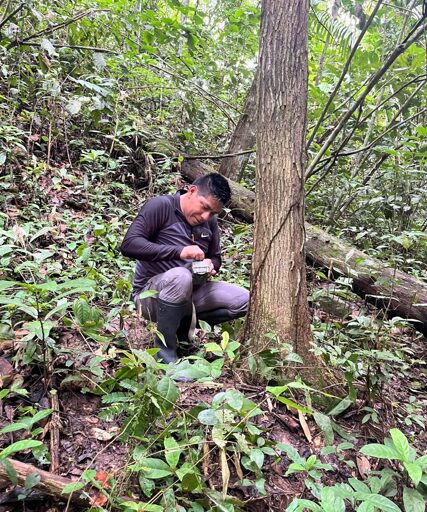
Founder’s Briefs: An occasional series where Mongabay founder Rhett Ayers Butler shares analysis, perspectives and story summaries. For most of Peru’s scientific history, Indigenous knowledge has existed outside the formal record. It shaped how forests were used, how species were managed, and how risk was understood, but rarely appeared in journals or policy. The boundary is shifting. One of the researchers bringing community knowledge into the scientific literature is Richar Antonio Demetrio, an Asháninka from the central Peruvian Amazon, reports contributor Xilena Pinedo for Mongabay. In March 2025, Demetrio became the lead author of a peer-reviewed paper documenting Asháninka knowledge of stingless bees, published in the journal Ethnobiology and Conservation. It was the first time a member of the Asháninka people had led a study in a high-impact scientific journal. The paper catalogs how communities identify nesting trees, harvest honey without cutting forests, and manage pests using ash. Its findings are careful and empirical. Its significance lies elsewhere. Much of the information had circulated for generations without being treated as science. Demetrio’s path to authorship was indirect. Born in the community of Caperucía in Junín province, he trained as a teacher, served as a community leader in his early 20s, and later worked as a park ranger in the Asháninka Communal Reserve. His exposure to formal research came through short courses offered by Peru’s protected areas agency and, later, through collaboration with established scientists. He did not arrive with institutional authority. He arrived with familiarity: with language, with forest species,…This article was originally published on Mongabay
From Conservation news via This RSS Feed.