

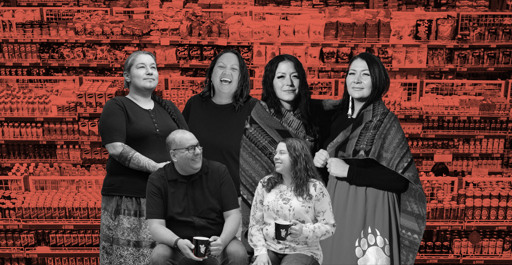

The lands and waters known as Canada are rich with Indigenous grown and manufactured foods, but they often aren’t on grocery store shelves due to high fees, challenging supply demands and efforts to balance production with cultural values. Illustration: Shawn Parkinson / The Narwhal. Photos: Supplied
This story was originally printed in The Narwhal and appears here with permission and minor style edits.
Walking down the aisles of one of “Canada’s” major groceries, it’s rare to see Indigenous food products. Even in smaller, independently-owned retailers, they are still few and far between. Fish might be from Alaska and seaweed from Japan, despite being plentiful on the coast of “British Columbia” and harvested by local First Nations. There are many “Canadian” products big and small, but Indigenous producers, as well as their local traditional foods, are rare. Where are the Indigenous goods?
Food is a unique gateway for bridging cultures and building understanding, and picking up a package of bannock mix or candied salmon is a tangible way of supporting Indigenous economies. For those seeking them, they’re not too hard to find at gift shops and independent markets, and directly purchasing from Indigenous businesses online and in person is an option too. But it left me wondering — what does it take to get Indigenous foods into grocery stores? And is the effort worth it for the companies?
The production costs can be high, while the margins can be low, business owners told me. Grocery stores can charge producers high fees to be on their shelves, and distributors can want a cut of the profit too, while expecting low costs on wholesale goods. Meanwhile, meeting large orders and checking all the boxes can challenge the capacity of small businesses.
Kelsey Coutts is co-owner of Bangin’ Bannock, which sells premade bannock mix and is based in Coast Salish territories. She said covering those fees requires raising the price. “Then who are we catering to, who is it for, if it’s very expensive?” she asked. At the same time, Indigenous food producers are like other businesses: they want to reach more customers and be sustainable.
So, how docompanies break into these stores — and do they even want to? Read on.

Kelsey Coutts (left) and Destiny Houshte are co-founders of Bangin’ Bannock. Coutts said community support was integral to them getting their company off the ground. Photo: Supplied by Bangin’ Bannock
Fees are a challenge for small producers, Indigenous businesses say
Some Indigenous producers have found a foothold in stores. Authentic Indigenous Seafood can be found in stores of all sizes, in particular their candied and canned salmon — and that’s because it is a supply chain co-operative that brings together about a half-dozen fisheries, making the costs more approachable. Authentic Indigenous Seafood takes in fish from Indigenous fisheries and takes on the often expensive roles of transporting, processing, packaging and marketing to get fish to market. The costs can be prohibitive when operating independently, especially cold storage for frozen fish.
Gordon Sterritt, chief executive officer of the co-operative and member of the Gitxsan Nation, said the idea came from a handful of Indigenous fisheries finding they didn’t have the capacity to do the processing and marketing individually.
Lena Russ, the co-operative’s special projects manager and a member of Haida Nation, said they would like to expand more into frozen fish in grocery stores, and into restaurants and wineries. For now, their shelf-stable preserved fish has been easier to transport and stock. Every bag or can of salmon gives details where the fish came from and which community caught it.
“It took us a while to get to a point where distribution is easy now, and we’re not fighting for sales,” she said.
The fees to be carried in a grocery store can be high. They vary by store, but food suppliers can face late delivery fees that can cost up to $1,200 per delivery, out of stock fees that can cost thousands, and unloading fees that can charge $500 per pallet of goods, according to a 2021 report from a working group on retail fees in the “Canadian” food industry. The working group said shelf fees — essentially, the cost to claim space in a grocery aisle — broadly made sense to food suppliers, but other fees were more contentious for lacking transparency and being unpredictable.
Grocery stores largely keep data on these fees confidential, but anecdotal research found between 15 per cent and 40 per cent of sales could go to the grocery store, according to the report.
There can also be fees to the small producer if goods get damaged, even if it happens in the grocery store, Greg Taylor said. He’s an advisor for Lake Babine Nation, which owns Talok Fisheries.
“If your products get damaged in their stores or their process, they charge you back for them at the price they would have sold them for — not at the cost they bought them for,” he said. “And this is the damage done in theirshop.”


Authentic Indigenous Seafood’s collective structure means independent fisheries can access equipment, refrigeration and transportation that can be too expensive for a small operation to take on alone. Photos: Supplied by Authentic Indigenous Seafood
Some grocery stores have local programs that waive shelving fees for local businesses, like the Loblaw small supplier program. But overall, the fees can be prohibitive for small companies, Shyra Barberstock, chief executive officer of Anishinaabe tea and coffee company Kebaonish, said — making it largely worth it for them to prioritize seeking direct sales or working with smaller stores, at least while they grow.
“Our main focus right now is working with smaller independent businesses … but we do expect that as we expand, we also will eventually be in mainstream supermarkets,” she said.
Sayisi Dene chef Sarah Meconse Mierau had a similar experience. Mierau runs Tradish, where she started out selling teas and jams, and expanded to a food truck, catering and running The Ancestor Café at “Fort Langley.” Initially, she wanted Indigenous people to be able to see her jams with plant medicines in the grocery store, but she quickly realized the cost of getting into the big chains “wasn’t very feasible.” She said it didn’t align with her cultural protocols to profit off selling plant medicines. Instead, she prices them just to cover the cost of producing them, and makes a profit from the other parts of her business.
Jordan Hocking, founder of Sriracha Revolver Hot Sauce, said bigger chains often require business owners to put their products on sale for a certain amount of time each year, but the business owner has to pay the difference in price to make up for the customer’s discount. “I can see why it’s not always a place people want to stay, or go, in the first place,” she said.
Hocking, a member of Sweetgrass First Nation, said getting commercial kitchen space to create enough supply is another high cost. She got coaching and access to a kitchen from Andrea Gray-Grant, founder of Good to Grow, which provides training support for emerging food and beverage companies.

Sriracha Revolver founder Jordan Hocking said small businesses are often making high quality products, which makes them less competitive price-wise. “Your product may have better ingredients, but the consumer doesn’t always know that, or isn’t able to hear your story from the shelf to know why they want to invest in you,” she said. Photo: Supplied by Sriracha Revolver
Pursuing growth while upholding values
Sterritt pointed out that post-contact, First Nations were restricted to reserves and prevented from living off traditional foods. After operating fisheries for millennia, communities were sidelined in the newly imposed system and found it hard to compete.
Sterritt first began working in fisheries in 1997 and said for a long time, due to these systemic issues, it could feel like their project was “never going to get anywhere.” But business really took off the past couple years, and Authentic Indigenous Seafood received an Indigenous Business Award in 2024.
Operating as a collective works better for the small, in-river fisheries run by Indigenous communities that are prioritizing sustainable harvest. These fisheries harvest salmon close to their spawning grounds, according to the number that have managed to return in a given year. Marine fisheries, on the other hand, will catch large numbers of fish mid-migration based on spawning predictions, before it’s known how many will actually get to their spawning grounds.
“Our fisheries have to be sustainable. They have to have that conservation focus,” Sterritt said.
Challenges such as climate change and natural disasters, including the 2019 Big Bar landslide and Chilcotin landslide in 2024, affect their planned fisheries. But Authentic Indigenous Seafood hopes to grow, which depends on partnering with more fisheries.
“We have huge opportunities, we just need to have the supply,” Sterritt said.
For others, maintaining high-quality ingredients or sustainable packaging that align with their values and protocols can also make it hard to meet supply demands of bigger chains. Hocking’s hot sauces don’t rely on traditional Indigenous ingredients, but for businesses that do work exclusively with those foods, maintaining a consistent supply year-round “can be a real challenge,” she said. “If you’re going to make a relationship with a large retailer, they’re going to expect that you are going to supply that product when they need it … So that is intimidating.”
Mireau uses all organic and local ingredients in her Tradish jams, and hemp labels for the jars, and acknowledges that gets expensive. She wants to keep the cost per jar as low as possible, and the easiest way to do that is to sell them at markets and online. She’d prefer bigger chains mark up products to create their own profits, rather than cut into the independent businesses’ profits by asking for a lower price.
“Our profit margin is already so small,” she said. “They want us to do it for literally nothing.”

Trained chef Sarah Meconse Mierau said culinary school helped her learn the ins and outs of running a food business. She focuses on selling her jams and teas directly to people to keep the cost as accessible as possible. Photo: Supplied by Tradish

Sarah Meconse Mierau said the glass jars, hemp labels and all-organic ingredients cost her $15 per jar of jam to make, and she sells them at $20 to cover overhead costs. She could cut costs by using cheaper materials and ingredients, but she’s not willing to sacrifice on the quality or the values she upholds, she said. Photo: Supplied by Tradish
Collaboration, mentorship and community are key to success
Coutts is working with distributors to sell her bannock mix, but said the capacity demands can be very high for such a small company. There can be last minute, very large orders that are hard for a small team to fulfill.
“We do it — but it can be a bit stressful,” she said.
Coutts said Bangin’ Bannock was only possible due to community support. In their first year, before they had the funds for a warehouse space, Squamish Nation’s Chief Joe Mathias Centre let Coutts and co-founder Destiny Houshte use the recreation centre’s kitchen to make their mixes. Coutts is Nak’azdli Dakelh and Houshte is Assiniboine.
“That’s the only reason we were able to begin,” Coutts said. “Just the community who decided to open their hearts and their doors and allow us to come in and succeed.”
She said she and Houshte combined their two family bannock recipes, and it was a winner on the first try. Then they created a gluten-free version.
“That was super fun too, because you’d have the uncles in and we’re getting up to try all the different tasters of bannocks and jams,” she said of the recipe development process.

Kelsey Coutts said federal requirements called for French on Bangin’ Bannock packages, but she and Destiny Houshte pushed back to include Cree and Nakota instead, the languages spoken by their families. Photo: Supplied by Bangin’ Bannock
She said peer support and mentorship has been key. “The small Indigenous business world is just so uplifting and so supporting and so loving,” she said.
Bangin’ Bannock is currently stocked in over 150 stores across “Canada,” and while Coutts and Houshte are more focused on smaller stores that are more community-oriented, Coutts said she sees the value in getting on big grocery store shelves for the representation of Indigenous foods. She wants young people to see Indigenous products where they shop. And that representation can also lead to connection, she said.
She’s found “bannock is a golden ticket to be able to have a non-threatening conversation with many curious people,” she said.
“We’re able to have conversations about food sovereignty, and about reservations and residential schools and all of the history that brought us to what bannock is,” she said.
“It’s so much more than fried bread — it’s a really full history.”
The post Why aren’t there more Indigenous foods in ‘Canadian’ grocery stores? appeared first on Indiginews.
From Indiginews via This RSS Feed.