

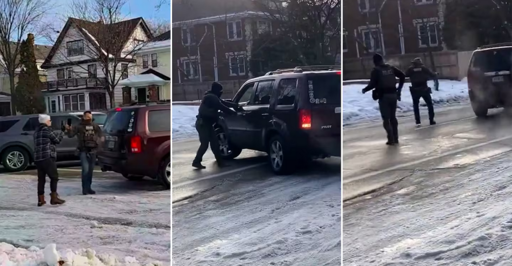

Moments before the murder of Rachel Good by federal secret police (X, 1/7/26).
Millions have seen the video, but some reports suggest that you should not believe your eyes that saw ICE agents murder Renee Nicole Good as she attempted to slowly move her car away from them.
What you are instructed to believe, according to Donald Trump (USA Today, 1/7/26), and those in media who obey him, is that Good was “a professional agitator,” who was “very disorderly, obstructing and resisting, who then violently, willfully and viciously ran over the ICE Officer, who seems to have shot her in self defense.”
You’re to understand that Good was engaged in “an act of domestic terrorism,” according to Homeland Security Secretary Kristi Noem (PBS NewsHour, 1/7/26), and that “an officer of ours acted quickly and defensively shot to protect himself and the people around him.”
‘Deep divide’

NPR (1/8/26) wants you to know it doesn’t know much.
NPR (1/8/26) underscored the idea that you should wait before decrying a murder, saying reactions to the killing “reflect outrage over Good’s death and a deep divide in how it’s portrayed—as either a tragic abuse of power or an officer acting in self-defense.”
Only after setting up readers up with six paragraphs of (relevant, we’re to understand) details about how officer Jonathan Ross had previously “sustained injuries’ from “an anti-ICE rioter” who was a “Mexican national,” NPR allowed as how Minnesota Attorney General Keith Ellison “disagrees with Noem’s characterization of Good as a domestic terrorist.”
In the 13th paragraph, we get the mayor of Minneapolis: “Frey said of the self-defense explanation, ‘Having seen the video myself, I want to tell everybody that is bullshit.'”
Did the NPR reporters see the video themselves? Can they tell us whether or not this is bullshit? How exactly do they define the job of reporting?
‘Before facts could be established’
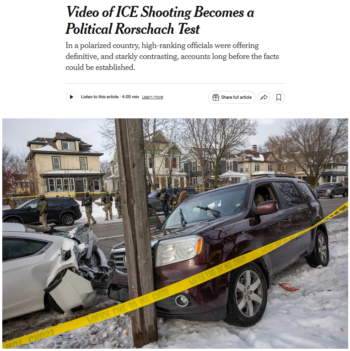
For the New York Times (1/7/26), the smart response is to say that reality is unknowable.
The New York Times (1/8/26) seeks points for having “pressed” Trump on what he insists is reality—”We Pressed Trump on His Conclusion About the ICE Shooting” read the headline—and for printing that he showed a “reflexive defense of what has become a sometimes violent federal crackdown on immigration.”
Setting aside whether there is a crackdown on “immigration” or on some and not other immigrants, that supposed journalistic bravery has to battle in Times readers’ minds with the textbook garbage they also put forward with the piece by Kurt Streeter headed “Video of ICE Shooting Becomes a Political Rorschach Test” (1/7/26).
That piece explained that you can’t really know what you saw, or what it means, because “in a polarized country, high-ranking officials were offering definitive, and starkly contrasting, accounts long before the facts could be established.”
The Times sees its role as telling you that whether or not you believe Renee Good deserved to be murdered depends on whether you’re a Democrat or a Republican. Someone should tell them that millions of Americans are over that old line.
But still, for the New York Times, you are to ignore what you saw, and ponder:
Was the officer struck by the vehicle, as President Trump insists, or did the car pass by or around him? Was he positioned in front of the vehicle or to the side? Did he have a genuine, reasonable fear for his life in that moment, or did he create the very danger he then used lethal force to escape?
That pondering of never-answered questions, you see, is what smart people do. It leads to nothing changing, which is convenient, but you can always say you thought deeply and from all sides.
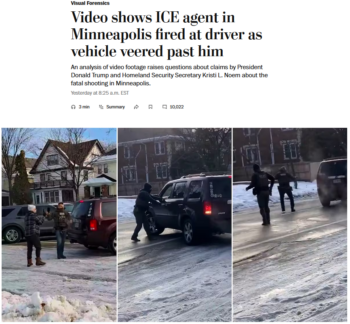
The Washington Post (1/8/26) employs an advanced journalistic technique called “looking at the video.”
Not like those “political leaders” who “deliver[ed] their verdicts within hours.” Or like all of us evidently unsophisticated people did in reaction to the slow-motion murder of George Floyd. We are all, the Times says, doing wrong by picking a pro– or anti–state-sanctioned murder side, when “facts are not established, but the first words from political leaders are conclusive and set the frame—and with it, the battle lines.”
Even the Trump-pandering Washington Post (1/8/26) was able to perform the basic function of journalism by describing the reality shown in the video. Its headline stated: “Video Shows ICE Agent in Minneapolis Fired at Driver as Vehicle Veered Past Him.”
But the subhead had to say that the video “raises questions about claims by President Donald Trump and Homeland Security Secretary Kristi L. Noem about the fatal shooting in Minneapolis.”
Corporate media are demanding we ignore what we see and only listen to what they say.
From FAIR via This RSS Feed.
I feel like every fair.org post is pure gold. So invaluable!