

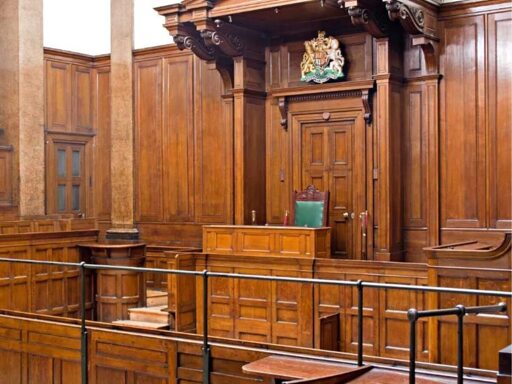
It’s a bright new year, and Labour are still lurching ahead with its plans to scrap the right to jury trials for thousands of cases. They’ve cited the massive backlog of court cases, causing record waits for criminal justice procedures. Alongside this, it’s worth remembering a simple fact – huge numbers of courtrooms are sitting idle.
In fact, on 8 January 14% of Crown courtrooms in England and Wales weren’t sitting. To put it another way, of the 516 Crown courtrooms available, 70 were empty.
Courtrooms are empty ‘not because there are too many juries’
Back in November, over 100 lawyers – including 24 King’s Council – wrote an open letter to justice secretary David Lammy to express “deep concern” in response to the Leveson Review of the criminal court, which originally suggested restricting the right to jury trials.
The letter made it clear that:
The simplest solution is more court sitting days in existing courts, and judges and lawyers to staff them.
The letter also explained that diverting judges from sitting Crown Court jury trials would not reduce the backlog. Likewise, if there’s money to pay new judges, it should be going to the Crown Court as it currently exists.
Similarly, the proposed Crown Court Bench Division – that is, a judge sitting with two magistrates and no jury – would not be free. It would need deliberation rooms, office space, waiting rooms, cells and docks. If there’s money for these facilities, surely it should go towards making full use of the existing Crown Courtrooms.
Nevertheless, on 2 December, Lammy confirmed that he will remove the right to trial by jury for thousands of ‘either-way’ cases – that is, trials which could take place either at the Crown or Magistrates Courts.
In reply, shadow chancellor Robert Jenrick pointed out in parliament on 2 December that:
This morning, more than 50 Crown courtrooms sit empty in England alone. In fact, over 21,000 court days have gone unused this year. Why? Not because there are too many juries, but because the Justice Secretary will not fund the sitting days. Had he done so, the backlog would have shrunk by up to 10,000 cases, but the fact is that it has risen this year.
‘Up to half of Britain’s courtrooms sit idle’
As it turns out, 2 December was actually the best day for courtroom use for the entirety of the following month:
- On the day of the announcement, 2 December, 10 % – 53 out of the 516 – didn’t sit across both England and Wales.
- Later, on 5 December, 70 Crown courtrooms sat empty. That’s 14 %.
- The worst day of last month was 22 December. Some 215 – 42% of Crown courtrooms – were idle.
- As courts re-opened on 2 January, 347 did not sit cases. That’s more than two in every three, topping out at 67%.
In case you might think this is a problem isolated to the holiday period – it isn’t. In June of last year, the Telegraph reported that:
Up to half of Britain’s crown courts stand idle each day as victims face record delays of four or more years for justice, analysis has found. […]
A third of courtrooms at more than a dozen major court centres have been lying empty on any given day since December, according to a league table compiled by Crush Crime, the campaign group.
Analysing official figures, it found the “most idle” was Winchester, where 53 per cent of courtrooms were shut on any given day since December.
The Central Criminal Court – most commonly known as the Old Bailey – was the second-worst, with 43 per cent of its courtrooms standing idle.
‘Nothing to do with reducing delays’
So, if so many courtrooms are sitting empty, and the creation of judge-only trials might not actually save money, you’d be forgiven for asking why the hell Labour is even contemplating restricting the right to jury trials.
Well, fortunately, courts minister Sarah Sackman just managed to answer that very question. Because, you know, Labour can never help but say the quiet part out loud. Sackman told MPs:
People ask me – Sarah, would you be doing this if there wasn’t a crisis in our courts? I say yes, because we need a better system where courts, not criminals, triage cases. One that makes better use of jurors’ time.
For the record, ‘triage’ is sorting the urgency with which something or someone needs (usually medical) attention. Judge-only trials are not a triage system. By analogy, it’s foisting the work of a full medical staff onto one doctor and telling them to do whatever they fancy.
Riel Karmy-Jones KC, Criminal Bar Association chairman, stated:
Sarah Sackman’s comment demonstrates that the Government’s actions have nothing to do with victims, and nothing to do with rectifying the backlog, and nothing to do with reducing delays.
Rather, in stating that they are ‘taking this crisis and turning it into an opportunity’, they have shown their true colours – they simply do not trust ordinary people. This is a change born out of ideology. It has no sound evidential basis, and there has been no impact assessment.
If this was about speeding up the justice system, surely we’d be making full use of the courts we do have. Most importantly, if it was about justice, we would not be talking about restricting the right to one of the cornerstones of the justice system.
But then, Lammy’s plan was never about justice. This is an ideological venture, plain and simple – and an attack on the freedom of the public, to boot.
Featured image via the Canary
From Canary via This RSS Feed.