

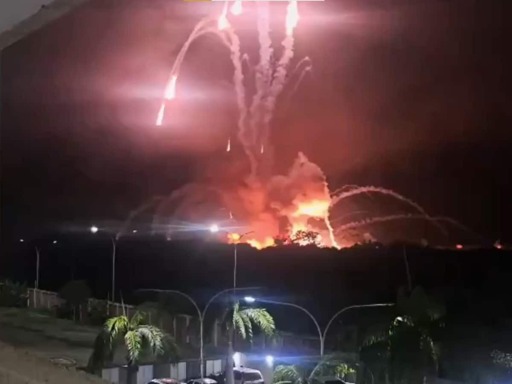
In the wake of recent US bombings against Venezuela and the kidnapping of president Nicolás Maduro and his wife, Cilia Flores, daily life is gradually returning to normal as the country grapples with the aftermath of deadly US aggression. The Bolivarian government remains in place under acting president Delcy Rodríguez, who has assured continuity.
The attack on Venezuela
In the early hours of 3 January, US aircraft bombed numerous civilian, military, government, and critical infrastructure sites across Venezuela’s northern region, in and around the capital, Caracas. Venezuelan authorities have confirmed two civilians and 56 military officers killed, while dozens are injured, but information is still being gathered.
The following 72 hours after the attack were marked by some uneasiness among the people in and around the capital, Caracas, where the US strikes heavily impacted civilians, military and government locations. Some people were seen queuing outside the few shops that opened to secure enough food and water, fearing another bomb attack or difficulties obtaining these essentials.
However, there were no reports of chaos or looting anywhere in the country, and the streets remained calm and mostly empty while police and military patrols increased. As of Tuesday, normal commercial activity and public transport resumed across Caracas and the rest of the country. Public recreational areas, such as parks, malls, and some beaches in La Guaira state, were seen with families before school returns on 12 January.
The sense of calm comes as Venezuelan authorities have reassured governance and call for unity and serenity amid the unprecedented situation. On Monday, Rodríguez, who was serving as Maduro’s vice president, was sworn in as acting president in accordance with national legislation.
Rodríguez’s first acts were to ratify a “state of external commotion,” an emergency decree to mobilize the nation against foreign aggression, and to assign a high-level commission for the liberation and return of president Maduro and Flores. On 5 January she said:
President Maduro is still the constitutional president.
The acting president has also called on Washington to work on an “agenda of cooperation” based on sovereignty and non-interference, while explicitly rejecting the claims of President Donald Trump and his officials that the US was “in charge” of the Caribbean nation.
During a meeting on 6 January with the country’s agri-food, industrial, and communal sectors to reinforce sovereign production, Rodríguez said:
We are governing together with the people. We have a constitutional government; no external agent is ruling Venezuela.
Rodríguez emphasized that, despite the recent unilateral and unlawful aggression by the United States:
The people are active in the streets, marching for peace in our country, demanding the freedom of our heroes [Maduro and Flores].
Since mid-August, Washington has militarised the Caribbean Sea and has extrajudicially killed at least 115 civilians on small boats. More recently, Trump imposed a naval blockade against Venezuela, seizing two tankers carrying Venezuelan heavy crude.
The blockade aims to suffocate the country’s economy, which relies heavily on oil revenue, further aggravated by the preceding array of unilateral coercive measures since 2017.
Defence minister Vladimir Padrino López has assured that the Bolivarian Armed Forces (FANB) is committed to preserving the country’s democratic continuity. He referred to the US attacks as “criminal” and Maduro’s abduction as a “cowardly kidnapping.”
On 5 January, Maduro appeared in a New York court charged with narco-terrorism, conspiracy to import cocaine, and weapons offences. Since then, the US Department of Justice quietly dismissed the claim that the Venezuelan president led a drug outfit called the Cartel of the Suns, admitting that it did not exist, according to a New York Times report.
Pleading not guilty, Maduro told the court:
I’m a war prisoner. I am innocent, and I am still president.
Flores also pleaded not guilty. Legal experts have confirmed that the Venezuelan leader is entitled to protection from prosecution as the head of a sovereign state.
President Trump has repeatedly stated that the US intends to “take control” of Venezuela and extract “a tremendous amount of wealth” from the ground, as alleged compensation for the early 2000s oil re-nationalization carried out by Hugo Chávez to assert sovereignty over the country’s natural resources. Venezuela has the largest oil reserves in the world.
Venezuelans mourn amid wreckage
In Catia La Mar parish, La Guaira state, about 31 kilometres north of Caracas, US strikes targeted a naval academy. A projectile hit a nearby three-story residential building in the Soublette sector, destroying eight of the 16 apartments in the housing block.
An 80-year-old woman, Rosa González, died after suffering a trauma to the chest, and nine others were injured. Tibisay Suárez, an 82-year-old Alzheimer’s patient, was severely wounded.
82-year-old José Luis González, Rosa’s brother, told local reporters:
The front door flew off with the impact and threw me against the wall.
His house of 57 years is now destroyed. Rosa was buried on Monday in a small chapel as a shocked and mournful community began cleaning the wreckage and working with local authorities to rebuild.
The bombings also hit a police training centre and a strategic port in La Guaira, destroying multiple shipping containers, warehouses, and a security post. La Guaira’s governor, José Alejandro Terán, reported that one of the destroyed containers had medication for kidney-disease patients.
Another civilian fatality occurred in El Hatillo municipality, Miranda state, where 45-year-old Colombian national Yohana Rodríguez Sierra was killed after two US missiles hit an airport and telecommunications antennas near her home. Rodríguez was being carried to a medical center when she died from her injuries in the arms of her 22-year-old daughter, Ana Corina Morales, who was mildly wounded.
The Venezuelan Institute for Scientific Research (IVIC), located in San António de los Altos, Miranda state, was also severely damaged by US strikes. An educational site dedicated to advancing scientific knowledge, mainly for medical and environmental purposes, was left with charred antennas and equipment and craters in the ground.
La Carlota Airbase, in Miranda state, as well as other military facilities and airports in Higuerote and Charallave, near Caracas, were impacted by bombs.
The capital, Caracas, saw the heaviest concentration of strikes. The Fuerte Tiuna military complex, where President Maduro’s residence is located, was the main target and suffered significant fire damage. US forces stormed the residence, killed 32 Cuban nationals, members of the president’s security team, before kidnapping Maduro and Flores.
Cuban President Miguel Díaz-Canel confirmed that the 32 Cuban combatants died after “fierce resistance” in direct combat against the US attackers or due to bombings, and were acting within defense cooperation agreements between Venezuela and Cuba.
Venezuela’s Bolivarian National Armed Forces (FANB) have also confirmed that at least 24 officers died in US attacks, posting videos of funeral tributes. The government has declared seven days of mourning to honour all those who lost their lives.
Fuerte Tiuna is home to both military structures and residential areas, including the large Ciudad Tiuna housing development, which contains several sports and cultural facilities. The bombings left nearby communities such as El Valle, Coche, Santa Mónica, El Cementerio, Caricuao and Cumbres de Curumo without electricity for over 24 hours.
Grassroots demand Maduro’s return
As daily life resumes, Venezuelan grassroots have taken to the streets every day since the bombings, pledging steadfast resistance to US intervention.
The first rally gathered near Miraflores Palace in Caracas, where popular leaders and local authorities spoke on an open stage to denounce the violation of Venezuela’s sovereignty and call for the return of president Maduro and Flores.
A man told the cheering crowd:
We have a brave people who will defend Bolivarian and Chavista socialism.
A larger rally on 4 January saw a collective pledge to defend the homeland and prepare for armed resistance. A woman proclaimed:
President Maduro, rest assured that your people love and support you; we will take up arms and defend our homeland.
On 6 January, women’s organisations led a march along Libertador Avenue in support of Flores, elected last year as deputy to the National Assembly and slated to be sworn in on 5 January.
Venezuela’s 5,336 communes—assembly-driven socialist organisations—have called a nationwide “great march” on 7 January to demand the liberation of Maduro and Flores and ratify communal resistance to what they describe as US neocolonial designs.
Featured image via the Canary
From Canary via This RSS Feed.