

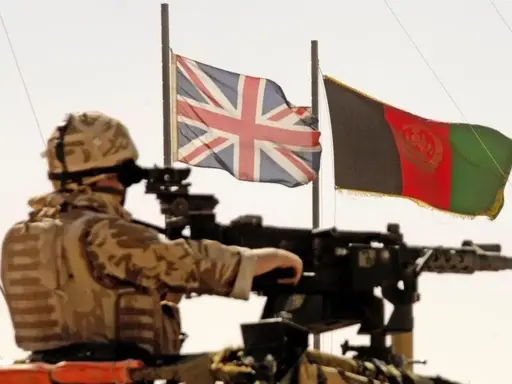
Paul Dixon’s new book, The Militarisation of British Democracy: The Iraq and Afghan Wars and the Rise of Authoritarianism, argues that the British military elite and a broader militarist coalition blundered into two unwinnable wars in Iraq and Afghanistan. Yet, they were never held to account and, paradoxically, emerged with their power enhanced.
Richard Dannatt
Recently disgraced lord general sir Richard Dannatt is a key figure in the book, having just been suspended from the House of Lords for four months. Paul Dixon defines the militarist (or pro-war) coalition as a “broad, loose, complex and diverse group”.
At its core is the British military elite, the powerful group of officers at the top of the armed forces, such as Dannatt, who served as head of the army from 2006.
Despite breaking parliamentary lobbying rules, Dannatt remains a columnist for GB News, a
platform he uses for warmongering. This continues a pattern of activism dating back to the early 2000s.
Presented as “A Very Honest General” in a 2006 Daily Mail interview, he was positioned as an army leader who frightens the life out of (allegedly dishonest) politicians. In the same article, he claimed the Afghanistan war was Britain’s chance to “get it right” after the failure in Iraq.
Dixon dissects this profile precisely. In it, Dannatt claimed his views were informed by Christianity and that the Judaeo-Christian tradition underpinned the army and British society. He believed Britain’s “weak values have allowed the predatory Islamist vision to take hold”.
Dannatt also leveraged unverified anecdotes, like the alleged “Selly Oak Hospital” incident, to dramatize the breakdown of the “military covenant” between the nation and its Armed Forces:
The case of a wounded soldier in Selly Oak Hospital in Birmingham being abused by an anti-war civilian showed a breakdown of the covenant. …the Army won’t let the nation down, but I don’t want the nation to let the Army down.
Dixon questions the veracity of this incident. The allegations were later investigated by the House of Commons Defence Committee (HCDC). Julie Moore, chief executive of University Hospital Birmingham NHS Foundation Trust, described them as “urban myths”.
The military political complex, as seen by Paul Dixon
These military elites, Paul Dixon argues:
[often] claim to be non-political, [but] their history suggests a close relationship with the political right, sympathy for monarchy and imperialism, and hostility to liberalism, socialism, feminism and democracy.
Dannatt became a Lord in 2011 after being nominated by David Cameron.
The book reveals the revolving door between politics and the military elite:
Military service ‘turbo-charged’ the political careers of Tom Tugendhat and Jonny Mercer, until Mercer’s heavy defeat at the 2024 general election.
Along with other military elites chronicled in the book, Dannatt comes from a unique stratum of British society: “white, male and privately educated”. This group includes general sir Mike Jackson, general sir David Richards, general sir Mike Walker, general sir Jock Stirrup, general sir Nick Houghton, and general sir Nick Carter.
Dixon frames the 9/11 attacks as transforming US foreign policy and accelerating tendencies “already apparent in Britain’s foreign policy”. At the Labour Party conference in 2001, Tony Blair ‘hugged the Americans close’ and claimed Britain had to pay a “blood price” to protect the “special relationship”.
This dynamic created a powerful incentive for both political and military leaders to commit to aggressive military action, framing it as a necessary demonstration of loyalty and strength. By 2009, for the military, Afghanistan provided an opportunity to restore their reputation in American eyes.
General Dannatt stated:
Taking steps to restore this credibility will be pivotal – and Afghanistan provides an opportunity.
Forgetting the Chilcot Report
The Militarisation of British Democracy: The Iraq and Afghan Wars scolds British media and culture for forgetting the findings of the Chilcot Inquiry and Report (2009–16):
Even after the Chilcot Report (2016) produced considerable evidence of the military elite’s failures, a strongly ‘militarised patriotic’ culture simply ignored and ‘forgot’ the report’s findings.
The Chilcot Report contradicted the military elite by revealing the extent of the British military’s role, in alliance with the US military, in maximising Britain’s involvement in both wars. Maximum British military involvement in the invasion was not necessary to preserve the “special relationship”. The report also showed how the Blair government was deferential to the military’s judgment and that Blair himself did not show great interest in the detail of military operations.
What Human Rights, argues Paul Dixon
Paul Dixon argues the militarist coalition has systematically undermined accountability for military human rights abuses.
This effort is often framed as protecting soldiers. For instance, Dannatt has expressed disappointment when proposed laws to shield veterans from prosecution over historical allegations in Iraq and Afghanistan were delayed or dropped, arguing that soldiers acting in good faith should not face relentless investigation.
Official investigations failed to deliver justice. The Iraq Historical Allegations Team (IHAT), set up in 2010 to probe abuses including torture, was closed in 2017 after examining 3,400 cases with zero prosecutions.
Operation Northmoor, investigating alleged illegal killings by British forces in Afghanistan, was also shut down without charges. Despite this, evidence of war crimes continued to emerge from reports by the Sunday Times and BBC Panorama.
The pattern mirrors the US response to atrocities like the 2005 Haditha massacre and the Abu Ghraib prison scandal: initial outrage is followed by cover-ups, a political backlash against prosecution and eventually minimal legal accountability.
Featured image via the Canary
By Anonymous
From Canary via This RSS Feed.