

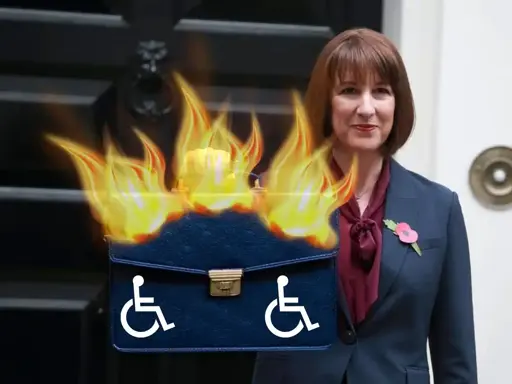
The Department for Work and Pensions (DWP) has yet to reveal which disabled people will bear the brunt of its £2bn cuts.
Six weeks after the DWP quietly revealed the cuts in budget documents, the department has still not responded to requests from Disability News Service (DNS) and the Liberal Democrats.
According to DNS:
Treasury documents, published on the day of the budget, showed that ministers will cut £85 million in 2026-27, £310 million in 2027-28, £520 million in 2028-29, £580 million in 2029-30 and £455 million in 2030-31, from spending on disability benefits.
The documents show the changes, to be introduced from April, are linked to plans to increase DWP’s “capacity” to reassess claimants of out-of-work disability benefits through the work capability assessment (WCA), increase the number of face-to-face benefit assessments, and extend personal independence payment (PIP) “award reviews periods”.
When DNS first asked the DWP for an explanation, it claimed the cuts would include:
tightening eligibility for overseas pension accrual, reforming Motability, and reducing duplication in benefit administration.
However, since then, it has admitted it made a mistake. In an apology to DNS, it claimed it had mistakenly referred to pensions and Motability cuts, which were separate budget measures.
Now, the DWP is still refusing to say who will be suffering the consequences of their latest cuts. It remains unclear how it will split the cuts between recipients of Personal Independence Payment (PIP) and out-of-work disability benefits.
Last month, a DWP press release provided details of the measures, without the figures to show how many disabled people will lose out, and by how much.
DWP: slashing support for disabled people
This comes as the DWP is also attempting to “rebalance” Universal Credit (UC). According to reports, the DWP will reallocate spending to encourage work and address purported perverse incentives within the benefits system. However, the health element of UC is set to be halved for new claimants.
But as the Canary previously reported:
On paper, this may seem like a simple arithmetic exercise: lift the baseline for everyone and tighten targeted support. But for chronically ill and disabled Universal Credit claimants, this “rebalance” is a reckless, punitive reshaping of the welfare state that will leave many worse off, poorer, and more vulnerable.
This means that anyone found entitled to the health element will receive only £217.26 per month, instead of the previous amount of £432.27. This amount has also been frozen until at least 2029/30.
This only applies to new applicants, meaning that two people with very similar health conditions will receive wildly different amounts of UC.
Making matters worse
Research shows that the DWP reducing financial support does not help disabled people – it simply makes life harder for them.
As the Canary’s Steve Topple said:
Cutting support for disabled people does not just strain incomes, it worsens health outcomes. Poverty and ill health are mutually reinforcing: less money means poorer nutrition, more stress, inability to afford heating or medications, and greater barriers to accessing treatment. In practice, this policy accelerates a brutal cycle where people are penalised for being sick.
These DWP cuts could throw thousands of disabled people into, or even further into, poverty.
Keeping disabled people in the dark about huge changes that could affect them is dangerous and anxiety-provoking. It makes us wonder how bad it really is when they won’t even publish who the cuts will affect.
The DWP could be taking the opportunity to fix some of the problems that previous Conservative administrations have caused. Instead, they are throwing disabled and chronically ill people under the bus. There is no doubt that soon, Starmer and Reeves will have even more blood on their hands.
Feature image via HG
By HG
From Canary via This RSS Feed.