

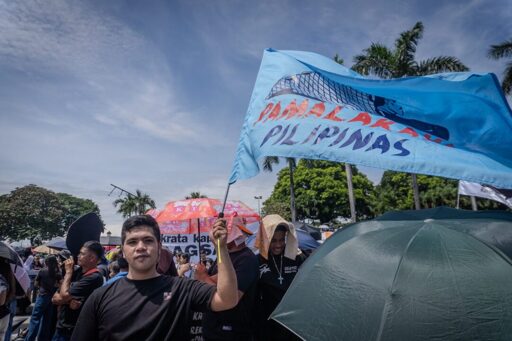
MANILA – At the start of the year, fisherfolk under the banner of Pambansang Lakas ng Kilusang Mamamalakaya (Pamalakaya) call on the government to review clean energy projects that trample the human rights and welfare of coastal communities.
In a statement, Pamalakaya pointed out that tens of thousands of fishing families were affected by renewable energy projects that the Department of Energy (DOE) granted permits.
The group flagged the projects to be built in coastal communities including a 23,000-hectare offshore wind farm in San Miguel Bay, Camarines Sur; a Buhawin offshore wind farm in Ilocos Norte; an offshore floating solar farm in Laguna de Bay; Guimaras Strait Offshore Solar Wind Farm in Panay and Negros Islands; and Quezon North Wind Farm.
There are a total of 1,319 commercial renewable energy projects in the Philippines, 22 percent of them are wind projects while 39 percent are solar projects.
“A transition to clean energy should not trample socio-economic rights of the fisherfolk and coastal communities,” Pamalakaya national chairperson Fernando Hicap said in a statement. “Moreover, it should not lead to privatization and corporatization of communal fishing grounds.”
The group estimates that over 8,000 fisherfolks and more than 2,000 individuals in the aquaculture sector are affected by the construction of the floating solar farm project. Meanwhile, 6,5000 fisherfolk in Ilocos Norte are seen to lose their livelihood — traditional fishing — to the offshore wind farms.
They call on the Department of Environment and Natural Resources (DENR) to review some renewable energy projects over potential threat to environment and socio-economic rights of the coastal communities.
In September 2025, Manila Observatory released a paper articulating that a narrow, carbon-centric transition agenda that focuses on compliance and restrictions without recognizing the plight carried by the marginalized sectors — farmers, fisherfolk, and Indigenous Peoples — worsen their situation.
“In particular, agricultural land and fishing areas are increasingly at risk of being converted for energy infrastructure projects in the name of transition, displacing food production and threatening rural livelihoods,” the paper reads.
It calls for the adoption of a just transition framework for Philippine agriculture, which seeks to address deeply-rooted injustices in access to land, capital, and even decision-making. It seeks to transform the marginalized sectors as active agents of innovation and resilience rather than passive victims of transition.
One particular victory, which Pamalakaya hailed, is the revocation of the memorandum of agreement (MOA) for the seabed quarrying operations of the Isla Verde Mining Development Company (IVMDC) in Caoayan and Santa, Ilocos Sur.
Before the dredging project started in 2024, fishers reportedly gather at least 100 cans (17 liters) of ipon (a species of gobies) per trip. But the dredging operations leave them with empty nets nowadays.
“This is an initial victory for the fisherfolk, their coastal communities, and fishing waters,” said Pamalakaya vice chairperson Ronnel Arambulo. “But this is not enough as the struggle continues for the fisherfolk due to the disruption of their livelihood. There should be sufficient compensation for the livelihood cost they lost and rehabilitation of their fishing grounds.”
IVMDC continues to operate despite being suspended, even outside what is allowed in the navigational channel and the river dredging zone. This became the ground of the cancellation of the company’s MOA with the DENR. (RTS)
The post Fishers kick off year fighting back vs dev’t aggression appeared first on Bulatlat.
From Bulatlat via This RSS Feed.