

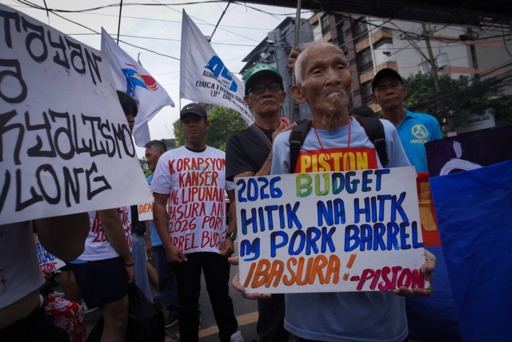
The 2026 General Appropriations Act prioritizes the interests of political elites over the needs of workers, farmers, fisherfolk, students, women, and the youth.
By Dulce Amor Rodriguez
Bulatlat.com
MANILA — President Ferdinand Marcos Jr. signed into law the 2026 General Appropriations Act (GAA), a move that progressive lawmakers and peasant groups said entrenches pork barrel allocations, patronage politics, and corruption-prone spending.
Members of the Makabayan bloc said that the signing of the 2026 budget shows that the administration chose to preserve systems of corruption instead of pursuing genuine reform. ACT Teachers Rep. Antonio Tinio, Gabriela Women’s Party Rep. Sarah Jane Elago, and Kabataan Rep. Renee Louise Co said that the president’s veto of P92.5 billion in unprogrammed appropriations failed to change the budget’s character.
They said the veto served as pampalubag-loob (consolation) while billions of pesos in pork barrel funds remain intact across key agencies. “The pork barrel system remains alive and well,” they said in a joint statement, warning that corruption is “guaranteed” under the signed budget.
At the center of criticism is the Department of Public Works and Highways which retained the so-called “allocables” system that allows lawmakers to identify infrastructure projects in their districts. Progressive groups have long flagged this mechanism as a rebranded pork barrel scheme that enables kickbacks, overpricing, and ghost projects.
The Makabayan bloc said that Marcos Jr avoided vetoing these allocables, ensuring the continuation of the most entrenched corruption system. They added that infrastructure funds have become a tool to maintain Malacañang’s influence over Congress through patronage.
The lawmakers also criticized the P73.2-billion Local Government Support Fund, including P15.33 billion for disaster rehabilitation carved out of the calamity fund. They said that these allocations function as local government pork vulnerable to political manipulation instead of genuine disaster response or development.
They further flagged the retention of P8 billion for the Support to Barangay Development Program under the National Task Force to End Local Communist Armed Conflict (NTF-ELCAC) which progressive groups have linked to militarization and human rights violations in rural communities.
Confidential and intelligence funds exceeding P11 billion remain in the budget, most of which are shielded from public scrutiny. Progressive lawmakers warned that these funds lack clear accountability mechanisms, making them prone to abuse.
They also criticized the expansion of patronage-based social assistance programs, including P63.9 billion for the Assistance to Individuals in Crisis Situation, P51.6 billion for the Medical Assistance to Indigent and Financially Incapacitated Patients, and P22.4 billion for the Tulong Panghanapbuhay sa Ating Disadvantaged Workers program. They said that these function as dole-outs controlled by politicians rather than rights-based social services.
“These are not solutions to poverty, unemployment, or lack of healthcare,” the Makabayan bloc said. “These are tools for vote-buying and political control.”
Farm-to-market roads
The Kilusang Magbubukid ng Pilipinas (KMP) echoed these concerns, particularly over the P33-billion allocation for farm-to-market roads in the 2026 budget. The group said that the program remains one of the most corruption-prone items in the national budget and serves as a major conduit for pork barrel politics.
KMP Chairperson Danilo Ramos said that lawmakers use farm-to-market roads to channel kickbacks through politically dictated projects. “In the name of helping farmers, billions are poured into road projects that farmers never asked for or never even see completed.”
The allocation ballooned far beyond original proposals and now exceeds P33 billion under the signed budget, according to KMP. Of this amount, P4.89 billion will go to Central Luzon, P4.3 billion to Eastern Visayas, P3.78 billion to Cagayan Valley, P3.57 billion to Soccsksargen, and P2.65 billion to Calabarzon.
For his part, KMP Secretary-General Ronnie Manalo said that the program has become “farm-to-pocket roads,” with funds siphoned through overpriced, substandard, or non-existent infrastructure. He said that the budget continues to neglect genuine agrarian reform, irrigation, and support for local agricultural production.
The peasant group criticized the retention of P150.5 billion in unprogrammed appropriations after the president vetoed P92.5 billion, describing the remaining amount as a massive presidential slush fund that allows spending outside the regular budget process. KMP said the fund lacks safeguards and has a long record of abuse.
“This budget is not for the people,” Ramos said. “It is a budget for pork, patronage, and the political survival of the Marcos regime.”
KMP further denounced allocations that it said fuel militarization in the countryside, including confidential and intelligence funds and the barangay program under the NTF-ELCAC. Manalo said that these funds bankroll surveillance, red-tagging, and harassment of rural communities instead of addressing poverty and landlessness.
The group stressed that assistance programs for farmers, including the Presidential Assistance to Farmers and Fisherfolk, function as soft pork funds that offer temporary relief while leaving structural problems unaddressed.
Progressive lawmakers and peasant groups said that the 2026 General Appropriations Act prioritizes the interests of political elites over the needs of workers, farmers, fisherfolk, students, women, and the youth. They reiterated calls to reject pork barrel politics and push for a budget that supports genuine land reform, national industrialization, decent jobs, and free, quality public services.
“This budget offers scraps to ordinary Filipinos while billions flow into corruption-prone programs,” the Makabayan bloc said. “Walang pagbabago, walang reporma, walang hustisya.” (There is no change, no reform, and no justice.) (DAA)
The post 2026 budget preserves pork barrel system appeared first on Bulatlat.
From Bulatlat via This RSS Feed.