


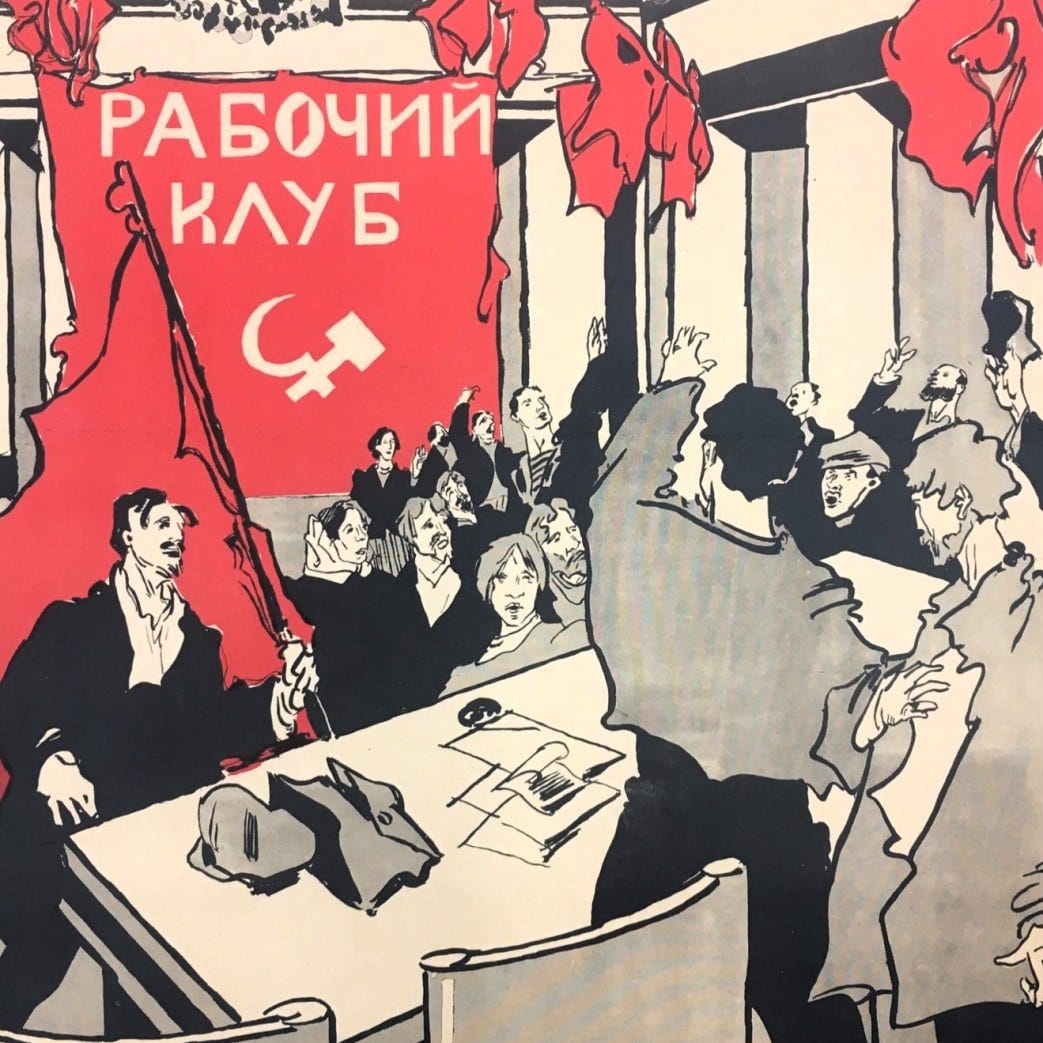
1920 poster depicting a social and educational workers’ club, printed by the Soviet Commissariat of Public Education
…We want to know everything that others know, we want to learn the details of all aspects of political life and to take part actively in every single political event. In order that we may do this, the intellectuals must talk to us less of what we already know and tell us more about what we do not yet know…
- Vladimir Lenin, What Is To Be Done (1902)
Introduction
These days, NYC-DSA feels like a laboratory. We’re testing the limits of how fast a socialist movement can grow and what that movement can achieve. What began as ~5,900 members in October 2024 is now over ~13,000 in January 2025. New members now outnumber those who were around before the Zohran campaign began. I myself joined and took an active role in DSA during the “Zohran Era.” That makes me both a test subject and researcher investigating the member experience over the past year.
DSA will continue to grow. As it does, we must use this unprecedented moment to understand why members join DSA, what their expectations are, and what they hope to learn from us. The results of the experiment in NYC-DSA can help us understand the profile of the average member who joins during a large local campaign, which many other chapters will replicate in 2026 or 2028.
Our onboarding process must go beyond surface-level engagement and give members a way to learn about the rich political life within DSA. Currently, there is an aversion within NYC-DSA leadership and our Membership Committee to integrate our organization’s politics into onboarding, due to a worry that it will stoke factionalism. To the contrary, without understanding and exposure to DSA’s political diversity, members are more likely to default to factionalism and retreat into their own corner of the organization, or bounce off entirely.
How do I Make the Change I Want to See?
My introduction to NYC-DSA has largely been a wonderful experience. I’d like to emphasize this at the start because when I later offer some criticisms, it’s because I feel passionately about improvement that retains the basic aspects of the chapter that made it appealing to me and others in the first place. My frame of reference for new member sentiment comes from the members I spoke to while canvassing, in the reading groups I’ve run, the dozens I’ve had onboarding calls and 1:1s with, and the conversations I’ve had while hosting Coffee with Comrades.
If I were to sum up the feelings of the average new member, it would be, “I felt like it was time to get organized and contribute to a socialist project.” This is the Democratic Socialists of America, so it makes sense that our members will have at least begun to develop their political perspective on socialism and have taken one of the biggest steps towards putting that perspective into practice: joining an organization. The triggers that push these members to join and the contributions they hope to make vary wildly, but what ties new members together is their belief that we are stronger as an organized group that can plan and coordinate our contributions around shared goals.
This perspective leads to new members being very curious about how DSA works, but that information is mostly absent from the member experience. I distinctly remember attending a Socialism 101, and when the event finished, someone sitting next to me leaned over and said, “That’s it? I didn’t learn anything about DSA, socialism, or what DSA thinks about socialism.”
In the conversations I’ve had with members, this is an increasingly common response to our onboarding process and introductory courses. There are a few main causes for this. First, DSA’s structure can be very complicated. There are few ready-made public resources, and the ones that do exist are, by their nature, difficult to understand. Second, there is a prevailing idea in the chapter that discussing internal politics will discourage member involvement, and that it’s better to avoid it unless members seek it out.
To the first point, steps are already being taken to solve the information deficit, like the creation of a NYC-DSA Wiki. The Membership Committee has also increased the frequency of Coffee With Comrades, which are both more informal than DSA 101s and more collective than individual onboarding. Members have reacted positively to these events in both respects.
To the second, I’ll once again give a disclaimer: I completely understand the desire not to disrupt the flow by mass-introducing all new members to our often messy internal debates. We have a world to win, and that will mostly be done in the work we do interacting with those not already in DSA. But members see the “democratic” in our name and have an understandable desire to know how they can participate in deciding our direction.
I chose to join DSA over any other org because, unlike other “communist” organizations with self-perpetuating boards of directors, there was a level of transparency and democracy easily visible from the outside. Most of its activities were public, and it had democratically elected leadership. I assumed there was a fairly low chance I was joining a cult or sect. So far, that assumption has proven correct. The main issue once joining wasn’t that any information was purposefully hidden, but that information was hard to find because there didn’t seem to be much local importance placed on the democratic process.
Eventually, I learned that the question many new members ask themselves—***“*How do I make the change I want to see?” —does not have a simple answer. And that’s because the answer is “You’ll have to convince people to work with you or find a group that’s already doing what you want to do.” This is where the difficulty really begins.
The incentive structure created by DSA’s existing ecosystem encourages caucuses and working groups to compete for new members who show interest in DSA to enlist them in their projects. Members will be mobilized as foot soldiers for already existing groups, sometimes without being fully conscious of this fact. Caucuses will leverage their organizing relationships with new members to get them out to vote for their preferred candidates, and most of these voters wouldn’t be able to tell you the difference between one leadership slate and another. Their participation in the chapter is defined by a factional lens from the outset, despite onboarders’ best efforts to avoid discussing factions.
Members who become especially active will quickly learn about caucuses. At a certain level, this is unavoidable; caucuses are political formations that seek to influence the direction of DSA, both inside and out. However, instead of being introduced to caucuses in a low-stakes and multi-tendency environment, a member’s education on factions will generally come from the work they’re passionate about being dominated by one group or another. This contradiction has no easy solution. Providing better educational resources during onboarding can help, but there is little initiative within the chapter to encourage that education. Members’ access to resources to be able to seek that information out themselves will also be uneven.
The Current Process
When I first joined DSA, the advice I was given was to split my time into three categories: “Social, Praxis, and Theory.” I still believe this trifold division is a good base for building an onboarding program:
-
Social - Not everything should be work. We want our bread, and our roses too! NYC-DSA has so many amazing members who host events, create sports/hobby clubs, and provide spaces where we can enjoy each other’s company.
-
Praxis - We’ve all joined DSA to advance democratic socialism, and there’s always some way to advance the cause. Whether that’s knocking doors, creating content, or salting a workplace, there’s something for everyone.
-
Theory - This is a broad category that includes political education, reading groups, and trainings. New members should be encouraged to learn about DSA, expand their skills, and discuss politics with other members to develop their perspective.
NYC-DSA’s biggest strength by far is the vibrant social life of the chapter. It’s easy to discount this, but it really does play a significant role in making members feel at home. I couldn’t count on my fingers how many new members have told me something along the lines of “It’s so nice to be able to hang out and know everyone else is a socialist.”
Our options for practical work are also robust and varied. There’s obviously the Tax the Rich and Rapid Response campaigns ramping up, but outside of that, there’s an array of projects in tenant and workplace organizing, anti-war actions, and the administrative work it takes to keep the chapter running. In such a large chapter, there’s bound to be a division of labor, and that has made the chapter strong as members are encouraged to find a place that feels right to them, where they can lend their skills and labor to building the socialist movement while also being able to try new, productive outlets. With so many options, however, it is often difficult for new members to know where to plug in.
Where NYC-DSA struggles the most is in the learning category. Until recently, it was all hands on deck for the Zohran campaign. I understood just as well as anyone that winning a mandate in the November elections would have huge ramifications over the next few years. But even now, with the campaign over, members are still rarely encouraged to learn as often as they’re encouraged to contribute their labor to a new campaign or attend one of the many socials/fundraisers.
Now that the Zohran campaign has come to a close, we need a model for members to learn and collaborate with each other while developing their engagement in social activities and practical work. Let’s keep our working groups and campaigns, but we need to carve out space for new members to learn the political stakes of the organization in a constructive environment and take the reins of their experience into their own hands.
The Cohort Model
To illustrate what this might look like, I’d offer the reading groups on Revolutionary Strategy (2006) I’ve been coordinating over much of the past year as an example. I’ve structured the groups to connect DSA’s present democratic and socialist traditions to the history of our movement: like the socialist and communist Internationals, the Bolsheviks, the Social Democratic Party of Germany (SPD), the Socialist Party of America (SPA), and Marx himself, which many have already read. This shouldn’t necessarily be surprising, but most people don’t join and pay money to a socialist organization without some basic knowledge of the history of socialism. If there’s anything that they’re less familiar with, my syllabus offers helpful supplemental materials along the way.
At the beginning of the group, I introduce a basic guiding question that I’ll try to help them all answer: “How do I make the change I want to see now that I’m a DSA member?” A few weeks in, we cover the political tendencies in DSA as well as notable issues and dividing lines, using the recent National Convention as a case study. As the group comes to a close, we dive into our own local context to help get everyone plugged into all that NYC-DSA has to offer.
A big advantage of doing this in a reading group instead of as a presentation, PDF, or even a DSA 101/201 is that it offers a way for new members to get the hang of discussing socialist politics and DSA-specific issues in a low-stakes and multi-tendency environment with the same group of people. Individual onboarding is more relational than DSA 101s, but lacks the collectivity members crave. Coffee with Comrades offers a more collective onboarding experience, but serves mainly for one-off events with limited follow-up. The two times I ran my reading group, we all grew our knowledge of DSA together by sharing what work we were getting plugged into, what events we were attending, and what happenings were drawing our attention locally, and the relationships those members built with each other lasted beyond the group itself.
I recently proposed something similar to the Membership Committee—a sort of “DSA 301.” This would be a multi-week onboarding revolving around The Long Reroute: A Historical Comparison of the Debsian Socialist Party of America and the New Democratic Socialists of America (2025), an article by SMC member David Duhalde. The goal of the group would be to introduce the history of DSA, the roots of our debates in American socialism, and quickly bring members up to date on the questions DSA faces today. This suggestion was deemed too “factional,” since caucuses are mentioned in the article, and it was implied that the onboarding could be used to whip votes around election-time. But it bears repeating that it is not a question of if members will learn about DSA’s internal politics, but when and how. And a reading group is no more rife for factional whipping than a field lead shift or a campaign meeting.
My proposal may have been shot down, but I strongly believe in the importance of thinking in terms of “cohort” onboarding as we continue to grow. We should actively facilitate opportunities for new members to be introduced to DSA collectively and learn and grow together. This can continue informally, through reading group facilitators taking on more responsibilities, or ideally through the formal creation of new onboarding procedures. In cohorts of 15-20 people, led by one or two facilitators, these groups can plan events, collectively attend established DSA events, read materials that relate to DSA in some way, and create online and in-person spaces for members to organize together on projects and initiatives.
The current 1:1 model of onboarding provides a more personal experience and should be continued. But as NYC-DSA grows, the cohort model is a scalable way to onboard more members at once, which also offers members the guidance of experienced onboarder(s) for weeks or even months as they integrate into the chapter.
We could begin testing the waters of this initiative by offering it as a follow-up to members after they’ve completed a NYC-DSA 101 or 201. Not everyone will want to join an “onboarding cohort,” but we should provide the option for members who desire a comprehensive, collaborative, and collective introduction to DSA. Limiting it to promotions at DSA 101s and 201s also filters for the types of members that an onboarding cohort would appeal to: mostly new to DSA, willing to go to an in-person meeting of socialists where they may not know anyone else, and explicitly looking to learn more. These first experiments would provide valuable feedback, experience, and training for future onboarding cohorts. Once we’ve ironed out the program, we could begin offering it as an alternative to a one-time onboarding for those who want a more thorough introduction.
I recently listened to an episode of Left on Red where Susan Kang perfectly put into words what joining DSA feels like: “Joining a political organization is like trying to find someone to sit at lunch with when you’re new to middle school.” Members will understandably be overwhelmed by the breadth of working groups, political debates, caucuses, elections. Providing a low-stakes cohort option for onboarding is the best way to help new members to not feel intimidated in the “lunchroom” that is NYC-DSA.
From The Socialist Tribune via This RSS Feed.