

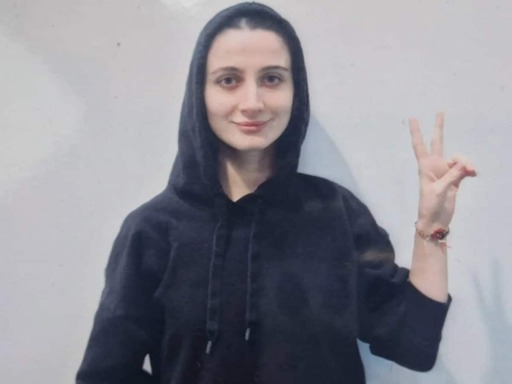
State cruelty has forced UK political prisoner Teuta (‘T’) Hoxha to pause her hunger strike. Keir Starmer’s government has faced UN criticism over its blatant disinterest in hunger strikers’ well-being. And after two months with no food, supporters say:
T needs urgent medical care in hospital
Hunger strike paused
The state has held T in jail for more than a year without a conviction, and her trial isn’t due until April 2026. Her excessively harsh treatment over alleged damages to an Israeli weapons factory in Bristol in 2024 is due to the pro-Israel government‘s political persecution of direct action group Palestine Action.
As T’s 17-year-old sister Rahma told the Canary:
My sister is my best friend, my soulmate and my mother figure…
I feel as if the state have taken away a piece of me and shattered my heart.
Prisoners for Palestine said on 5 January that:
The prison is refusing T medical treatment which is required to prevent death in extreme cases of starvation.
They added:
We keep witnessing the prisons and Ministry of Justice break their own policies and guidelines regarding the treatment and response to hunger strikers.
The government has tried to ‘condition society to accept this and not ask questions’
Speaking about T, Rahma told the Canary:
I don’t want to lose my sister, I don’t want to imagine a life without her, I need her in my life, I love her so much, I am so grateful for her – she always cheers me up
She stressed:
I really miss her and wished the state wasn’t cruel.
Uncompassionate state actions include authorities removing Rahma’s phone number from T’s contact list for a month, she said, “which ruined me”. On top of this, it’s:
so hard to visit her as I have to take an adult and it takes a whole day’s journey… [and] the train tickets are very expensive.
When she has seen T in recent weeks, she stated, her sister spoke of “headaches and constantly feeling nauseous”. She was also suffering from very weak limbs, including arms so skinny “I could see her bones”.
The government’s highly controversial proscription of Palestine Action led to such extreme treatment of political prisoners that T saw hunger-striking as a necessity. In part, Rahma explained, this was because T:
believes that, once you’re labelled a terrorist, you have entered a black hole and society is conditioned to accept and not ask questions
Former Guantánamo abductee Mansoor Adayfi echoed this in an article announcing a hunger strike in solidarity with the Palestine Action captives.
Resist the ‘stripping of our humanity’
In the same way genocide requires dehumanisation, so does repression of dissent. As Adayfi highlighted:
Violent words are meant to strip you of your humanity so the public doesn’t have to feel the sting of your suffering.
The “open mockery”, “smirks”, “cowardice”, and “deliberate contempt” we have seen from political elites in response to the hunger strikes are very much because they think they can get away with what they’re doing.
We’re living in a time of genocide and assaults on international law to serve and protect the criminals behind it. The crimes of Guantánamo didn’t disappear. As Adayfi insisted, they were simply “experiments” that have been:
exported. Absorbed. Normalised. And now, they are applied inside [our] prisons.
Western governments have learned techniques and language from each other that help them get away with caging people and stretching the law to crush dissent. And they won’t stop doing this until we challenge them head on.
That’s why we must keep speaking up about the human rights of political prisoners like T, and about the establishment assault on international law that’s trampling all over them.
Featured image via the Canary
By Ed Sykes
From Canary via This RSS Feed.