

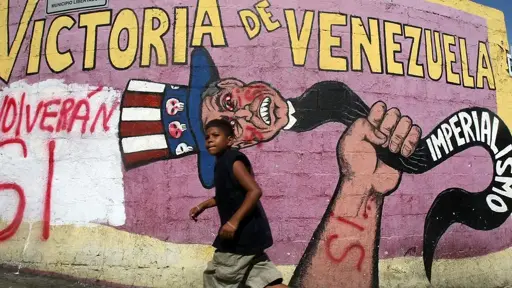
In this article, I examine the motivations for Trump’s attack in the context of a new cold war with China. The forceful removal of Maduro should be interpreted as the first step in implementing Trump’s National Security Strategy, which calls for a regroupment of military forces to the Western Hemisphere, at the same time pointing to a renewed push for domination in the region, as well as a recognition of its limits as world hegemon. A more aggressive policy toward Latin America will face resistance from within the United States and from the region’s social movements, labor, and left organizations.
Motivations
It should be obvious to anyone by now that the main reason for the military invasion of Venezuela and the kidnapping of Nicolás Maduro–and, by doing so, the decapitatation of the Venezuelan government–has nothing to do with combatting drug trafficking. Not only is this story hard to believe when Trump is, at the same time, pardoning scores of people serving time for drug-trafficking, like former Honduran president Juan Orlando Hernández. But also, as Trump himself noted in the public conference after the military operation, access to Venezuela’s oil reserves alongside its mineral deposits are at the center of U.S. motivations to overthrow Maduro.
Venezuela’s oil reserves, amounting to 300 billion barrels are today the largest in the world. Furthermore, this is heavy crude oil, not the less dense shale oil produced through fracking, which the US has more than enough of. This highly viscose oil can be used to make diesel, asphalt, and other petroleum derivatives that shale oil is not suitable for. Furthermore, American refineries in the Gulf Coast and in the midwest were built decades ago to process heavy crude oil. These refineries need at least a certain percentage of heavy crude to operate efficiently, reason why the U.S. currently imports some 3-6 millions of barrels of crude oil a day. Venezuela’s oil will no doubt represent a boon for U.S. refineries, although some questions remain about the feasibility of reviving the countries oil infrastructure. In order to secure the massive investment needed to maximize oil extraction, U.S. capital will require stability.
Yet there is another reason why Venezuela was in American empire’s crosshairs, and it also has to do with its oil. In 2023, China bought almost 70% of the oil Venezuela exported. Even though this represents only around 5% of China’s oil imports, with enough investment from the Asian country, daily production could increase exponentially. Venezuela’s oil exports to China are only a measure of the Asian giant’s rapidly growing influence in Latin America. China has become the top trading partner for South America (the second one after the U.S. for Latin America as a whole). Furthermore, Chinese investment, and particularly its focus on energy sources and infrastructure has probably sounded an alarm in Washington DC.
Chinese state companies operate large swaths of the electric and distribution grid in South American countries, more than half of Chile’s grid, the whole area of Lima, Peru, and an area covering 60 million people in Brazil. A similar trend can be observed with key natural resources, such as lithium or cobalt. With the decapitation of the Venezuelan regime, the Trump administration drew a line in the sand for China’s penetration in Latin America. It is at the same time reclaiming territorial dominance over the continent, securing access to valuable natural resources, some of which have regained importance with the AI-race and the battle with China for technological supremacy, sending a message to the rest of Latin America with the warning: we will not tolerate a government that does not align with American interests.
Making Sense of the Overthrow of Maduro
The violent ouster (and kidnapping) of Nicolás Maduro is an obvious escalation in U.S.’s hostility against rival national leaders. It is a flagrant violation of international law and the UN charter as well as an obvious infringement of Venezuela’s sovereignty. To find a similar example of a unilateral use of force against U.S. opponents in Latin America, we have to go back more than 30 years to invasion of Panama by George H.W. Bush in 1989.
How to interpret this shift in foreign policy? On the one hand, it signals a leap in the level of military action the US is willing to use to discipline governments that challenge US dominance in Latin America (or who have drifted too far into China’s sphere of influence). The swift operation alone sends a signal to other countries and national leaders in the region trying to chart a path of certain independence from the U.S.
The document on National Security Strategy published by the White House in November lays out a new roadmap in foreign policy, to bring a “readjustment of our global military presence to address urgent threats in our Hemisphere” and away from other regions that are less pressing today. In other words, the U.S. is partially retreating from the world scene to regroup forces and strengthen its presence in the Western hemisphere. It is an implicit recognition of the waning power of the U.S. in an increasingly multi-polar world. Greg Grandin has observed that the U.S. has retrenched to Latin America twice during the twentieth century, after overstretching its forces globally: once in 1930 during the great depression, and the second time in the 1970s, after its defeat in Vietnam.
Lastly, news reports about the military operation mention an “inside” contact in Maduro’s circle of confidence. In fact, the relative ease with which the US whisked Maduro away, in a blitz operation with almost no casualties, seems to signal that a growing number of high-ranking officials were ready to let Maduro go, at least some of them openly collaborating with the U.S., as reported in different media.
Ripples
The violent ouster of Maduro is an alert for all Latin America. It sends a message to other rival governments in the region, such as Petro’s in Colombia, Sheinbaum’s in Mexico, or Lula’s in Brazil. If the message was not clear enough, we can always count on Trump to say the quite part loud, explicitly pointing to Colombia and Cuba as possible next targets. A larger U.S. presence in Latin America will mean more repression of its people, an increase in the plunder of natural resources, and a political agenda that will seek to take away social rights and cut social spending, deteriorating people’s lives for the benefit of foreign corporations.
The total disregard of international law undermines U.S. legitimacy and puts into question the whole post-WW2 international order. If the claims that the U.S. wages war on countries all over the world in defense of freedom and democracy were already hard to believe before this event, it is now untenable even as a rhetorical device. The assault on Latin America’s sovereignty, social rights, and natural resources will no doubt unleash a renewed anti-American sentiment across the region. As Brian Winter warns, Trump’s new incursion in Latin America can “[plant] the seeds of an anti-American backlash that could outlive the current administration.”
What Now?
The main question today, after taking out Maduro, is how will the U.S. guarantee that the new leader enacts more U.S.-friendly policies? Although Trump said not to fear a ground operation, it is clear that this would be deeply unpopular in the US, including among the MAGA base, who overwhelming rejects having the U.S. involved in another “forever war”. As Marjorie Taylor Greene put it, “this is the same Washington playbook that we’re so sick and tired of, that doesn’t serve the American people, but actually serves the big corporations, the banks, and the oil executives.”
Venezuela is a vast territory with 30 million people, twice as large as Iraq. And however unpopular the regime has become in the past decade or so, there is a deep sentiment of empowerment and sovereignty among much of its population. A ground operation could easily become a quagmire for the Trump administration. Even though Trump said the administration is not afraid of “boots on the ground”, a military occupation of Venezuela has high chances of going awry.
The obvious choice for replacing Maduro, from Trump’s perspective, was opposition leader María Corina Machado. Trump’s decision not to force the transition of power to her seems puzzling. But Machado is, in fact, a polarizing figure, who doesn’t have an overwhelming support in Venezuela.
So, the plan relies on the willingness of the high commands of Madurismo to forsake their –at least in rhetoric – anti-imperialist program, and work with Trump, open the country for American oil companies, stop shipping oil to China. How feasible is this? Well, at this point we know that there has been some level of collusion between at least some of Maduro’s high commands and the Trump administration: someone helped strike the blow. Maybe even Delcy Rodriguez, or her brother Jorge, who had been an interlocutor of the US government over the past few years. But these are only speculations. In any case, the insurmountable pressure the US government put on the Venezuelan government through the deployment of warships and the repeated bombing of boats off the country’s coast must have made the option of giving up Maduro to preserve Chavismo easier to digest.
The writing was on the wall, Maduro was on the way out. Yet a complete selling out to the US would face at least two obstacles: on the one hand, it would require a unified armed forces behind this plan, a split among high or mid-rank military commands would elicit a blood-bath, a fratricidal war, in which the US would become embroiled and would no doubt make more bloody. Second: it will inevitably unleash resistance among working-class people. Delcy Rodriguez gave a relatively combative speech against the U.S., demanding the release of Nicolás Maduro. But very quickly her tone changed, including profuse calls for peace and an explicit “invitation to the US government to work together on a cooperation agenda, aimed at a joined development, within the framework of international law…”. It may well be that, as Angel Arias proposes, the transition out of Maduro’s regime will be led by a Chavista government with an American gun to its head.
Take Action
The response from most Latin American governments has ranged from a tepid condemnation to outright celebratory. Yet US’s agenda in Latin America will face opposition, if not from the bourgeoisie and their politicians, from working-class people and their organizations. There have been mobilizations in virtually every country in Latin America since Saturday. And even though the ghastly popularity of the Maduro regime made it easier for people in Latin America to support a U.S. intervention, we can expect widespread rejection to further attacks. Resistance to U.S. imperialism, honed throughout the 20th century, is part of Latin Americans’ collective memory.
It was not due to self-restraint that the United States refrained from deploying a more direct colonial rule in the region–it was a response to opposition to U.S. encroachment in many forms: revolutions, boycotts, national liberation movements, and in some cases, bourgeois nationalist political projects. As early as the 1910s, the Mexican revolution expropriated American capital and fended off U.S. military threats, setting limits to American expansionism southward. Almost fifty years later, decades of plunder and oppression sparked in the small nation-island off the coast of Florida the most spectacular revolution of the continent in modern times. The Cuban Revolution started as a national liberation movement against the United States, and it was only after a massive capital strike, boycotts and capital flight that the Castro leadership decided to expropriate the domestic and foreign bourgeoisie’s assets.
The neoliberal period, beginning with the coup against Salvador Allende in 1973 opened a period of free-trade, privatizations, and austerity policies recommended by Washington-led International Financial Institutions (primarily, the International Monetary Fund and the World Bank. These policies succeeded in their aims of dismantling social safety net, weakening labor movements, and further commodifying people’s lives. But it also sowed the seeds of a powerful backlash against neoliberalism that swept the region in the late 1990s and early 2000s. Mass mobilizations took to the streets, fought back against the police, took part in roadblocks and lootings, and toppled governments in several countries, including Argentina, Bolivia, and Ecuador.
Organized labor in Argentina, despite its bureaucratic character, called for six general strikes in 2001 alone. Indigenous organizations occupied Quito for months before the US-friendly government of Jamil Mahuad. Working masses won a long-drawn conflict against the privatization of the water–recommended by the World Bank–in Cochabamba in 2000. Only 3 years later, the militant proletariat of Bolivia, alongside Indigenous and peasant organizations, rose up to oppose the sale of gas to the U.S. with such strength and determination that not only the government had to backtrack, but also neoliberal president Gonzalo Sánchez de Lozada had to resign.
More recently, several countries have seen mass mobilizations against their governments, including Chile, Perú, Colombia, Ecuador and Bolivia. This gymnastic of protest and mobilization have hone a vanguard of struggle. The working class, social movements, and resistance in Latin America will no doubt pose a big challenge to US renewed military presence in the region. In a political conjuncture where U.S. imperialism seems all-powerful, it is important to keep these opposition forces in mind. The main task for revolutionaries in Latin America is to unite these efforts, to build a revolutionary organization that could wage these fights throughout the region, coordinate the resistance, and act as a gravitational pole for all those willing to fight U.S. imperialism.
Social movements for women’s rights, for the environment, intellectuals, student organizations, indigenous movements, organized labor, can all united under the leadership of a transnational working-class organization. As leader of the PTS in Argentina, Emilio Albamonte, comments, “How powerless would the enormous American mercenary army–armed to the teeth with high technology–be against the force of hundreds of millions of poor people led by the proletariat?”
There is an important role to play for us in the U.S. The tasks for progressives, left, anti-imperialist, and simply all pro-democracy individuals and organizations in the US is to undermine the empire’s capacity to wage a war of colonization against Latin American peoples. In fact, building a strong, working-class opposition within the empire will be key for the victory of resistance movements in Latin America. For this we can build from the experience and activist networks of the powerful pro-Palestine movement.
We must denounce the intervention in Venezuela and demand the immediate release of Nicolás Maduro. This does not mean lending any support to him or the Chavista/Maduro regime, but simply demanding to respect the sovereignty of Venezuela and its people. We must mobilize, protest, disrupt, join all demonstrations to repudiate the attack. We must demand our unions to take a clear stance against U.S. imperialism, and to not only issue statements but also call to actions in repudiation of the attack on Venezuela. True international solidarity demands from us to raise hell at home, throw sand in the gears of U.S. imperialism, create enough havoc that would push the government to curb its imperialist advance.
The post What’s Next for Venezuela and What Can You Do About It? appeared first on Left Voice.
From Left Voice via This RSS Feed.