

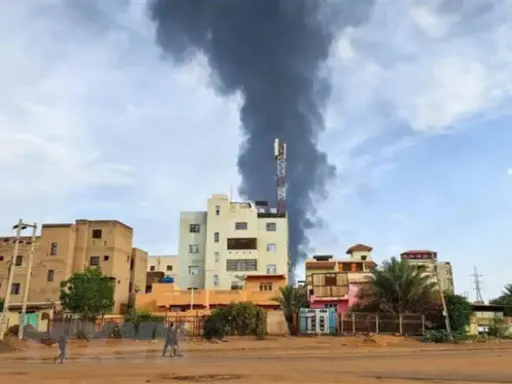
In recent days, the situation in Sudan has been deteriorating even further – as multiple children have been killed in the ongoing, Western-backed civil war.
On Saturday 3 January, drone strikes on the Sudanese villages of Al-Zurg and Ghurair caused civilian casualties. The infrastructure damage included a medical clinic and a marketplace, according to UN spokesperson Stéphane Dujarric.
On the same day, two further drone attacks struck near Kulbus in West Darfur. They reportedly killed one civilian. UN humanitarian partners have stated that attacks in the area have displaced over 600 people.
Meanwhile, in Dilling, South Kordofan, drone strikes over 1 – 3 January killed and injured multiple civilians. Humanitarian conditions also continue to worsen in the area, as the siege on Dilling prevents supplies from entering the area.
As of Sunday 4 January, at least 114 people had been killed.
Then, on Monday 5 January 13 people were killed – eight of them children – after a drone strike on a house in the Sudanese city of el-Obeid.
Dujarric stated during a press conference on 5 January:
We reiterate our call for the protection of civilians and for the unhindered humanitarian access to all affected areas.
Continued and predictable humanitarian access to deliver life-saving assistance and to prevent further deterioration of the humanitarian situation is essential.
Mass displacement in Sudan
The UN’s International Organisation for Migration (IOM) has stated that almost 65,000 civilians have fled Kordofan in the last three months alone. Of these, over 42,000 were from North Kordofan, 21,860 from the south, and 250 from Geibaish in the west.
However, these figures are preliminary, and could rise with new intelligence on the conflict in Sudan. Since the civil war between the Sudanese Armed Forces (SAF) and the paramilitary Rapid Support Forces (RSF) began, almost 13 million people have been displaced.
The RSF currently occupies five states, all of them in Darfur. For comparison, the SAF hold the other 13 states that make up Sudan – including Khartoum, the capital.
Both the SAF and RSF have been accused of human rights abuses and war crimes. The RSF, in particular, committed mass killings in El-Fasher, and have been accused of attempted genocide.
UK arms involved
The Sudanese government and human rights agencies have accused the United Arab Emirates of arming the RSF. As Middle East Eyeexplained:
Its leader, Hemedti, with a wealth estimated at $7bn in 2023, has financial ties with the UAE, which has supported the group in breach of UN arms embargoes.
The UAE has supplied the RSF with weapons through a complex network of supply lines and alliances across neighbouring Libya, Chad, Uganda, and breakaway regions of Somalia.
In May 2025, Amnesty International found that the UAE was sending advanced Chinese-made weaponry into Darfur.
Abu Dhabi holds significant interests in Sudan’’s agricultural and mineral sectors, much of which are untapped, including gold. The UAE has become a global trading hub in gold, in its attempts to diversify its oil-dependent economy.
Worse still, the UAE is a major customer for UK-made arms. Per a Guardian report from October 2025, the UN Security Council has proof that British equipment sold to the UAE is being used in Darfur by the RSF.
The Guardian also reported that several UK arms licenses have been granted to UAE since 2013. Despite evidence of these arms being used in Sudan, the UK even issued a further license in 2024.
The UK’s utterly careless trade in weaponry and wargear is dragging us into complicity with yet another genocide. The evidence that British arms are being used in Sudan could not be clearer – and yet our sales to the UAE are only increasing.
As Emily Apple, Campaign Against Arms Trade’s media coordinator, stated:
Our government knows that the UAE is diverting military equipment to the RSF for its war crimes. It knows that Israel is using UK military equipment in its genocide in Gaza. It knows it is breaching international law. This is an export system that lacks accountability, designed to safeguard the profits of arms dealers, no matter the cost.
Featured image via the Canary
From Canary via This RSS Feed.