

Bullets:
Half the world’s population now relies on telecommunications powered by Huawei and other Chinese companies.
China’s telecom companies are under heavy US and European sanction since 2017. Huawei and other firms are not allowed to import Western technology or components, and neither are they allowed to export telecom equipment to the United States and most of Europe.
But worldwide adoption of Huawei’s 5G stacks is accelerating. Chinese companies enjoy monopolistic access to the most important supply chains for 5G, and can build equipment faster and more affordably than Samsung, Nokia, and Ericsson.
Despite highly favorable regulatory and tax incentives, no US companies build 5G telecom systems.
Inside China / Business is a reader-supported publication. To receive new posts and support my work, consider becoming a free or paid subscriber.
Report:
Good morning.
Huawei is the most important tech company here, in China. And going back eight years, Huawei has been the target of US sanctions. The objective of these sanctions was to deny Huawei access to Western tools and technologies, and – it was believed then – Huawei and other Chinese companies would not be able to build advanced semiconductors, or build 5G telecom systems even inside China, but especially for export to the rest of the world.
Beginning in December of 2017, the first Trump Administration, Huawei and ZTE were specifically prohibited from selling equipment to the Pentagon. Next year the DOD added phones, then in August 2018 expanded the restriction to local governments. Then came a series of Executive Orders, rulings by the FCC and the Department of Commerce during the Biden Administration, now it’s Trump again.
All these efforts, across three presidential administrations now, have been for naught. As of three months ago, over 3 billion people outside China use 5G networks powered by Huawei equipment. That includes nine countries that are closely allied to the United States, and most of the NATO countries.
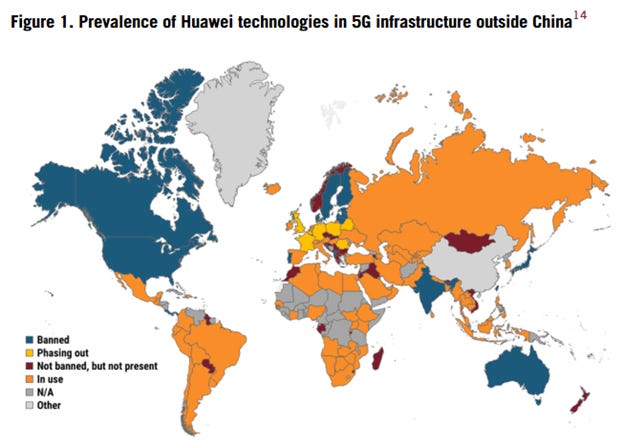
Here is the worldwide map, for the prevalence of Huawei equipment outside China. Yellow is Western Europe, and Huawei gear is in use but being phased out over time. Orange is where Huawei is in use.
Vietnam is marked red on the map, “Not banned, but not present.” That part needs updating. Huawei and ZTE recently signed deals to supply 5G equipment in Vietnam. Those came right after the high tariffs were announced against Vietnamese exports to the United States.
These contracts have not been widely reported; Huawei and a group of other companies got a $23 million contract for 5G in April, soon after the tariff announcements. ZTE won two other contracts, for over $20 million for 5G antennas. Those buys have US officials concerned, and warned that they might jeopardize access to advanced technology from the United States.
But that’s the problem, in Vietnam and scores of other countries on that map. It is China that has the advanced 5G technology that they need. Experts point out that this “battle for 5G supremacy” across the world is one of the most important competitions for the rest of the century. It has deep implications for national security and geopolitical influence, and China and the United States have different strategies to win that race.
The US and China started in the same position. Commercial 5G services began six years ago in both countries. But their approaches were radically different. For China, 5G was a key part of their economic and industrial strategy. In the United States, the focus was on getting regulations written so that the private sector would come in and make big investments in the industry.
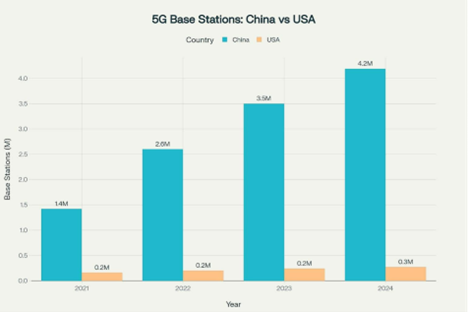
Here is where things stand today. Chinese have built over 4 million 5G base stations, compared to 270,000 for the United States. Over 15 times as many. It’s even more startling when we see how much faster: in the past three years, China added 2.7 million stations, while the US added 210,000:
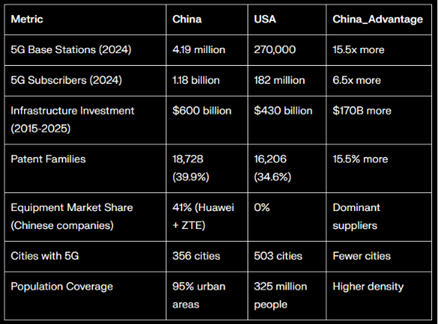
The table above compares the key metrics in the 5G race, with China leading in 5G base stations, subscribers, investment, patents, and market share—Huawei and ZTE combine for 41% of the global equipment market, while the United States is at zero:
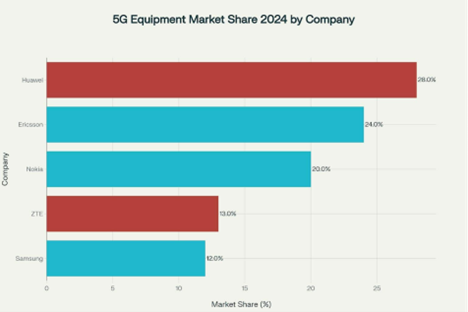
Remember the strategy: The United States changed the tax codes and the regulations, to encourage American companies to invest in and build 5G equipment. Three presidential administrations passed laws and signed executive orders and issued regulations to deny Chinese companies access to the American market, which should have been a boon to any American company who wanted to build the telecom gear.
But nobody did.
Be good.
Resources and links:
Backfire: Export Controls Helped Huawei and Hurt U.S. Firms
https://itif.org/publications/2025/10/27/backfire-export-controls-helped-huawei-and-hurt-us-firms/
The 5G Race: USA vs China - A Deep Dive into Global Technology Leadership
[ Personal Tiger
The 5G Race: USA vs China - A Deep Dive into Global Technology Leadership
The battle for 5G supremacy represents one of the most significant technological competitions of the 21st century. This race extends far beyond telecommunications, encompassing national security, economic dominance, and geopolitical influence. Two superpowers stand at the center of this competition: China and the United States, each pursuing dramaticall…
Read more
6 months ago · 1 like · PersonalTiger](https://personaltiger.substack.com/p/the-5g-race-usa-vs-china-a-deep-dive)
Reuters Exclusive: Huawei, ZTE seal 5G deals in Vietnam after US tariffs, as ties with China warm
https://www.reuters.com/world/china/huawei-zte-seal-5g-deals-vietnam-after-us-tariffs-ties-with-china-warm-2025-11-28/
Inside China / Business is a reader-supported publication. To receive new posts and support my work, consider becoming a free or paid subscriber.
From Inside China / Business via This RSS Feed.