

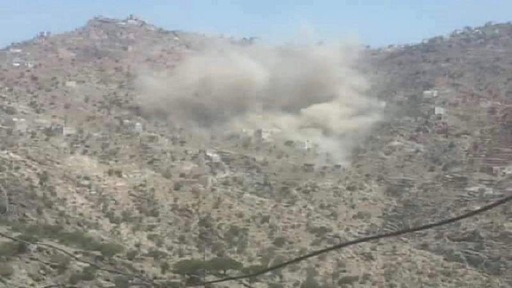
Over the past several days, the United Arab Emirates has suffered its first clear defeat in a direct power contest with Saudi Arabia in eastern Yemen. For the first time since its establishment in mid-2017, the Abu Dhabi-backed Southern Transitional Council (STC) has been forced to relinquish its military presence in the governorates of Hadramout and Al-Mahra. Under sustained ground pressure from Saudi-aligned Nation’s Shield forces – backed by Saudi airpower – the STC withdrew from all the military positions it had seized across both governorates.
The fighting, which began last Friday, ended last night with Nation’s Shield forces securing full control of Mukalla, the capital of Hadramout, one day after the fall of the First Military Region headquarters in Seiyun, the administrative center of Wadi Hadramout. Mukalla’s fall came after local tribes reclaimed the oil plateau in Ghayl Bin Yamin district, an area STC forces abandoned following intense clashes that preceded the arrival of Nation’s Shield units.
The STC initially attempted to reframe the setback by announcing on Friday evening a two-year transitional phase aimed at imposing a so-called “State of South Arabia.” The council later conceded defeat, however, and submitted to Saudi Arabia’s demand that it enter a South–South political dialogue under Riyadh’s patronage. In a statement posted on its official website, the STC said it welcomed Saudi Arabia’s call to sponsor a southern dialogue, portraying the move as consistent with its long-stated commitment to dialogue as the sole means of addressing political issues, foremost among them what it described as the southern people’s right to restore their state.
Observers see the announcement as a retreat driven by military pressure in Hadramout and Al-Mahra, where the STC suffered heavy losses and its fighters were seen fleeing multiple cities across Hadramout. Agence France-Presse cited an STC source as saying that Saudi airstrikes killed at least 80 STC fighters and wounded 152 others, while the fate of hundreds remains unknown, amid reports that around 130 were captured by Nation’s Shield forces.
Hours after the Saudi-aligned leadership of Hadramout governorate announced that Seiyun had been secured, pro-Saudi factions completed their deployment in Mukalla on Sunday afternoon. Local sources told Al-Akhbar that the forces spread throughout the city after taking control of Riyan Airport and Al-Dhaba oil terminal without direct clashes. The same sources said the Hadrami Elite Forces – the STC’s military arm along the Hadramout coast – fully withdrew from Mukalla, while several camps previously loyal to the UAE broke with the STC and surrendered without resistance after receiving Saudi assurances that their members would not be harmed and would be integrated into the Nation’s Shield forces.
Although STC units remain in Al-Mahra, having withdrawn from the city of Al-Ghaydah and refusing calls for a safe pullout from key facilities there, including Nishtun Port, the fall of Mukalla and Ash Shihr has left those forces effectively trapped. With their supply lines cut, they now face the prospect of capture unless an agreement is reached to allow them a safe exit toward Shabwa governorate.
The recent developments have revived talks of a self-rule plan for Hadramout, which covers roughly half of Yemen’s land area. In this context, informed political sources told Al-Akhbar that Saudi Arabia is moving to fully reassert control over Yemen’s eastern region – Shabwa, Hadramawt, and Al-Mahra – by pushing out UAE-backed forces. The sources added that Riyadh is also advancing moves in the oil-rich governorate of Shabwa, currently under STC control, with the goal of taking it over as well. This follows Saudi-aligned forces consolidating control over Hadramout’s valley, desert, and coastline, as well as the return of Hadramout Governor Salem Al-Khanbashi from Saudi Arabia to manage the administer from Seiyun for the first time in a decade.
The sources added that Shabwa Governor Awad Al-Wazir, a senior figure in the General People’s Congress with close ties to the UAE, has been urged to hand over the governorate. They said Saudi Arabia is carrying out military preparations in Al-Abr area near Shabwa, with plans to assert control in the coming days. If fighting in the eastern governorates ends, Riyadh is expected to consolidate its dominance there while leaving the southern governorates of Abyan, Aden, Lahij, and Al-Dhalea under STC control. Analysts view this as a sign of a new division of influence, with Saudi Arabia seeking to reshape Yemen into four regions – two in the south and two in the north.
First published by Al-Akhbar English.
The post Saudi Arabia pushes UAE allies out of eastern Yemen appeared first on Peoples Dispatch.
From Peoples Dispatch via This RSS Feed.