

Bullets:
China’s dominance in commercial shipbuilding is hugely advantageous to the Chinese Navy, which is now the largest in the world.
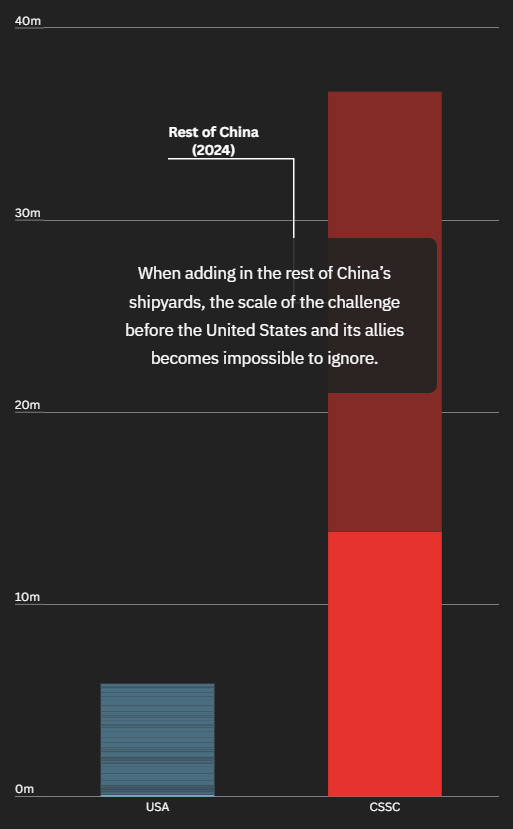
The shipbuilding industry in the United States exclusively serves the Pentagon; American shipyards built just five commercial ships in 2024, while just one Chinese firm built 250.
Russia, Iran, and North Korea also combine for a significant share of warship production.
China has taken over the global shipbuilding industry in the same way they have done, in so many others. Their factory sector has enormous productive capacity and slack, which results in intense competition, ruthless competition and efficiencies, and lower prices.
Inside China / Business is a reader-supported publication. To receive new posts and support my work, consider becoming a free or paid subscriber.
Report:
Good morning.
The Western world is slowing – but finally – waking up to the consequences of two generations of the financialization of our economies, across all the most important industries. The world’s productive economies – pulling raw materials out of the ground, and refining them, and turning them into real products in real factories—are now in China, and in the Global Majority countries.
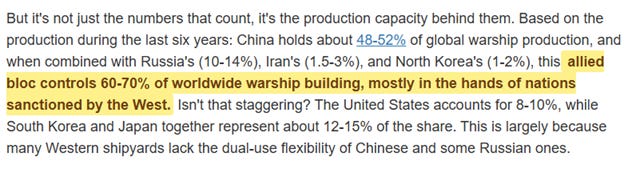
We’ll start with this amazing data point: Four countries, China plus Russia plus Iran plus North Korea— now control up to 70% of the worldwide industry for building navy ships, warships. Those four countries, under economic sanction by the West to prevent them from building weapons at all, build more military ships than the rest of the world combined.
How they got there is simple: a dual-use shipyard is one that can build military vessels, as well as civilian ones. Put a better way, it’s a shipyard that builds supertankers for oil companies, or giant cargo ships for food or raw materials coming into China, or builds giant container ships for Chinese factory products going the other way. And then some guys show up from the Chinese Navy and ask if they can get some ships with room on the top for some radars and big guns, and it’s no problem. China has 300 shipyards that build half the world’s commercial ships, and many of those also build for the Chinese Navy.
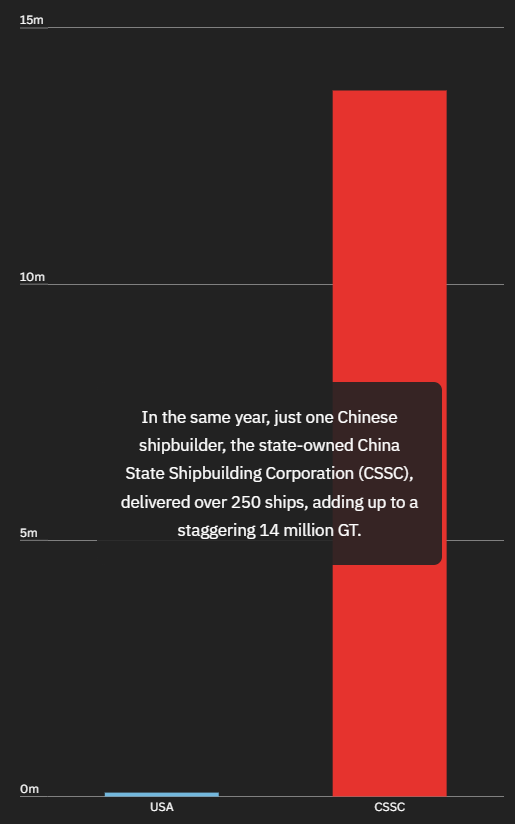
In 2024, US shipyards built five merchant ships, for a total of 76,000 gross tons. Also in 2024, just one Chinese shipbuilder, built 250 ships, totaling 14 million gross tons.
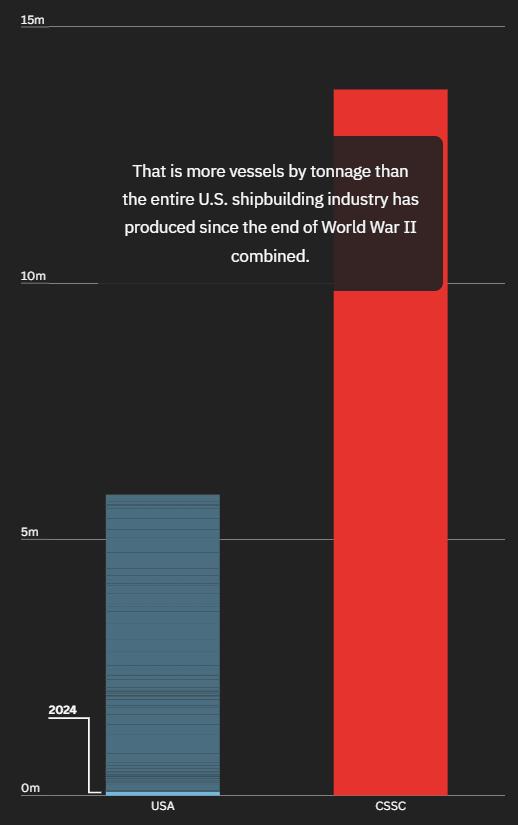
That one Chinese company, the China State Shipbuilding Corp, built more tonnage in 2024, than all the shipyards in the United States, combined, for the past 80 years.
This graphic adds the other shipbuilders from China—just in 2024:
The idea was that the Pentagon could focus on building ships for the Navy, and civilian firms can buy their ships from Japan and South Korea, and some friendly countries in Europe. Back in 2000, that probably seemed reasonable. Then ten years later, in 2010, Chinese shipyards had passed Korea and Japan, and today build more than Korea plus Japan plus everyone else:
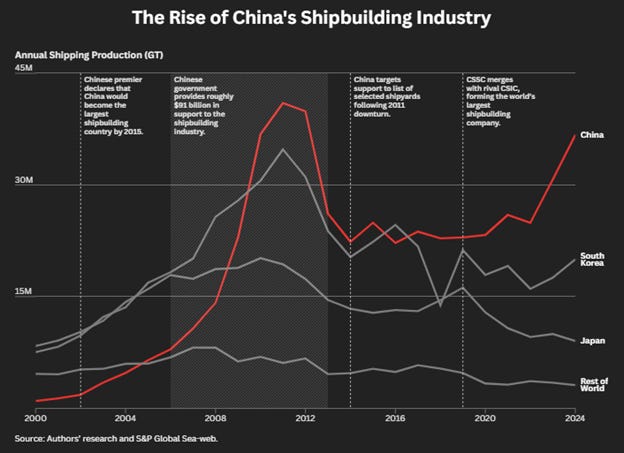
The supply chains, the shipyards, the highly skilled labor that can turn out whatever the commercial shipping industry needs are also necessary for building ships for military forces, and that red line for how many ships the Chinese Navy puts to sea is the result. It’s the biggest surface navy in the world, and still growing.
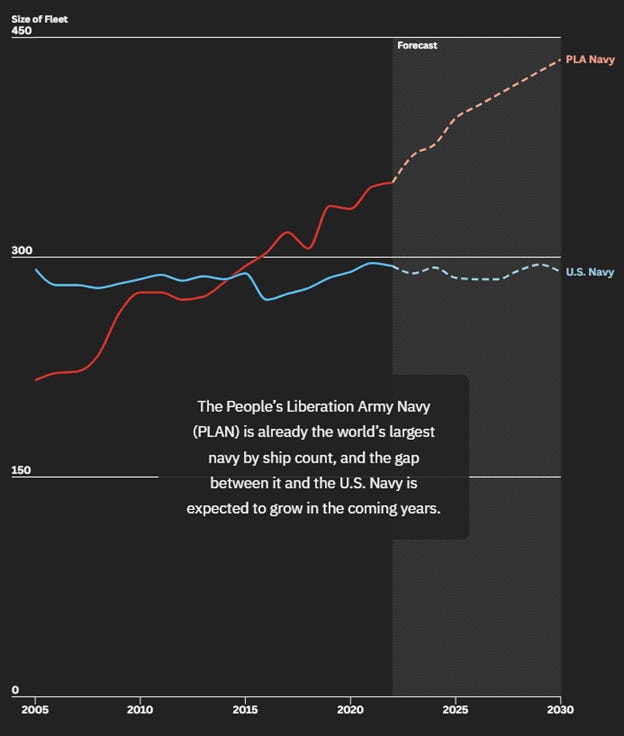
In just a six-year period, China built over 115 warships averaging about 20 per year. During the same time, the combined production of the US, Japan, and South Korea was about 50 ships. The United States doesn’t have dual-use shipyards; they are exclusively military. The bloc of shipbuilding countries closely allied to the United States combines for about a quarter of the world’s total capacity for navy ships. Seventy percent is in China, Russia, Iran and North Korea.
Looking at submarines, and the disparity is just as stark. China has 68 subs, with about 15 in the past six years. The United States also has 68, and have built fewer than half as many. Put all the Western countries together, and at current production rates China will have more than all of them, combined, before 2040.
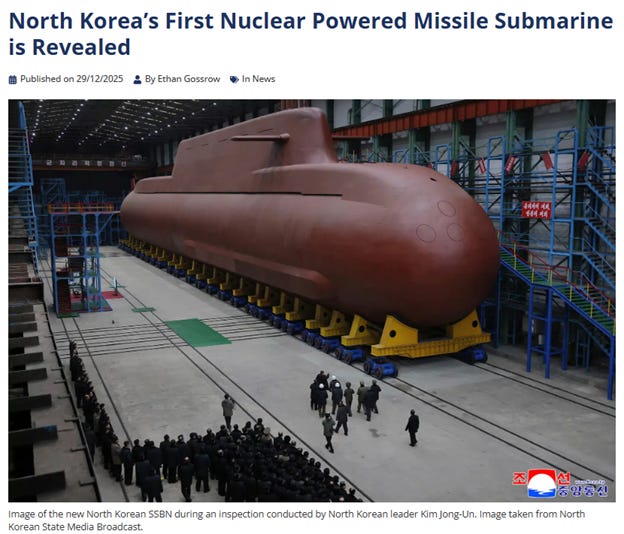
Here is the newest boat from North Korea. We need a disclaimer here that this is a new industry for North Korea—putting nuclear rockets on boats that go under the water is no easy thing. We can only guess how good they are at it, so far. But we also know that there are teams of people at the Pentagon and at intelligence bases elsewhere, and their full-time job now is knowing where that thing is, all the time.
The capability to build things, and to keep them maintained and repaired, is everything. And when our top officials and policymakers buy plane tickets and fly to China, and lecture the Chinese about their “overcapacity”, nobody here is quite sure what to make of that. Overcapacity means they have the capacity to build more. When I go into our factories here that build manufactured homes, and we’ve got new orders from Africa or Australia and we ask if they can build 200 houses this month instead of 80, it’s no problem—they’ll just add a half-shift for three months. And my price even goes down.
How is that not a huge advantage, for our company, and for that factory, and for our customers? And how is that not a huge advantage for the Chinese navy, who can walk into one of those dozens of shipyards and ask if they can please add to their previous order, and they say it’s no problem, they even get a better price than last year. Does anyone actually believe that would happen at a Pentagon contractor?
China’s “overcapacity” is an enormous advantage. All those companies, with all that capacity, competing against each other, and against all the other shipyards on earth. Quite obviously it’s a serious problem now for the Pentagon that a lot of the stuff they need to build warships for our navy is dependent on the Chinese supply chains. .
And so imagine now, you’re from a country that is growing, fast, and you observe these trends. You read about how the Pentagon is out of interceptor missiles, just because of Israel and Iran, Yemen, and Ukraine. NATO can’t build new missiles fast enough to replace the ones that are gone, can’t even mass-produce basic artillery shells. The BRICS countries control the natural resources of the world, and easily build everything that their commercial and industrial sectors need, with plenty left over to build modern militaries. How should countries across the world think about all that? How does that inform their economic policies, and their diplomacy?
Be good.
Resources and links:
How is China Modernizing its Navy?
https://chinapower.csis.org/china-naval-modernization/
Murky Waters: Navigating the Risks of China’s Dual-Use Shipyards
https://features.csis.org/hiddenreach/china-shipyard-tiers/
MARINS: The inexorable rise of the Chinese navy
https://www.intellinews.com/marins-the-inexorable-rise-of-the-chinese-navy-416621
North Korea’s First Nuclear Powered Missile Submarine is Revealed
https://www.navalnews.com/naval-news/2025/12/north-koreas-first-nuclear-powered-missile-submarine-is-revealed/
Yellen pushes for joint G7 response to China’s industrial overcapacity
https://www.reuters.com/markets/yellen-says-us-europe-must-respond-jointly-chinas-industrial-overcapacity-2024-05-21/
Bloomberg, America’s war machine can’t produce basic artillery fast enough https://www.bloomberg.com/features/2024-us-global-war-weapons-race/
Statista, BRICS expansion map
https://www.statista.com/chart/30672/brics-expansion-map
The BRICS+: economic alliance or future private club of raw materials?
https://www.polytechnique-insights.com/en/columns/geopolitics/the-brics-economic-alliance-or-future-private-club-of-raw-materials/
78% of US military weapon systems vulnerable to China’s critical mineral dominance
https://theoregongroup.com/commodities/rare-earths/78-of-us-military-weapon-systems-potentially-vulnerable-to-china-critical-mineral-dominance/
Inside China / Business is a reader-supported publication. To receive new posts and support my work, consider becoming a free or paid subscriber.
From Inside China / Business via This RSS Feed.