


Makenzie Huber*South Dakota Searchlight*
Half the people released from prison in South Dakota return within three years, according to the state Department of Corrections’ newly released 2025 annual report — the highest recidivism rate in at least the last eight years.
Among Native Americans released from prison, 59 percent return within three years — the highest of any race. Native Americans comprise 39 percent of inmates in the state prison system — 35 percent among men and 61 percent among women. The recidivism rate among Native American women is 66 percent.
Department officials shared the statistics and annual report with members of the Correctional Rehabilitation Task Force at its Dec. 17 meeting in Pierre. The recidivism rate is seven points higher than last year.

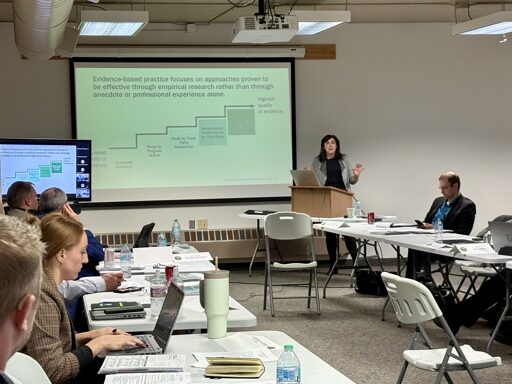
The task force, made up of lawmakers, government officials and nonprofit leaders, is considering ways to reduce the state’s recidivism rate by expanding prison-based rehabilitation and helping released inmates transition back into their communities. The group was created earlier this year as lawmakers approved construction of a $650 million men’s prison in Sioux Falls, and it’s focusing on behavioral health, educational, faith-based and Native American-themed programs.
The group approved several recommendations at its meeting, including an endorsement of a faith-based seminary program.
Task force member Rep. John Hughes, R-Sioux Falls, said he hopes for “transformational offerings” to inmates.
“If we don’t see lives changed, then I don’t know what we’re doing here,” Hughes said. “We’re just managing statistics and personal failures.”
‘We’re not appropriately supporting the Indigenous population’
Task force member Rep. Kadyn Wittman, D-Sioux Falls, told South Dakota Searchlight the increase in recidivism, especially among Native Americans, will “further strain an already strained system.”
“It’s indicative of the fact that we’re not appropriately supporting the Indigenous population,” Wittman said. “We’re already overincarcerating Indigenous people in South Dakota, and then we’re seeing them return at a much higher rate.”
The task force approved 11 immediate recommendations for the Department of Corrections. The list includes bringing back evening volunteers in prisons, designating the Sisseton Wahpeton Oyate parole program as a “flagship model” in the state, and establishing volunteer roundtables to give feedback on department policy and programs.
The recommendations are “small wins or barriers that can be removed,” Wittman said, while the task force continues to work on more complex issues.
Wittman is most excited about a recommendation that the department hire a tribal cultural liaison to coordinate ceremonies, tribal contacts and volunteer access to the state’s prisons. The position should be piloted for six months, the task force recommended.
“The fact that the DOC is willing to establish an individual whose sole focus is going to be better programming for its Indigenous population is huge,” Wittman said. “They’ll hopefully identify where Indigenous programming will be most effective.”
Lt. Gov. Tony Venhuizen, the task force chairman, confirmed with recently appointed Corrections Secretary Nick Lamb that the department would look into the recommendations and report back which could be viable options.
New corrections secretary lauds faith-based program
The prison seminary program endorsed by the task force was created by Mississippi Department of Corrections Commissioner Burl Cain while he served as warden of the Louisiana State Penitentiary at Angola. Cain resigned from his role in Louisiana in 2015 amid investigations of his business dealings.

Mississippi Department of Corrections Commissioner Burl Cain speaks during a meeting with South Dakota Gov. Larry Rhoden (not pictured) in October 2025.
Credit: Photo courtesy of the South Dakota Governor’s Office
The program operates in 26 states and partners with accredited, four-year Christian seminary programs to teach inmates. They can earn a seminary degree through the program, often with graduates serving as ministers in prison systems.
Lamb helped implement the program in the Illinois prison system. Within months of its launch, Lamb said, he saw fewer assaults between inmates and against staff.
“Whatever your religious beliefs are, whatever you think, this program works,” Lamb said. “It worked everywhere they tried.”
Cain spoke to lawmakers in October about the program, ahead of the task force’s first meeting in Sioux Falls. He said the state would need a nonprofit to run it. The task force voted on Wednesday to encourage South Dakota Gov. Larry Rhoden’s administration to authorize the program.
Rhoden said in a Wednesday news release that he “accepted” the recommendation. The news release did not say who would operate the program, but said it would be privately supported, requiring neither Department of Corrections nor inmate funding.

From left, Mississippi Department of Corrections Commissioner Burl Cain, South Dakota state Sen. Sue Peterson, R-Sioux Falls, and South Dakota Gov. Larry Rhoden speak at a meeting in Sioux Falls in October 2025.
Credit: Photo courtesy of the South Dakota Governor’s Office
“Bringing this seminary program to our state will restore hope, build character, and strengthen our correctional system from the inside out,” Rhoden said in the news release.
Jon Ozmint, the former director of South Carolina prisons, also presented to the task force in October. He said the recidivism rate for state inmates in the faith-based seminary Cain created is around 2 percent in South Carolina.
Wittman said after Wednesday’s meeting that she has “reservations” about the seminary program.
“I don’t necessarily support Burl Cain-style programming in South Dakota prisons because rehabilitation needs to be voluntary, secular and grounded in evidence,” Wittman said.
Despite those concerns, she voted in favor of implementing the program.
“I voted yes because, despite my reservations, I know how limited current programs are,” Wittman said, “and something is better than nothing.”
The post Half of South Dakota inmates return to prison, two-thirds among Native American women, new report shows appeared first on ICT.
From ICT via This RSS Feed.

