

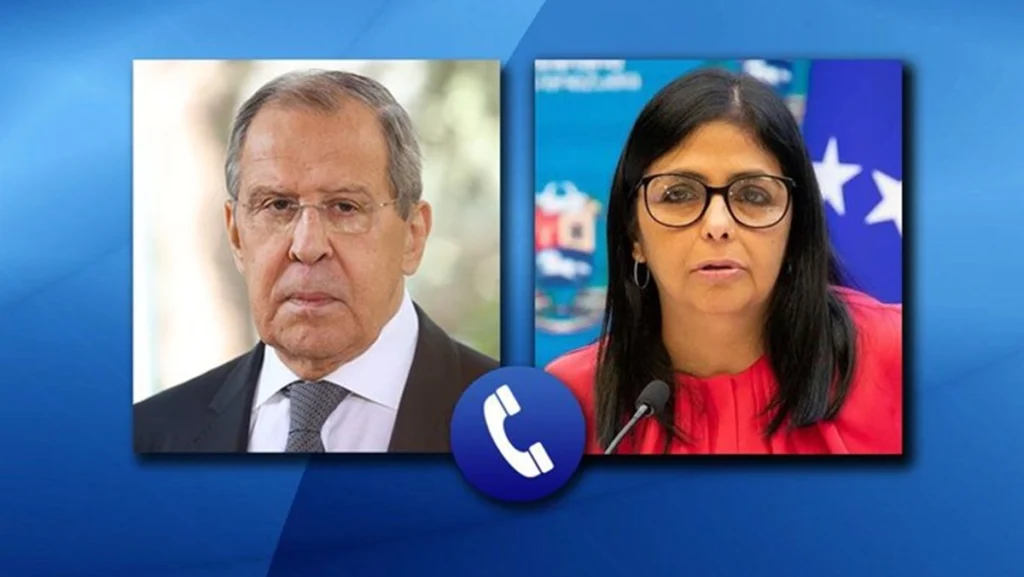
The Kremlin’s call adds geopolitical dimension to ongoing events.
On Saturday, the Russian Foreign Affairs Ministry urged the United States to release Venezuelan President Nicolas Maduro and First Lady Cilia Flores, who were seized by U.S. forces during an attack on the South American country in the early morning hours.
RELATED:
The World Condemns Imperialist Assault Against Caracas
“In view of the confirmed reports about Venezuelan President Nicolas Maduro and his spouse being in the United States, we strongly urge the U.S. leadership to reconsider their position and release the legitimately elected president of a sovereign country and his spouse. We highlight the need to create conditions for resolving any existing issues between the United States and Venezuela through dialogue,” the Russian diplomacy said.
This statement constitutes the first official confirmation by a foreign government regarding the whereabouts of the Venezuelan president, whose location had remained unknown since Venezuelan Vice President Delcy Rodriguez denounced the U.S. military aggression against Caracas and the states of Aragua, Miranda and La Guaira.
On Jan. 3, Russian Foreign Minister Sergey Lavrov also held a telephone conversation with Rodriguez in which he expressed Moscow’s “firm solidarity” with the Venezuelan people in the face of the aggression.
He affirmed that Russia would continue to support the course of the Bolivarian government, aimed at protecting national interests and sovereignty. Both officials agreed on the imperative need to avoid further military escalation and to find a solution to the crisis through political dialogue.
They also expressed their mutual willingness to continue strengthening the comprehensive strategic partnership between Russia and Venezuela, a link that encompasses military, energy, economic and diplomatic cooperation. Over the last decade, these multidimensional ties have allowed Venezuela to have a counterweight to Western sanctions and the isolation imposed by Washington.
The Kremlin’s diplomatic intervention adds a larger geopolitical dimension to the hemispheric crisis. Russia maintains close strategic relations with Venezuela, including arms sales, cooperation in the oil sector and financial support, making Moscow a relevant actor in any escalation involving the Bolivarian government.
The Russian emphasis on Maduro’s electoral legitimacy represents a direct challenge to the narrative of the U.S. government, which has systematically attempted to minimize the validity of Venezuelan electoral processes and accuses Bolivarian officials of links to international criminal organizations.
Moscow’s stance consolidates its role as a counterweight to U.S. influence in Latin America, a region Washington has historically considered within its sphere of influence according to the Monroe Doctrine.
Currently, the Kremlin’s call for dialogue openly contrasts with the military path taken by the administration of U.S. President Donald Trump.
Madelein Garcia, teleSUR correspondent, reports from La Carlota military base, one of the places that was hit by U.S. missiles in the attack they carried out against the nation in the early hours of January 3. pic.twitter.com/bwagA4PaTe
— teleSUR English (@telesurenglish) January 3, 2026
teleSUR/ JF
Sources: RT – teleSUR
From teleSUR English via This RSS Feed.