

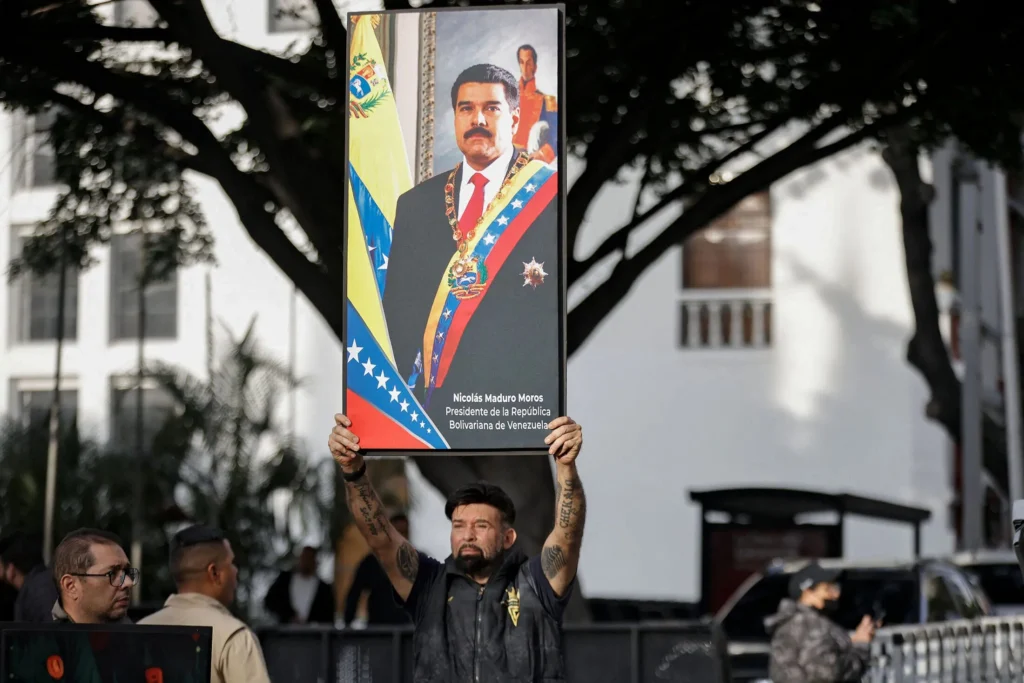
Personalities from around the world warn of a dangerous precedent for peace.
Caracas woke up on January 3, 2026 to the sound of explosions and the reality of a new U.S. war in Latin America: a surprise military operation that ended with the capture and removal of President Nicolás Maduro and First Lady Cilia Flores from Venezuelan territory.
RELATED:
Colombia Condemns U.S. Strikes on Venezuela
Under the name “Operation Southern Spear,” Washington has crossed the line from sanctions and covert pressure to open aggression, triggering a wave of international condemnation and fears of a return to old-style gunboat diplomacy in the Caribbean.
Nicolas Maduro and his wife, Cilia Flores, have been indicted in the Southern District of New York. Nicolas Maduro has been charged with Narco-Terrorism Conspiracy, Cocaine Importation Conspiracy, Possession of Machineguns and Destructive Devices, and Conspiracy to Possess…
— Attorney General Pamela Bondi (@AGPamBondi) January 3, 2026
A New Phase of US Aggression
In the early hours of January 3, U.S. special operations forces struck multiple civilian and military targets in and around Caracas before seizing President Maduro and First Lady Cilia Flores and flying them out of the country.
President Donald Trump later boasted that the United States had “successfully carried out a large-scale strike against Venezuela and its leader” and that the captured Venezuelan president would face charges on U.S. soil.
Far from a neutral “law enforcement action,” the assault violates core principles of the UN Charter, which prohibits the use of force against the territorial integrity or political independence of any state.
The operation deepens a long-running regime-change strategy that previously relied on unilateral sanctions, attempts at covert destabilization, and economic blockade to try to force the Bolivarian government from power.
Venezuelan Attorney General Tarek William Saab:
“As Attorney General I demand not only proof of life of our Commander-in-Chief of the Armed Forces and Head of State, Nicolás Maduro Moros, and of his wife, our sister and first combatant, Cilia Flores, but beyond that proof, I… pic.twitter.com/bqXVPi40ma
— Camila (@camilapress) January 3, 2026
Oil, Extraction, and a “Stolen Wealth” Doctrine
Trump’s own public comments leave little doubt about the material stakes of the attack. In remarks after the strikes, he signaled that the United States would be “very strongly involved” in Venezuela’s oil sector and that “we have the greatest oil companies in the world” ready to step in.
For years, Venezuelan officials and many in the Global South have warned that Washington’s real objective is to regain control over the world’s largest proven oil reserves and roll back decades of resource sovereignty.
The emerging U.S. narrative frames Venezuelan crude as “stolen” from American consumers and corporations, flipping reality on its head to present Latin American resources as U.S. property by right.
Key elements of this extractive offensive include:
- Reversing sovereignty: U.S. officials and aligned voices have floated plans to hand back strategic assets and contracts to multinationals like ExxonMobil and Chevron, effectively erasing Venezuela’s 1976 oil nationalization and the sovereign reforms deepened under Chávez in 2007.
- Economic siege: The escalation of U.S. sanctions and tanker blockades through 2024–2025 acted as a de facto siege, strangling public revenues and creating the “crisis” later cited as justification for direct military action.
- Colonial continuity: The kidnapping of a sitting head of state marks a return to open colonial extraction, where force replaces negotiation and international law is bent to protect corporate access to strategic minerals, gas, and crude.
#Breaking: The United States just launched a full scale attack on Venezuela from Air and Sea, report of hundreds of Toma Hawk Cruise Missiles striking dozens of targets in downtown Caracas. pic.twitter.com/IM0FYiCUVb
— ICOF (@ICOF__) January 3, 2026
Venezuelan Government: “State-Sponsored Kidnapping”
Inside Venezuela, authorities describe the events of January 3 as a “state-sponsored kidnapping” and a terrorist attack against a sovereign nation. Official statements place the defense of national sovereignty, territorial integrity, and popular participation at the center of the response.
- Vice President Delcy Rodríguez has become the most visible official voice, demanding transparency about the fate of the presidential couple. “We do not know the whereabouts of President Nicolás Maduro and First Lady Cilia Flores. We demand that the government of President Donald Trump provide an immediate proof of life for the President and the First Lady.”
- Rodríguez has emphasized that, despite the scale of the attack, the population remains organized: “Venezuela is in a state of calm, digesting what it means to face a military invasion that has violated our peace and murdered humble inhabitants.”
Minister of Interior, Justice, and Peace Diosdado Cabello has focused on internal security and the need for unity across social sectors.
- “The country was the object of a terrorist attack directed against its people, the motherland, and the electrical infrastructure… What they attempted with bombs and missiles, they achieved only partially. They expected a cowardly response; but the cowards are in the past.”
- Calling for a “civic-military-police” front, he warned: “I call for a perfect national union. No external government should think they can come here and appoint our leaders.”
Foreign Minister Yván Gil has taken the fight to international forums, filing complaints at the United Nations and denouncing the assault as a clear breach of the Charter. He described the operation as the work of “a rogue state, fueling unmasked hostility in the Global South to impose its devious schemes,” and an act of terrorism that threatens Latin America’s stability.
From the National Assembly, Nicolás Maduro Guerra has placed the crisis in a longer anti-colonial tradition, invoking the legacy of Simón Bolívar. “No one will violate the historical legacy of our father the Liberator [Simón Bolívar]. The people must activate themselves to defend our natural resources.”
Venezuela’s Interior Minister Diosdado Cabello spoke from the streets of Caracas hours after the US attacks, calling upon international organizations to reject the US attacks on Venezuela or “finally public reveal their complicity in the face of the invasion and attack, in the… pic.twitter.com/gUy75nUm32
— Peoples Dispatch (@peoplesdispatch) January 3, 2026
BRICS+ and the Multipolar Front
The attack has drawn a sharp line in global politics. While Washington courts a familiar “coalition of the willing,” core BRICS+ members have condemned the strikes as criminal and destabilizing.
Russia: “Cowboy Behavior” and Armed Aggression
Moscow has issued some of the strongest statements. The Russian Foreign Ministry has formally labeled the strikes “an act of armed aggression” and rejected U.S. legal justifications as “unfounded.” At the UN, Ambassador Vassily Nebenzia described the operation as “cowboy behavior and the greatest extortion known in modern history,” warning that it reflects a push to impose U.S. order on the world and plunder Venezuela’s riches.
China: “Hegemonic Behavior” and Violated Sovereignty
Beijing, usually cautious in tone, has expressed “deep shock” at the use of force against a sitting president and a sovereign nation. Through its Foreign Ministry, China declared: “China firmly opposes such hegemonic behavior by the U.S., which seriously violates international law, violates Venezuela’s sovereignty, and threatens peace and security in Latin America.” Chinese authorities emphasized their support for Venezuela’s “sovereignty and national dignity” and signaled they will not recognize any government installed through external force.
Global reaction builds after the U.S. operation in Venezuela:
Lula: Bombings on Venezuelan territory + capture of its president cross an “unacceptable line.”
Russia: Condemns the strikes as “armed aggression,” calling the justifications groundless.
China:… pic.twitter.com/LEiJIlQOFV
— Defence Chronicle India
(@TheDCIndia) January 3, 2026

Latin America: Defending the “Zone of Peace”
Across Latin America, leaders have framed the kidnapping and bombardment as a “dangerous precedent” that tears at the foundations of regional order. Many invoke the notion of Latin America and the Caribbean as a “Zone of Peace” and warn that the assault risks turning the continent into another permanent war theatre.
- Brazil – President Luiz Inácio Lula da Silva called the bombings and capture “an unacceptable line” crossed, describing them as a grave affront to Venezuelan sovereignty and “an extremely dangerous precedent for the entire international community.”
- Colombia – President Gustavo Petro rejected the aggression “against the sovereignty of Venezuela and of Latin America,” reiterating previous warnings that such an intervention could turn the region into “another Syria.”
- Mexico – President Claudia Sheinbaum reaffirmed Mexico’s doctrine of non-intervention with a clear “No to interventionism,” demanding an immediate halt to military actions.
- Cuba – President Miguel Díaz‑Canel denounced the operation as “State terrorism” and “unmasked hostility,” urging the international community “to react against this criminal attack and the brutal assault on a zone of peace.”
Other allied governments, including Iran and Belarus, have framed the attack as extortion designed to restore a unipolar order through force.
Tehran’s Foreign Ministry argued that “the United States has turned into the biggest threat to international peace and security,” while Minsk denounced the strikes as “armed aggression” and a direct threat to global stability.
Colombia’s president issues the first international response to the strikes in Venezuela:
“Caracas is under attack right now. The world must be alerted. Venezuela is being hit by missile strikes. The OAS and the UN must convene immediately.” pic.twitter.com/6VICCSTZ7p
— ConsciousInk (@ink_conscious) January 3, 2026
Europe and the Global Left
In Europe, official reactions have been mixed, oscillating between cautious language and explicit criticism, while left-wing parties and movements speak in far more direct terms.
- Spain’s Foreign Ministry called for “de-escalation and moderation,” insisting that all actions must respect international law and the UN Charter.
- UK Prime Minister Keir Starmer distanced London from the operation, stating: “I want to be absolutely clear: we did not participate. Everyone must respect international law.”
- Prominent figures of the European left, including Jeremy Corbyn and Irene Montero, warned through Progressive International that “this is a prelude to invasion” and “condemn[ed] in the strongest terms the military escalation against Venezuela.”
Grassroots organizations, trade unions, and internationalist networks across the Global North have joined protests, casting the events as part of a broader pattern of U.S. militarism, from the Middle East to Latin America.
Social Movements: “Venezuela Is a Hope”
Outside government halls, social movements and popular platforms have rapidly mobilized, describing the assault as a “colonial war” and calling for global solidarity with Venezuela.
- ALBA Movimientos, a continental network of movements, denounced the attack as a “criminal act of war” aimed at “the plundering of Venezuela’s strategic resources, especially oil and gold, through a colonial policy of military intervention and regime change,” stressing its direct violation of the UN Charter.
- La Vía Campesina, which represents over 200 million peasants worldwide, declared that “Venezuela is not a threat; it is a hope,” and condemned systematic threats of U.S. intervention while defending the Venezuelan people’s right to determine their own destiny.
- The Cabinet of the Progressive International described the kidnapping of a head of state as “an act of imperial lawlessness with few precedents in history,” warning that the emerging “Trump corollary” to the Monroe Doctrine is “the single greatest threat to peace and prosperity that the Americas confront today.”
Venezuelans denounce aggression and warn of military escalation, took to streets of Caracas to express outrage at attack perpetrated against them describing as a direct aggression with geopolitical and economic aims. “They’re not just coming for us, they’re coming for our oil”. https://t.co/YUmnEW0hv0 pic.twitter.com/O49ScwfGeI
— Gohonzon protected self radicalised non conformist (@UIconoclas52199) January 3, 2026
Legal and Human Rights Alarm
Legal organizations and human rights groups are framing the crisis as a test case for the future of international law. The central issues include the extraterritorial seizure of a sitting president, the bombardment of civilian areas, and the open rejection of UN procedures by a permanent Security Council member.
- The International Association of Democratic Lawyers (IADL) “unreservedly condemns the United States’ completely illegal and illegitimate aggression” and urges “all relevant legal and popular action to hold U.S. officials and military responsible for this blatant violation of the U.N. Charter.”
- From inside the U.S., CODEPINK demanded an immediate end to hostilities and the safe return of Maduro: “Last night, the United States government bombed civilian and military sites across Venezuela and illegally kidnapped Venezuelan President Nicolás Maduro. These are blatant and illegal acts of war by the Trump Administration.”
Anti-war coalitions like ANSWER connect the new war to domestic inequality, pointing out that “working-class young people… will be sent to kill and die, not the children of executives at ExxonMobil.” Networks such as Samidoun and currents of the Fourth International stress that “regardless of one’s opinion on the regime, imperialist intervention is not a solution” and can only bring “death, repression, and injustice,” demanding a full withdrawal of U.S. forces from the Caribbean.
#Venezuela
— International Human Rights Foundation (@IHRF_English) January 3, 2026
The United Nations: “A Dangerous Precedent”
The United Nations has responded with clear alarm at both the bombing and the removal of Venezuela’s head of state. While Trump officials present the operation as a lawful extension of anti‑narcotics policy, the UN’s concern centers on the precedent it sets for global order.
Through his spokesperson Stéphane Dujarric, Secretary‑General António Guterres said he is “deeply alarmed” by the escalation and warned that the events carry “worrying implications for the region.”
Crucially, the statement underlined that, “independently of the situation in Venezuela, these developments constitute a dangerous precedent,” stressing that the “rules of international law have not been respected” and calling for inclusive dialogue and full respect for human rights.
Venezuela’s Permanent Mission, led by Ambassador Samuel Moncada, has requested an emergency Security Council session to address what it calls “brutal, unjustified, and unilateral” armed aggression.
- The mission has formally invoked Article 51 of the UN Charter, reserving Venezuela’s right to legitimate self‑defense to protect its population and territorial integrity.
- Diplomatic letters to the Council describe the removal of Maduro as an “international crime of kidnapping” and a violation of the protections normally afforded to heads of state.
At stake is whether the international community will tolerate the use of raw military power to remove elected governments and seize strategic resources—or whether this moment becomes the catalyst for a strengthened, multipolar defense of sovereignty, law, and peace in Latin America and beyond.
Sources: teleSUR – Al Jazeera – Al Mayadeen – RT – Con el Mazo Dando – VTV – TRT – Xinhua – BBC – France 24 – Alba Movimiento – Democracy Now
From teleSUR English via This RSS Feed.